Char-Broil 5101426 Bedienungsanleitung

For Outdoor Use Only
Tools required:
Phillips screwdriver • Adjustable wrench
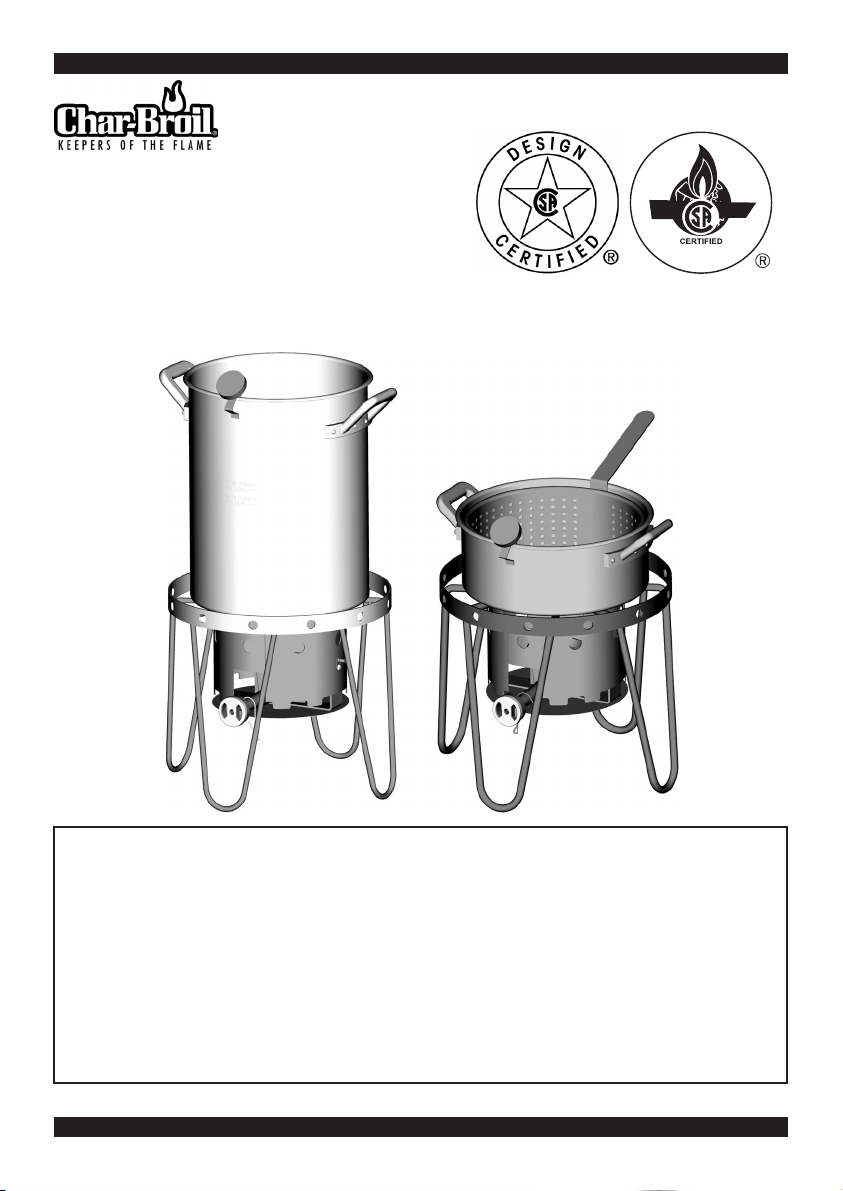
Turkey/Fish Fry Set
Assembly, Use and Care
Model 05101426
To installer or person assembling this appliance: Leave this manual with
this appliance for future reference.
This instruction manual contains important information necessary for
the proper assembly and safe use of the appliance.
Read and follow all warnings and instructions before assembling and
using the appliance.
Follow all warnings and instructions when using the appliance.
Keep this manual for future reference.
05101426 Turkey-Fish Fry Set / 42804096 / (12-09-04)

2
DANGER
If you smell gas:
1. Shut off gas to the appliance.
2. Extinguish any open flame.
3. If odor continues, keep away from the appliance and immediately call
your Fire Department.
Failure to follow these instructions could result in fire or explosion which
could cause property damage, personal injury or death.
1. Never operate this appliance unattended.
2. Never operate this appliance within 10 feet or 3 m of any other gas
cylinder.
3. Never operate this appliance within 25 feet or 7.5 m of any flammable
liquid.
4. Do not fill cooking vessel beyond maximum fill line.
5. Never allow the oil/grease to get hotter than 400°F or 200°C. If the
temperature exceeds 400°F (200°C) or if oil begins to smoke, immediately
turn the burner or gas supply OFF.
6. Heated liquids remain at scalding temperatures long after the cooking
process. Never touch cooking appliance until liquids have cooled to
115°F or 45°C or less.
7. If a fire should occur keep away from the appliance and immediately call
your fire department. Do not attempt to extinguish an oil/grease fire with
water.
Failure to follow these instructions could result in fire or explosion which
could cause property damage, personal injury or death.
DANGER

Safety Symbols
The symbols and boxes shown below explain what each heading means. Read and follow all of the
messages found throughout the manual.
DANGER
DANGER: Indicates an imminently hazardous situation which, if not avoided, will result
in death or serious injury.
3
WARNING
Combustion by-products produced when using this product contain chemicals known to
the State of California to cause cancer, birth defects, or other reproductive harm.
CAUTION
CAUTION: Indicates a potentially hazardous situation or usafe practice which, if not
avoided, may result in minor or moderate injury.
WARNING
WARNING: Indicates a potentially hazardous situation which, if not avoided, could
result in death or serious injury.

4
WARNING
1. Never leave the appliance unattended. Keep children and pets away from the
appliance at all times.
2. The use of alcohol, prescription or non-prescription drugs may impair the
consumer’s ability to properly assemble or safely operate the appliance.
3. This appliance is for OUTDOOR use only. Do NOT use in a building, garage or
any other enclosed area. Do NOT use in or on a recreational vehicle or boat.
NEVER use this appliance as a heater.
4. When cooking, the appliance must be on a level, stable noncombustible
surface in an area clear of combustible material. An asphalt surface (blacktop)
may not be acceptable for this purpose.
5. Keep the fuel supply hose away from any heated surfaces.
6. When cooking with oil or grease, the thermometer provided MUST be used.
Follow instructions in this manual for proper installation and use of the
thermometer. If the thermometer supplied with this appliance has been lost or
damaged, a replacement thermometer meeting or exceeding the appliance
manufacturer specifications shall be obtained before using the appliance.
7. If the temperature exceeds 400°F (200°C) or if oil begins to smoke, immediately
turn the burner or gas supply OFF and wait for the temperature to decrease to
less than 350°F (175°C) before relighting burner according to the
manufacturer’s instructions. If there is a lid (cover), do not remove the lid.
8. In the event of an oil/grease fire immediately call the fire department. Do not
attempt to extinguish with water. When cooking with oil/grease, have a Type
BC or ABC fire extinguisher readily available. A Type BC or ABC fire
extinguisher may, in some circumstances, contain the fire.
9. Never overfill the cooking vessel with oil, grease or water. Follow instructions
in this manual for establishing proper oil, grease or water levels.
10. Introduction of water or ice from any source into the oil/grease may cause
overflow and severe burns from hot oil and water splatter. When cooking with
oil/grease, all food products MUST be completely thawed and towel dried
before being immersed in the cooking vessel.
11. Do not place empty cooking vessel on the appliance while in operation. Use
caution when placing anything in cooking vessel while the appliance is in
operation.
12. In the event of rain, snow, hail, sleet or other forms of precipitation while
cooking with oil/grease, cover the cooking vessel immediately and turn off the
appliance burners and gas supply. Do not attempt to move the appliance or
cooking vessel.
13. Do not move the appliance when in use. Allow the cooking vessel to cool to
115 before moving or storing.°F (45°C)

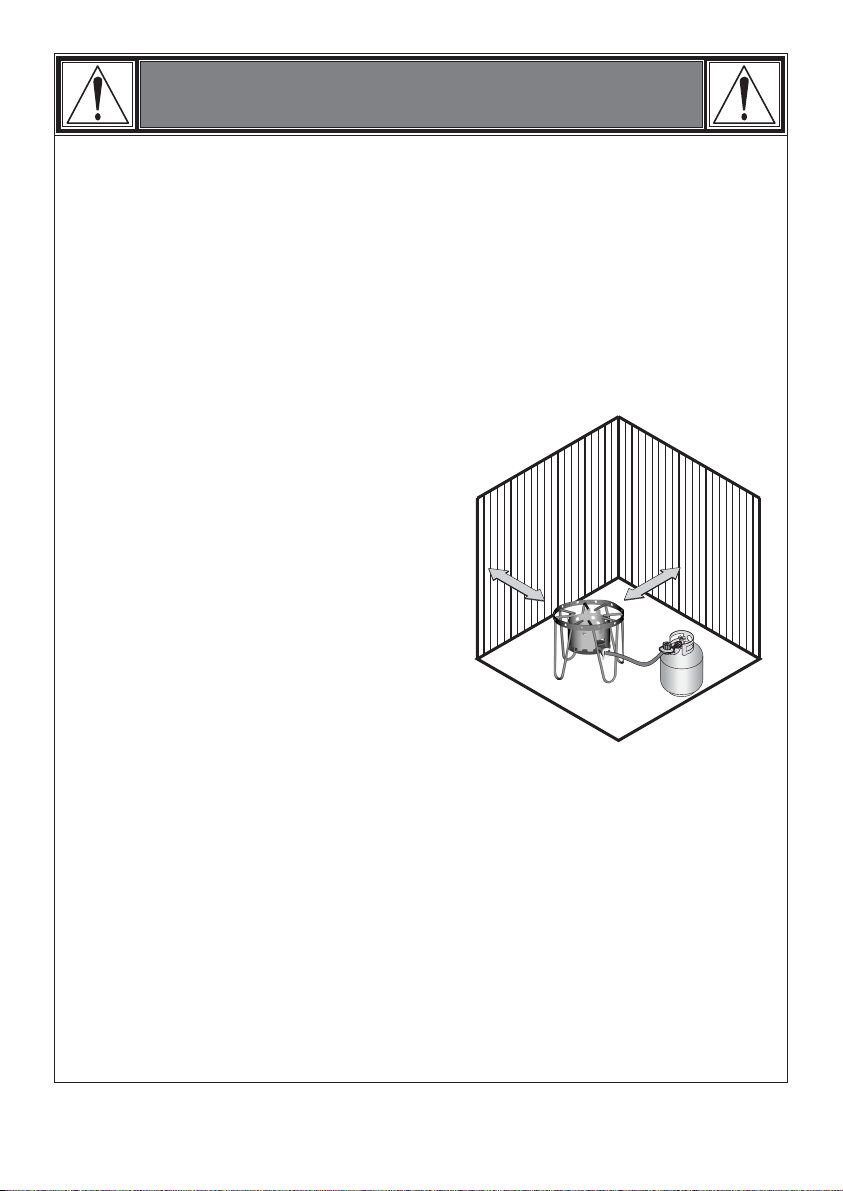
• Use appliance at least 10 ft. (3 m) from any
wall or surface. Maintain 10 ft. (3 m)
clearance to objects that can catch fire or
sources of ignition such as pilot lights on
water heaters, live electrical appliances, etc.
Never use under balconies made of wood or
ANY overhead construction.
• Apartment Dwellers: Check with
management to learn the requirements and
fire codes for using an LP Gas appliance at
an apartment. If allowed, use outside on the
ground floor with a ten (10) foot (three (3)
meter) clearance from walls or rails.
• Before opening LP tank valve, check the coupling nut for tightness. When appliance is
not in use, turn off control knob and LP tank valve.
• Never move appliance while in operation or still hot.
• If you notice grease or other hot material dripping from appliance onto valve, hose or
regulator turn off gas supply at once. Determine the cause, correct, clean and inspect
valve, hose and regulator before continuing. Perform a leak test.
• The regulator may make a humming or whistling noise during operation. This will not
affect safety or use of appliance.
• Clean and inspect the hose before each use of the appliance. If there is evidence of
abrasion, wear, cuts or leaks, the hose must be replaced prior to the appliance being
put into operation.
WARNING
Installation Safety Precautions
• Use appliance only with LP (propane) gas and the regulator/valve assembly supplied.
• Installation must conform with local codes, or in their absence with National Fuel Gas
Code, NFPA 54/ANSI Z223.1 or CAN/CGA-B149.2 Propane Installation Code.
Handling and storage of LP cylinders must conform to LP Gas Code NFPA/ANSI 58.
Appliance is not for use in or on recreational vehicles or boats.
• This appliance is safety certified for use in the United States only. Do not modify for use
in any other location. Modifications will result in a safety hazard.
• This appliance shall be used only outdoors and shall not be used in a building, garage
or any other enclosed area.
5

• Never use a cooking vessel larger than 30 qts. (28.3 liters) and taller than 15½ inches
(39.3 cm).
• Never fill pot above upper fill line. Oil can splatter causing staining or discoloration to
ground surface.
• Never leave the appliance unattended. Keep children and pets away from the
appliance at all times.
• Never place empty cooking vessel on the appliance while in operation. Use caution
when placing anything in the cooking vessel while the appliance is in operation.
• Never move the appliance when in use. Allow the cooking vessel to cool before moving
or storing.
• This appliance is not intended for and should never be used as a heater.
• Never operate appliance with LP tanks out of correct position specified in assembly
instructions.
• Always close LP tank valve and remove coupling nut before moving LP tank from
specified operating position.
• Appliance shall not be used for commercial cooking.
• This appliance will be hot during and after use. Use insulated oven mitts or gloves for
protection from hot surfaces or cooking liquids.
• Avoid bumping of or impact with the appliance to prevent spillage or splashing of hot
cooking liquid.
• Never drop food or accessories into hot cooking liquid. Lower food and accessories
slowly into the cooking liquid in order to prevent splashing or overflow. When removing
food from the appliance care should be taken to avoid burns from hot cooking liquids.
WARNING
6
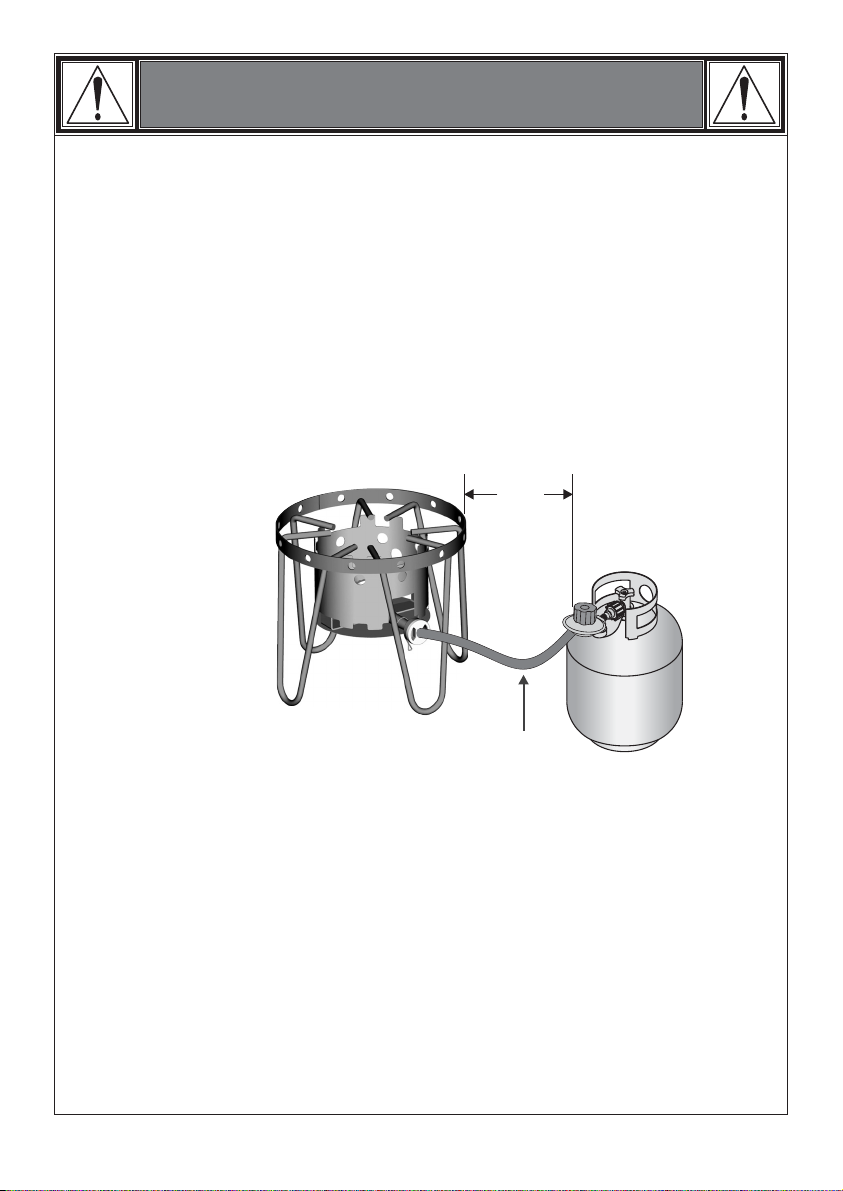
24”
WARNING: Hose is a trip hazard.

LP Tank Removal, Transport and Storage
LP Tank
The LP tank used with your appliance must meet the following requirements:
• Turn OFF all control knobs and LP tank valve. Turn coupling nut counterclockwise by
hand only — do not use tools to disconnect. Install safety cap onto LP tank valve. Always
use cap and strap supplied with valve. Failure to use safety cap as directed may result in
serious personal injury and/or property damage.
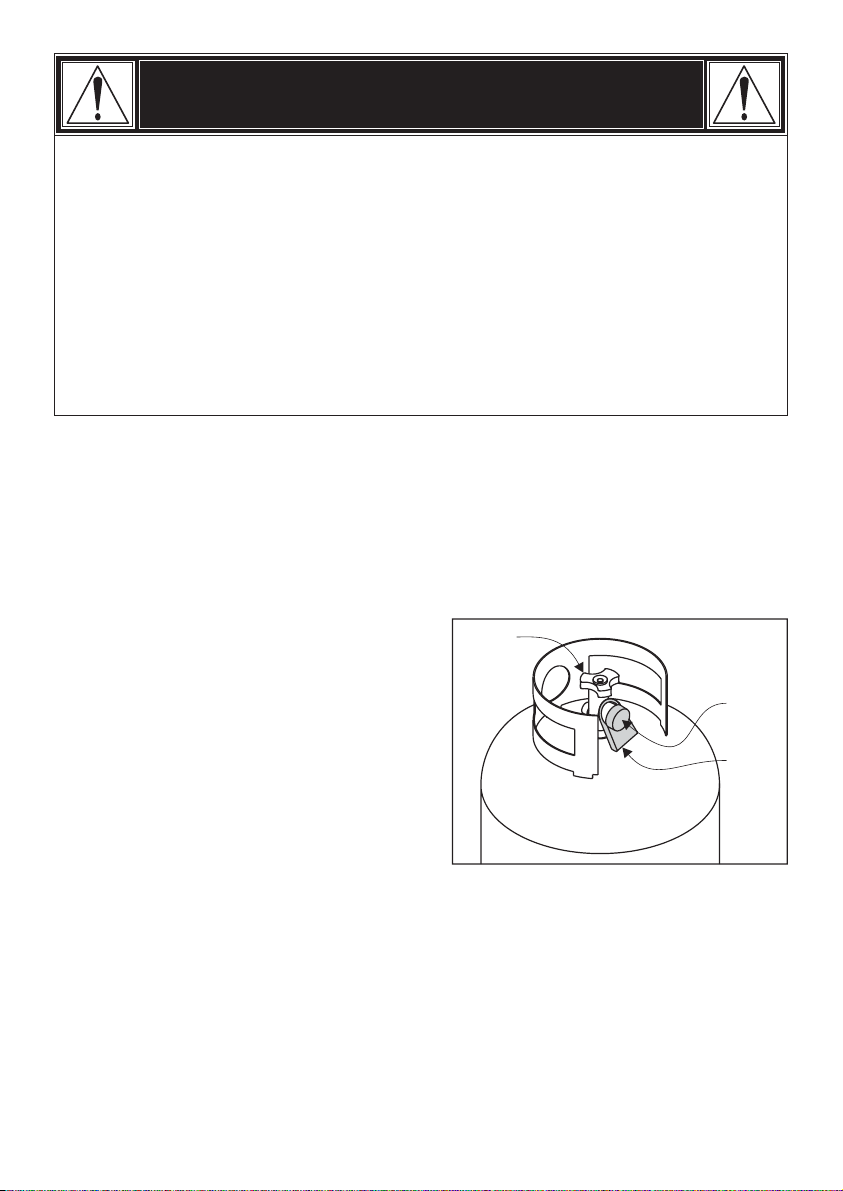
• A disconnected LP tank in storage or being
transported must have a safety cap installed
(as shown). Do not store an LP tank in
enclosed spaces such as a carport, garage,
porch, covered patio or other building. Never
leave an LP tank inside a vehicle which may
become overheated by the sun.
• Do not store LP tanks in an area where
children play.
• Purchase LP tanks only with these required measurements: 12” (30.5cm) (diameter) x 18”
(45.7cm) (tall) with 20 lb. (9 kg.) Capacity maximum.
• The LP tank must be constructed and marked in accordance with specifications for LP
tank of the U.S. Department of Transportation (DOT) or for Canada, CAN/CSA-B339,
cylinders, spheres and tubes for transportation of dangerous goods, Transport Canada
(TC). See LP tank collar for marking.
LP Tank
Valve
Safety
Cap
Retainer
Strap
7
DANGER
• The safety relief valve on the LP tank could activate releasing gas and cause an
intense fire with risk of death or serious injury. Therefore, follow instructions bulleted
below exactly.
• NEVER store a spare LP tank under or near appliance or in enclosed areas.
• NEVER fill the cylinder beyond 80% full. An overfilled spare LP tank is hazardous
due to the possible gas released from the safety relief valve.
• If you see, smell, or hear escaping gas, immediately get away from the LP
tank/appliance and call your fire department.
• All spare LP tanks must have safety caps installed on the LP tank outlet.

LP tank valve must have:
LP (Liquefied Petroleum Gas)
LP Tank Filling
LP Tank Exchange
• Type 1 outlet compatible with regulator or appliance.
• Safety relief valve.
• UL listed Overfill Protection Device (OPD). This OPD
safety feature is identified by a unique triangular hand
wheel. Use only tanks equipped with this type of valve.
LP tank must be arranged for vapor withdrawal and
include collar to protect LP tank valve.
• LP gas is non toxic, odorless and colorless when produced. For Your Safety, LP gas has
been given an odor (similar to rotten cabbage) so that it can be smelled.
• LP gas is highly flammable and may ignite unexpectedly when mixed with air.
• Use only licensed and experienced dealers.
• LP dealer must purge tanks before filling.
• Dealer should NEVER fill LP tank more than 80% of LP tank volume. Volume of propane
in tanks will vary by temperature.
• A frosty regulator indicates gas overfill. Immediately close LP tank valve and call local LP
gas dealer for assistance.
• Do not release liquid propane (LP) gas into the atmosphere. This is a hazardous practice.
• To remove gas from LP tank, contact an LP dealer or call a local fire department for
assistance. Check the telephone directory under “Gas Companies” for nearest certified
LP dealers.
• Many retailers that sell appliances offer you the option of replacing your empty LP tanks
through an exchange service. Use only those reputable exchange companies that
inspect, precision fill, test and certify their cylinders. Exchange your tank only for an OPD
safety feature-equipped tank as described in the “LP Tank” section of this manual.
• Always keep new and exchanged LP tanks in upright position during use, transit or
storage.
• Leak test new and exchanged LP tanks BEFORE connecting to appliance.
OPD Hand Wheel
8

LP Tank Leak Test
For your safety
Use mild soap and water. Do not use household
cleaning agents.
• Leak test must be repeated each time LP tank is exchanged or refilled.
• Do not smoke during leak test.
• Do not use an open flame to check for gas leaks.
• Appliance must be leak checked outdoors in well-ventilated
area, away from ignition sources such as gas fired or
electrical appliances. During leak test, keep appliance away
from open flames or sparks.
Use a clean paint brush and 50/50 soap and water solution.
Damage to gas train components can result.
Brush soapy solution onto all weld seams and entire valve area.
WARNING
If “growing” bubbles appear, do not use or move the LP tank. Contact an LP gas supplier
or your fire department.
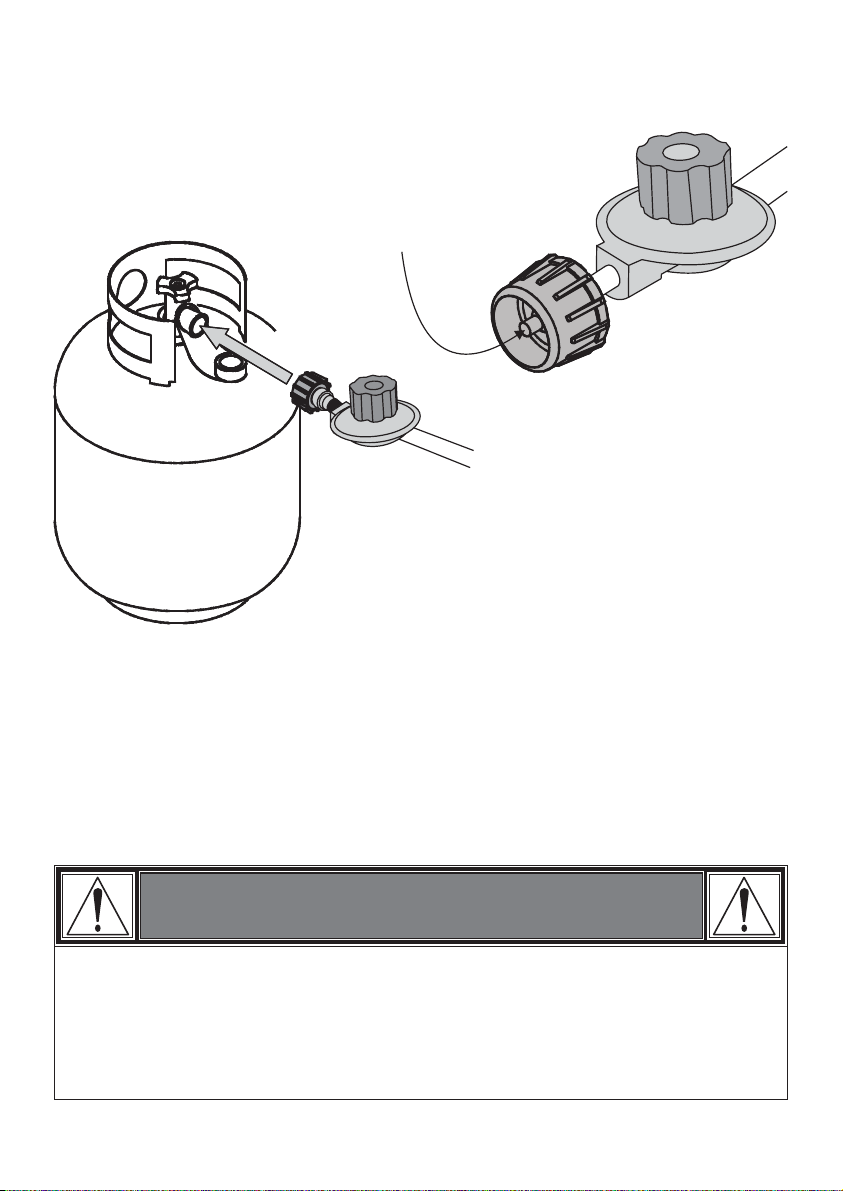
Connecting Regulator to the LP Tank
full stop.
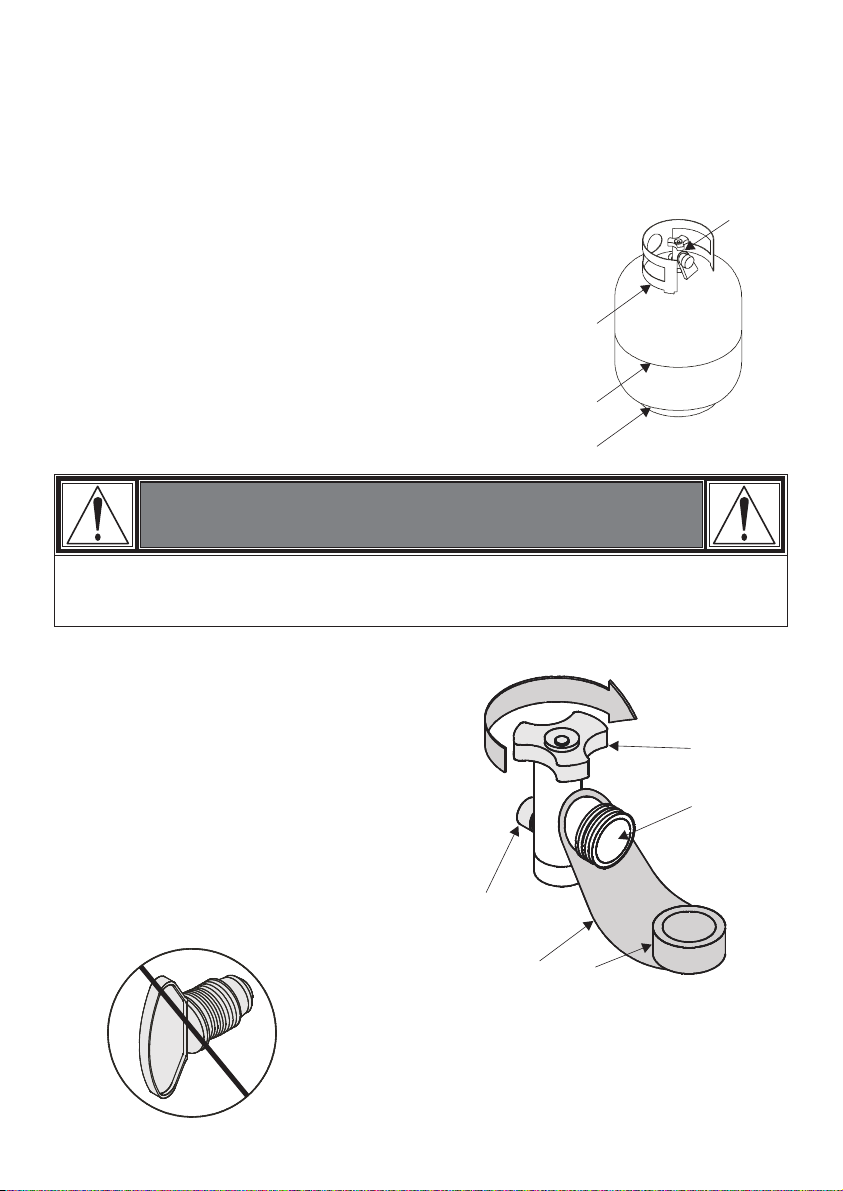
1. Place LP tank on a secure, level,
and stable surface.
2. Turn control knob to the OFF position.
3. Turn LP tank OFF by turning hand wheel
clockwise to a
4. Remove the protective cap from the LP tank
valve. Always use cap and strap supplied
with valve.
Do not use a POL transport plug (A) (plastic part with
external threads)! It will defeat the safety feature of the valve.
A
Off Clockwise
OPD Hand
Wheel
Type 1 outlet
with thread
on outside.
Safety Relief
Valve
Strap and cap
9

5. Hold regulator, insert nipple (B) into LP tank valve. Hand tighten coupling nut, holding
regulator in a straight line (C) with LP tank valve so as not to cross thread the
connection.
6. Turn the coupling nut clockwise to tighten to a full solid stop. The regulator will seal on
the back-check feature in the LP tank valve, resulting in some resistance. An additional
one-half to three quarters turn is required to complete connection. Tighten by hand only
— do not use tools.
NOTE: If you cannot complete connection, disconnect regulator and repeat steps 5 and 6.
If you are still unable to complete the connection, do not use this regulator!
WARNING
Hold coupling nut and regulator as shown
for proper connection to LP tank valve.
Nipple must be centered
into the LP tank valve.
B
C
Straight
10
• Do not insert any tool or foreign object into the valve outlet or safety relief valve. You
may damage the valve and cause a leak. Leaking propane may result in explosion, fire,
severe personal injury, or death.
• Never attempt to attach this appliance to the self-contained LP gas system of a camper
or trailer or motor home.
Inhaltsverzeichnis
Andere Char-Broil Fritteuse Handbücher

Char-Broil
Char-Broil THE BIG EASY 7101366 Bedienungsanleitung

Char-Broil
Char-Broil 4101424 Kurzanleitung zur Einrichtung

Char-Broil
Char-Broil 8101381 Bedienungsanleitung

Char-Broil
Char-Broil 8101480 Bedienungsanleitung

Char-Broil
Char-Broil 14101480 Bedienungsanleitung

Char-Broil
Char-Broil 14101480 Bedienungsanleitung

Char-Broil
Char-Broil Big Easy 08101480 Bedienungsanleitung