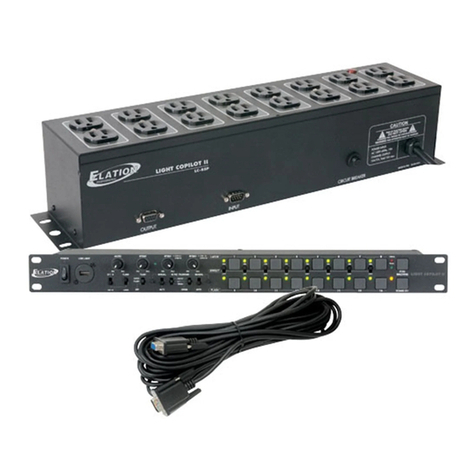
Elation DMX 101 Bedienungsanleitung

DMX 101:
A DMX 512 HANDBOOK
:,7+
(92/87,21
&20(6
&+$1*(

DMX 101: A DMX 512 Handbook
2 Elation Professional ®
Handbook Revision:
May 2008

www.elationlighting.com 3
1. Introduction to DMX ...................................................................................................................................... 4
2. Industry Standards .......................................................................................................................................... 5
2.1 USITT ..................................................................................................................................................... 5
2.2 ESTA ...................................................................................................................................................... 5
2.3 ANSI ....................................................................................................................................................... 6
2.4 EIA/TIA .................................................................................................................................................. 6
2.5 References............................................................................................................................................... 6
3. Theory of Operation........................................................................................................................................ 7
3.1 The Cable TV Analogy........................................................................................................................... 8
3.2 DMX Communications......................................................................................................................... 11
3.3 Summary............................................................................................................................................... 13
4. Protocol Specifications ................................................................................................................................. 14
4.1 Connectors ............................................................................................................................................ 15
4.2 Cabling.................................................................................................................................................. 16
4.3 Data ....................................................................................................................................................... 17
5. Sample Applications ..................................................................................................................................... 18
5.1 Dimmer Control.................................................................................................................................... 19
5.2 Intelligent Fixture Control .................................................................................................................... 20
5.3 Dimmer & Intelligent Fixture Control.................................................................................................. 21
5.4 Distributed Control ............................................................................................................................... 22
Table of Contents

DMX 101: A DMX 512 Handbook
4 Elation Professional ®
This handbook is designed to promote basic understanding of the DMX 512 protocol, including theory of
operation, proper equipment use, and some basic application examples.
DMX is an acronym for Digital Multiplex, a communication protocol (a set of rules) used to remotely control
lighting dimmers and intelligent fixtures. It is designed to provide a common communications standard between
these lighting devices regardless of the manufacturer.
The 512 after the DMX refers to the number of control channels used on one network segment (often called a
‘universe’) of devices. In a simple dimming system, one channel controls the intensity of one dimmer. A single
intelligent fixture, however, may require several channels to control its various parameters (one channel each for
pan, tilt, color, gobo, etc.).
A basic dimming control console (such as the 16 channel Elation Stage-Setter 8) may support only a few of the
512 available channels. Many professional control consoles (such as the 3 universe, 1536 channel Elation Show
Designer 3) support multiple universes, allowing for thousands of control channels.
The topics this handbook will cover are:
•Industry Standards
•Theory of Operation
•Protocol Specifications
•Sample Applications
1. Introduction to DMX
1

www.elationlighting.com 5
About 20 years ago, most manufacturers used their own, proprietary control protocols. This forced system
designers to use only fixtures and control consoles from the same manufacturer. There was no control standard
to allow the use of different products.
A standard is a set of widely agreed-upon guidelines for interoperability at both communications and mechanical
levels. Standardization of protocol and equipment provides many benefits to manufacturers and end users.
These benefits include:
•Increased product quality and safety
•Reduced development time and cost
•Sound engineering practices
•Protection against obsolescence
The following organizations have developed standards that relate directly to the DMX 512 protocol:
•USITT
•ESTA
•ANSI
•EIA/TIA
2.1 USITT
The United States Institute of Theatre Technology (USITT) supports, develops, and promotes a wide variety of
standards for the theatrical and entertainment industry. In 1986, USITT developed the DMX 512 protocol as a
simple, flexible, and reliable standard for lighting control.
In 1998, USITT transferred maintenance of the DMX 512 protocol to the Technical Standards Program of
ESTA. The standard is constantly revised and updated as technology continues to advance.
2.2 ESTA
The Entertainment Services and Technology Association (ESTA) is a non-profit trade association representing
the entertainment technology industry. ESTA promotes professionalism and growth in the industry and provides
a forum where interested parties can come together to exchange ideas and information, create standards and
recommended practices, and address issues of training and certification.
2. Industry Standards
2

DMX 101: A DMX 512 Handbook
6 Elation Professional ®
2.3 ANSI
The American National Standards Institute (ANSI) is an organization composed of representatives from industry
and government that collectively determine standards for the electronics industry as well as many other fields,
such as chemical and nuclear engineering, health and safety, and construction. ANSI also represents the United
States in setting international standards. New electronic equipment and methods must undergo extensive testing
to obtain ANSI approval.
In 2004, ANSI approved the DMX 512 standard, and has since approved several other related standards
including Remote Device Management (RDM) and Architecture for Control Networks (ACN). The actual
standards are listed below:
•ANSI E1.11-2004 - Entertainment Technology USITT DMX512-A - Asynchronous Serial Digital Data
Transmission Standard for Controlling Lighting Equipment and Accessories
•ANSI E1.20 - Entertainment Technology RDM - Remote Device Management over USITT DMX512
•ANSI E1.17 - Entertainment Technology ACN – Architecture for Control Networks (Multipurpose
Network Control Protocol Suite)
2.4 EIA/TIA
The Electronics Industry Alliance (EIA) is a trade organization composed of representatives from electronics
manufacturing firms across the United States. EIA began in 1924 as the Radio Manufacturers Association
(RMA), and has grown to include manufacturers of televisions, semiconductors, computers, and networking
devices. The group sets standards for its members, helps write ANSI standards, and lobbies for legislation
favorable to growth of the computer and electronics industry.
The EIA is composed of several subgroups including the Telecommunications Industry Association (TIA). The
EIA/TIA-485 standard is the communication basis for DMX 512.
2.5 References
For more information on any of these organizations or standards, visit their websites:
•www.usitt.org
•www.esta.org
•www.ansi.org
•www.eia.org
2

www.elationlighting.com 7
DMX 512 is an asynchronous serial digital data protocol. While that might mean something to an engineer, most
people are not familiar with how all this techno-gibberish actually accomplishes lighting control. This section
will attempt to explain how DMX operates in a simplified and easy-to-understand manner.
The topics this section will cover are:
•The Cable TV Analogy
•DMX Communications
3. Theory of Operation
3

DMX 101: A DMX 512 Handbook
8 Elation Professional ®
3.1 The Cable TV Analogy
A central concept of DMX 512 is the ability to transmit data on multiple channels over a single cable. To better
understand this concept, imagine a simple cable TV system (Figure 1) with four major components:
•Cable TV Company
•Cable
•Decoder
•TV
Figure 1
The Cable TV Company broadcasts many channels at once in a mixed signal over a single cable. The Cable
carries the signal to a Decoder, usually a cable TV box or similar device. The Decoder is able to separate all the
channels from one mixed signal, and send only the desired channel to the TV (channel 001, in this example),
ignoring the rest.
3

www.elationlighting.com 9
Now imagine a simple DMX system (Figure 2), where:
•The Cable TV Company is the DMX Control Console
•The Cable is the DMX Cable
•The Decoder is the DMX Decoder (built into a Dimmer)
•The TV is the Lighting Fixture
Figure 2
The DMX Control Console will broadcast up to 512 channels over one DMX Cable. Some of these channels
may not be used, but will still be transmitted, as required by the protocol. The Decoder in this example is built
into the Dimmer. It must be set to a desired channel (channel 001, in this example) to control the connected
Light Fixture. This is usually accomplished using a DIP switch or LED/LCD display. This desired ‘channel’ is
commonly known as the DMX address.
3

DMX 101: A DMX 512 Handbook
10 Elation Professional ®
Many DMX devices (such as dimmers and intelligent fixtures) are capable of receiving several control channels
at once. If a Dimmer has four channels capable of controlling four Light Fixtures (Figure 3), it must know which
four control channels to receive. This is accomplished by setting a ‘base address’, or the DMX address for the
first Light Fixture (channel 005, in this example). The remaining Light Fixtures will be controlled by the next
three sequential control channels. The DMX Decoder knows it needs only these four control channels, and will
ignore the rest.
Figure 3
3
Dieses Handbuch passt für folgende Modelle
1
Inhaltsverzeichnis
Andere Elation Controller Handbücher

Elation
Elation DMX PARTNER 1.0 24-004-1631 Bedienungsanleitung

Elation
Elation PIXEL DRIVER 1000IP Bedienungsanleitung

Elation
Elation SDC-6 V2 Bedienungsanleitung

Elation
Elation SDC12 Bedienungsanleitung

Elation
Elation ART SSC Bedienungsanleitung

Elation
Elation T4 Bedienungsanleitung

Elation
Elation eNODE 8 Pro Bedienungsanleitung

Elation
Elation PIXEL DRIVER 1000IP Bedienungsanleitung

Elation
Elation ELAR-DRIVER-8-12V Bedienungsanleitung

Elation
Elation SDC12 Bedienungsanleitung