Introduction 1
gas-net C1 and C2 Page 1-1
1 Introduction
1.1 The gas-net system idea
is the generic term for a whole device family. All gas-net devices,
including future device types, stand out due to a uniform
appearance, operation and parameterisation.
The FLOW COMP devices, each by itself, always cover a multitude of measure-
ment and control functionalities.
gas-net devices also provide this functional variety. To keep the operation and
parameterisation of the devices well structured and user-friendly, the gas-net
series is based on a modular concept. A module corresponds to a specific func-
tionality, and to each module belongs a group of settings within the parameter
data record. The DSfG gateway gas-net C1, for instance, includes the modules
System, DSfG, Data exchange, Counters, and Gas quality simulation.
A particular module can be employed in different device types. This yields a
modular system that is advantageous to the user as a particular module can
always be operated and parameterised in the same way, no matter in which
device type it has been installed.
1.2 The gas-net DSfG gateway
The DSfG protocol is a digital data protocol, especially developed for the com-
munication between gas metering devices in gas measuring and regulating
stations. However, such gas measuring and regulating stations often also con-
tain a PLC (programmable controller), the tasks of which comprise the open-
and closed-loop control of the station and telecontrol interfacing to a telecontrol
centre. Most of the PLCs are not DSfG-capable but use other digital communi-
cation protocols1. Consequently, they cannot be simply included in the DSfG
bus.
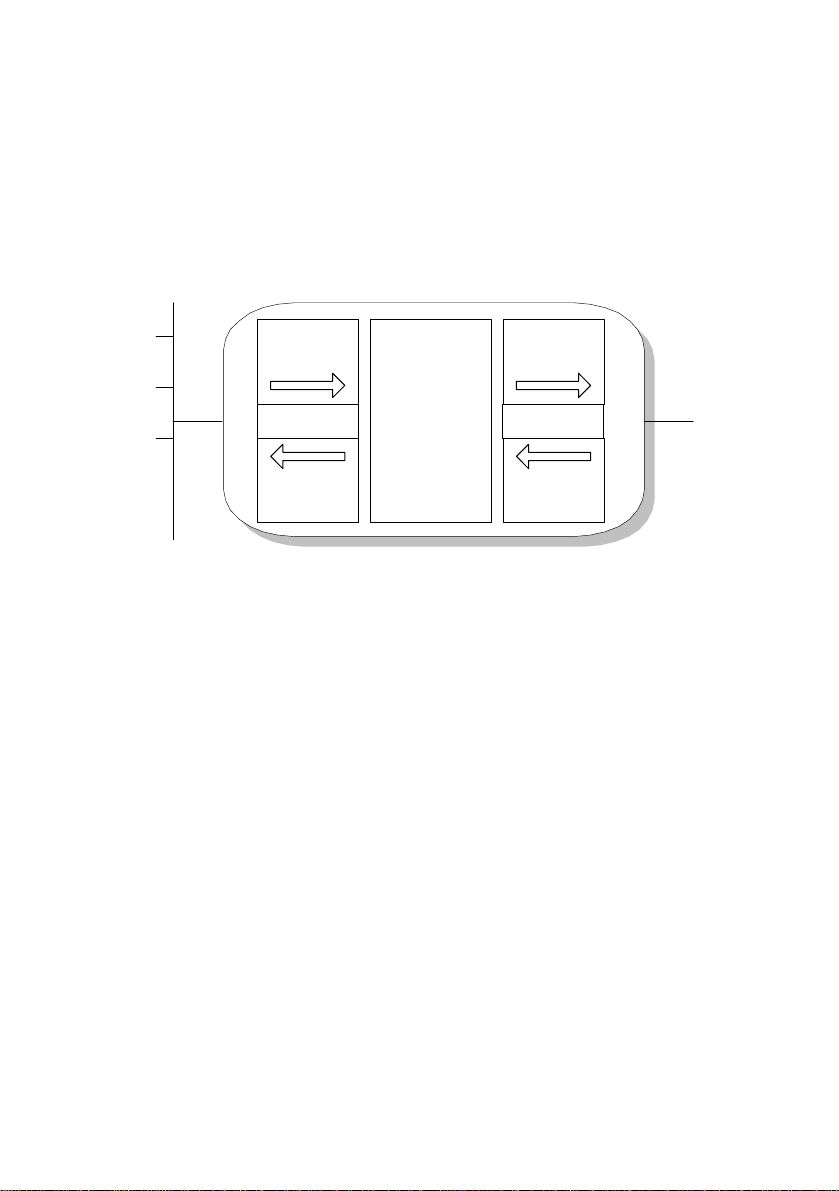
The gas-net DSfG gateway solves this problem: This device is connected to the
DSfG bus on the one side and on the other via a digital connection to the PLC
called host in the following.
1Typical protocols are, for instance, 3964R/RK512 (e.g. in case of Siemens S5/S7) or
Modbus-RTU (e.g. in case of Cegelec Modicon).