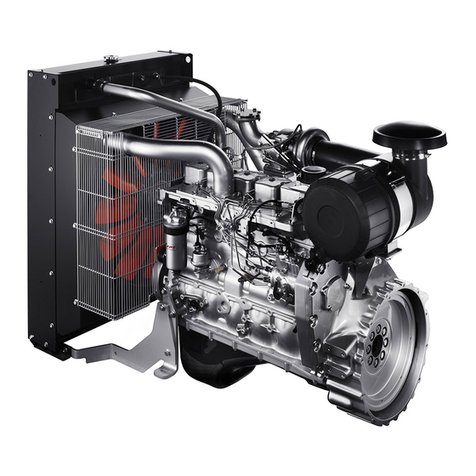
FPT CURSOR 87TE4 Benutzerhandbuch

4
ENGINE TECHNICAL DATA CURSOR 87
The technical code and serial number are indicated on a plate, which
is located on different parts of the engine, according to the model:
flywheel casing, tappet cover, other.
(*)Net power to the flywheel in compliance with ISO 3046-1. Test
conditions: temperature 25 °C; atmospheric pressure 100 kPa;
relative humidity 30%.
Code CURSOR 87
Engine family F2C
Cycle 4-stroke diesel
Number and arrangement
of cylinders 6, in line
Bore x stroke 117 x 135 mm
Total displacement 8,700 cm3
Air system Turbo aftercooler and after-
cooled
Injection type Common Rail
electronically managed
Engine direction
of rotation
Anticlockwise
(seen from flywheel side)
Dry weight (G-Drive) ~ 1050 kg
Electrical system 24 V
Accumulator/s
- capacity
-discharge current
180 Ah or above
1200 A or above
Performance (*) CURSOR 87TE3
Prime 229 kWm @1500 rpm
249 kWm @1800 rpm
Stand-by 249 kWm @1500 rpm
271 kWm @1800 rpm
Performance (*) CURSOR 87TE4
Prime 275 kWm @1500 rpm
306 kWm @1800 rpm
Stand-by 299 kWm @1500 rpm
333 kWm @1800 rpm
WARNING
Any alteration of the above mentioned characteristics, in particular
modification of the data stored in the injection system electronic units
or the characteristics of the engine and its fittings, is strictly prohibited,
penalty invalidation of the guarantee and absence of all liability on the
part of FPT.

5
ENGLISH
CURSOR87TE
1. Lifting eyelet - 2. Air filter - 3. Air delivery duct from filter to
compressor - 4. Lubrication oil filter - 5. Sump oil drain plug -
6. Turbocharger oil return pipe - 7. Heat exchanger - 8. Coupling of
engine coolant return - 9. Radiator - 10. Fan protective grille -
11. Thermostatic valve location - 12. Oil vapour filter seat - 13. Oil
vapour outlet coupling - 14. Exhaust manifold - 15. Turbocharger
exhaust gas outlet - 16. Turbocharger oil delivery pipe -
17. Turbocharger
CURSOR87TE
1. Radiator coolant inlet plug - 2. Engine coolant outlet pipe -
3. Alternator - 4. Intake manifold - 5. ECU - 6. Electric starter motor -
7. Fuel prefilter - 8. Completion kit - 9. High pressure fuel pump -
10. Oil filling cap - 11. Fuel filter
14_021_C
14_022_C

6
CURSOR87TE
1. Compressed air outlet pipe - 2. Turbocharger exhaust gas outlet
pipe - 3. Thermostat assembly - 4. Fan pulley - 5. Guide pulley - 6. Poly-
V belt - 7. Crankshaft damper - 8. Automatic belt tensioner -
9. Alternator - 10. Oil vapour filter - 11. Tappet cover
CURSOR87TE
1. Radiator coolant inlet plug - 2. Air filter - 3. Completion kit -
4. Engine air intake pipe - 5. Engine flywheel - 6. Turbocharger
14_023_C
14_024C

7
ENGLISH
SIGNS
Certain warning signs are affixed to the engine by the Manufacturer,
and their meanings are indicated below.
N.B. The signs with an exclamation mark on them underline a
potential danger.
Lifting point (engine only).
Fuel Cap
(on the fuel tank, if there is one).
Oil Cap.
Oil dipstick.
Danger of burning:
Expulsion of hot water under pressure.
Danger of burning:
Presence of high temperature parts.
Danger of fire:
Fuel present.
Danger of impact or catching
on moving parts:
Presence of fans, pulleys, belts or the like.

8
USE
PRELIMINARY CHECKS
Before starting the engine each time:
Check the level of technical fluids (fuel, engine oil and coolant), and
top-up if necessary.
Make sure that the air aspiration filter is not blocked or obstructed,
checking at the same time that the mechanical indicator on the filter
does not show the “red” sign. If the engine is equipped with an
electrical blockage sensor, an alarm will be displayed on start-up, by
means of the indicator light on the instrument panel.
Note: The procedures required to clean the filter are indicated
in the chapter CONTROLS AND MAINTENANCE.
STARTING AND STOPPING THE ENGINE
The start-up and shut-down operations described below apply to an
on-board control panel manufactured by FPT; if the Manufacturer of
the vehicle or machine has fitted a customised instrument panel, these
operations may vary according to the various choices made during
construction.
In these cases, follow the start-up/shut-down sequences and use the
instrument panel description provided in the specific documentation.
ENGINE PRE-HEATING (optional)
(Electrical device)
The engines for which low temperature start-up and immediate
delivery of power are required may be fitted with a 230 V single phase
electrical heating device, which allows the temperature of the coolant
to be raised to or maintained at suitable values. The device is fitted
with a thermostat to cut the power supply when the required
temperature is reached.
CAUTION!
Make sure that no combustible vapours or gasses are
present in the area in which the engine is to operate.
Ensure that closed areas are adequately ventilated and
fitted with a suitable exhaust extraction system.

9
ENGLISH
INTERCONNECTION ELECTRICAL UNIT
In order to allow the unit’s correct electrical functioning, an
interconnection unit has been fitted to the engine. The engine
electronic control system and the power unit system depend from the
aforesaid interconnection unit.
Some indications relating to its components and functions controlled
by programming commutators are reported here following.
Fuse
F1 Engine start
F2 Diagnosis connector
F3 Fuel heater on filter
F4 Engine electronic control unit
F5 Interface electronic unit
F6 E.C.U. power supply (enabling)
F7/8/9 Reserve
Relays
K1 E.C.U. supply (enabling)
K2 Engine start signal
K3 Engine start
K4 Fuel heater on filter
14_064_C

10
Engine speed and accessory functions control
Programming of the functions here following is possible commuting
the position of the JP switches.
JP1: Engine speed selection
1-2 = 1,800 rev. /min (60 Hz power generation)
2-3 = 1,500 rev. /min (50 Hz power generation)
JP2: Mode selection
1-2 = DIAGNOSIS MODE
2-3 = OPERATING MODE
JP3: Pre-heating warning light
1-2 = connected
2-3 = not connected
JP4: Fuel pre-heating
1-2 = relay on
2-3 = relay off
JP5: It CAN line
1-2 = available
2-3 = unavailable
BP1: Blink code request switch button
LD1: Blink code display
FOR PROPER USE OF THE ENGINE
Before starting the engine, check there is enough fuel in the fuel
tank.
Do not keep on starting.
Do not keep the engine idling for a long while since this has
negative effects to the engine performance.
Actual power values must comply with the rated values reported
in the technical documentation.
When operating the engine, regularly check that:
- the cooling liquid temperature does not exceed the threshold
value;
- the oil pressure keeps within normal values.
Particular attention must be drawn on emergency power unit
engines, which must be submitted to frequent overhauls in order
to ensure their prompt start whenever required.
WARNING
Pay attention to the board panel instrument readings and indications.

11
ENGLISH
SPECIAL WARNINGS
Engine cooling liquid
When the engine is running, regularly check that the engine cooling
liquid temperature does not reach the alarm threshold.
In case the temperature detected is excessive, disconnect the load and
stop the engine to check the cooling circuit status. Wait that the
engine is cold before checking: it is important to remind that, when the
engine is heated, the pressurized hot liquid within the cooling circuits
may be ejected causing burns and serious injury.
Moreover, check the following:
a) the alternator’s belt tension;
b) the thermostatic valve’s efficiency;
c) the conditions of the heat exchanger (to be cleaned if necessary).
Cooling liquid refill
For engine servicing and whenever the system requires significant
cooling liquid refill, proceed as follows:
Refill the engine and the heat exchanger until complete top up.
With the filler cap open, start the engine and keep it idling for nearly
one minute. This phase facilitates the cooling liquid air bleed.
Stop the engine and top up again.
Further information on the cooling liquid technical specifications and
quantity prescribed are reported in the CONTROLS AND
MAINTENANCE section.
Lubrication circuit
Regularly check that the oil pressure keeps within normal values. In
case the value detected is too low, check the oil level and refill if
necessary following the instructions reported in the CONTROLS
AND MAINTENANCE section.
If the failure persists, apply to the Technical Service for assistance.
CAUTION!
Open the cooling liquid tank cap only if it is necessary and
exclusively if the engine is cold.
CAUTION!
Failure to comply with the procedure may cause the
incorrect engine cooling liquid refill and, as a consequence,
wrong quantity within the engine.

12
Fuel circuit
Avoid using the engine with only a small reserve of fuel in the fuel tank;
this encourages the formation of condensation and makes it more
likely you will suck up dirt or air, resulting in engine stoppage.
The common rail injection system does not require air to be bled from
the fuel circuit.

Air intake and exhaust discharge circuits
Inspect the cleanliness of the air intake circuit on a regular basis. The
maintenance intervals indicated in this manual vary according to the
conditions in which the engine is used.
In particularly dusty environments it is necessary to carry out
maintenance at more frequent intervals than indicated in the chapter
CONTROLS AND MAINTENANCE.
Electrical starter system
Periodically check, particularly during the winter, to ensure that the
batteries are clean and in full working order, checking and topping up
as indicated in the chapter CONTROLS AND MAINTENANCE.
Should it be necessary to replace the batteries, always respect the
capacity and minimum discharge current intensity requirements.
CAUTION!
When refuelling, always pay great care to ensure that no
solid or liquid pollutants enter the fuel tank; you must also
remember that smoking and live flames are prohibited
when refuelling.
CAUTION!
Never loosen the high pressure fuel circuit connectors in
any way.
CAUTION!
Visually check that the exhaust circuit is not blocked or
damaged, so as to prevent dangerous fumes.
WARNING!
Contact a specialised workshop and check battery and recharging
system efficiency if the voltmeter indicates a voltage below 11 V (for
12 V rated systems), or 22 V (for 24 V rated systems).
Dieses Handbuch passt für folgende Modelle
2
Inhaltsverzeichnis
Andere FPT Motor Handbücher

FPT
FPT F Series Benutzerhandbuch

FPT
FPT N Series Benutzerhandbuch

FPT
FPT N45 AM1S Bedienungsanleitung

FPT
FPT NF67TE8W.S550 Benutzerhandbuch

FPT
FPT F32 Series Betriebsanleitung

FPT
FPT NEF Series Benutzerhandbuch

FPT
FPT NEF Series Benutzerhandbuch

FPT
FPT C13 ENS M33 Betriebsanleitung

FPT
FPT NEF Series Benutzerhandbuch

FPT
FPT CURSOR Series Betriebsanleitung


