
HANION L-1933 Bedienungsanleitung


i
PREFACE
FCC Compliance Statement
This device complies with part 15 of the FCC Rules. Operation is subjected to
the following two conditions:
1. This device may not cause harmful interference, and
2. This device must accept any interference received, including interference
that may cause undesired operation.
FCC WARNING
This equipment has been tested and found to comply with the limits for a Class B
digital device, pursuant to Part 15 of the FCC Rules. These limits are designed to
provide reasonable protection against harmful interference in a residential instal-
lation.
This equipment generates, uses and can radiate radio frequency energy and, if
not installed and used in accordance with the instructions, may cause harmful in-
terference to radio communications.
However, there is no guarantee that interference will not occur in a particular in-
stallation. If this equipment does cause harmful interference to radio or television
reception, which can be determined by turning the equipment off and on, the user
is encouraged to try to correct the interference by one or more of the following
measures:
Reorient or relocate the receiving antenna.
•Increase the separation between the equipment and the receiver.
•Connect the equipment into an outlet different from that to which the
receiver is connected.
•Consult the dealer or an experienced radio/TV technician for help.
Caution:
To comply with the limits for an FCC Class B computing device, always use the
shielded signal cord supplied with this unit.
The Federal Communications Commission warns that changes or modifications
of the unit not expressly approved by the party responsible for compliance could
void the user’s authority to operate the equipment.

ii
CE mark for Class B ITE (Following European standard EN55022/1998; EN61000-
3-2/1995; EN61000-3-3/1995, EN55024/1998, EN60950: 2000+Corr Feb. 2002, IEC
60950:1999+Corr Jan. 2000)
Radio Frequency Interference Statement
Warning:
This is a Class B product. In a domestic environment, this product may cause ra-
dio interference in which case the user may be required to take adequate
measures.
Canadian Doc Notice
For Class B Computing Devices
This digital apparatus does not exceed the Class B limits for radio noise emis-
sions from digital apparatus as set out in the Radio Interference Regulation of the
Canadian Department of Communications.
“Le présent appareil numérique n’èmet pas de bruits radioélectriques dépassant
les limites applicables aux appareils numériques de la class B prescrites dans le
Règlement sur le brouillage radioélectrique édicté par le ministère des Communi-
cations du Canada”

iii
Important Safety Instructions
Please read the following instructions carefully. This manual should be retained
for future use.
1. To clean the LCD Monitor screen, first, make sure the Monitor is in the
power off mode. Unplug the Monitor from its power source before cleaning
it. Do not spray liquid cleaners directly onto the unit. Stand away from the
LCD Monitor and spray cleaning solution onto a rag. Without applying ex-
cessive pressure, clean the screen with the slightly dampened rag.
2. Do not place your LCD Monitor near a window. Exposing the Monitor to
rain, water, moisture or sunlight can severely damage it.
3. Do not place anything on top of the Monitor-to-PC signal cord. Make sure
the cord is placed in an area where it will not be stepped on.
4. Do not apply pressure to the LCD screen. Excessive pressure may cause
permanent damage to the display.
5. Do not remove the cover or attempt to service this unit by yourself. You
may void the warranty. Servicing of any nature should be performed only
by an authorized technician.
6. Safe storage of the LCD Monitor is in a range of -20°C to +60°C (-4°F ~
140°F). Storing your LCD Monitor outside this range could result in per-
manent damage.
7. If any of the following occurs, immediately unplug your Monitor and call an
authorized technician.
•The power or Monitor-to-PC signal cord is frayed or damaged.
•Liquid has been spilled onto the Monitor, or it has been exposed to rain.
•The Monitor has been dropped or the case has been damaged.
8. Only with use of supplied adaptor, in case of loss or replacement contact the
retailer or service center.

iv
9. If you lost the power cord that we given, you must to purchase a same con-
figuration/type of power cord (with ground-connection)
Japan:VCTF type, 3 wires or with ground-wire, T-mark approval is
required.
U.S.:VW-1; 18AWG X 3C; SVT with national approval as UL and/or
CSA approval/number(s)
Europe:VDE/ÖVE and/or KEMA approval; H05VV-F, 3G, 0.75mm2,
or equivalent.
Above power cord should bear with the type and manufacturer name on.

v
TABLE OF CONTENTS
PREFACE ........................................................................................................... I
TABLE OF CONTENTS ....................................................................................V
CHAPTER 1........................................................................................................1
Unpacking……………………………………………………………………….1
Identifying Components………………………………………………………2
Hot-Key Buttons for Quick Adjustment of Monitor Settings……………..2
The LCD Monitor — Rear View…………………………………………….3
Adjusting the Viewing Angle…………………………………………………4
Connecting AC Power, Video, Audio……………………………………….6
Power Management System………………………………………………….6
CHAPTER 2........................................................................................................7
The LCD Monitor’s Display Controls……………………………………….7
Adjusting the Monitor’s Display……………………………………………..8
OSD Main Menu (Please refer to Chapter 1 for details on functions)….8
APPENDIX A ……………………………………………………………………...13
LCD Monitor Specifications ……………………………………………..13
APPENDIX B.……………………………………………………………………...15
APPENDIX C ……………………………………………………………………...16
Troubleshooting Procudures…………………………………………....16
16

1
CHAPTER 1
The LCD Monitor
Unpacking
After you unpack your LCD Monitor; make sure the following items are
included in the box and in good condition:
•LCD Monitor
•Monitor-to-PC Analog signal cable (15-pin)
•Stereo Jack Audio Cable
•Power cord
•User’s manual
If you find that any of these items are missing or appear damaged, con-
tact your dealer immediately. Do not throw away the packing material or
shipping carton in case you need to ship or store the LCD Monitor in the
future.

2
Identifying Components
Hot-Key Buttons for Quick Adjustment of Monitor Settings
Figure 1-1: Hot-Key buttons
1.”Auto-adjust” short-cut button:
Press button 2 to apply the monitor setting auto-
matically. A small “AUTO ADJUST” OSD is also
displayed.
2.” Adjust-volume” short-cut button:
Press button 3 to allow you to adjust the audio
volume directly.
3.” Contrast-adjust” short-cut button:
Press button 4 to allow you to adjust the contrast
of the display directly.
** To close the small OSD windows, press the power button (button 5).

3
The LCD Monitor — Rear View
Figure 1-2: LCD Monitor’s Rear Ports
1. Audio Line-in
2. AC Power Jack
3. VGA Cable Connector
4
Adjusting the Viewing Angle
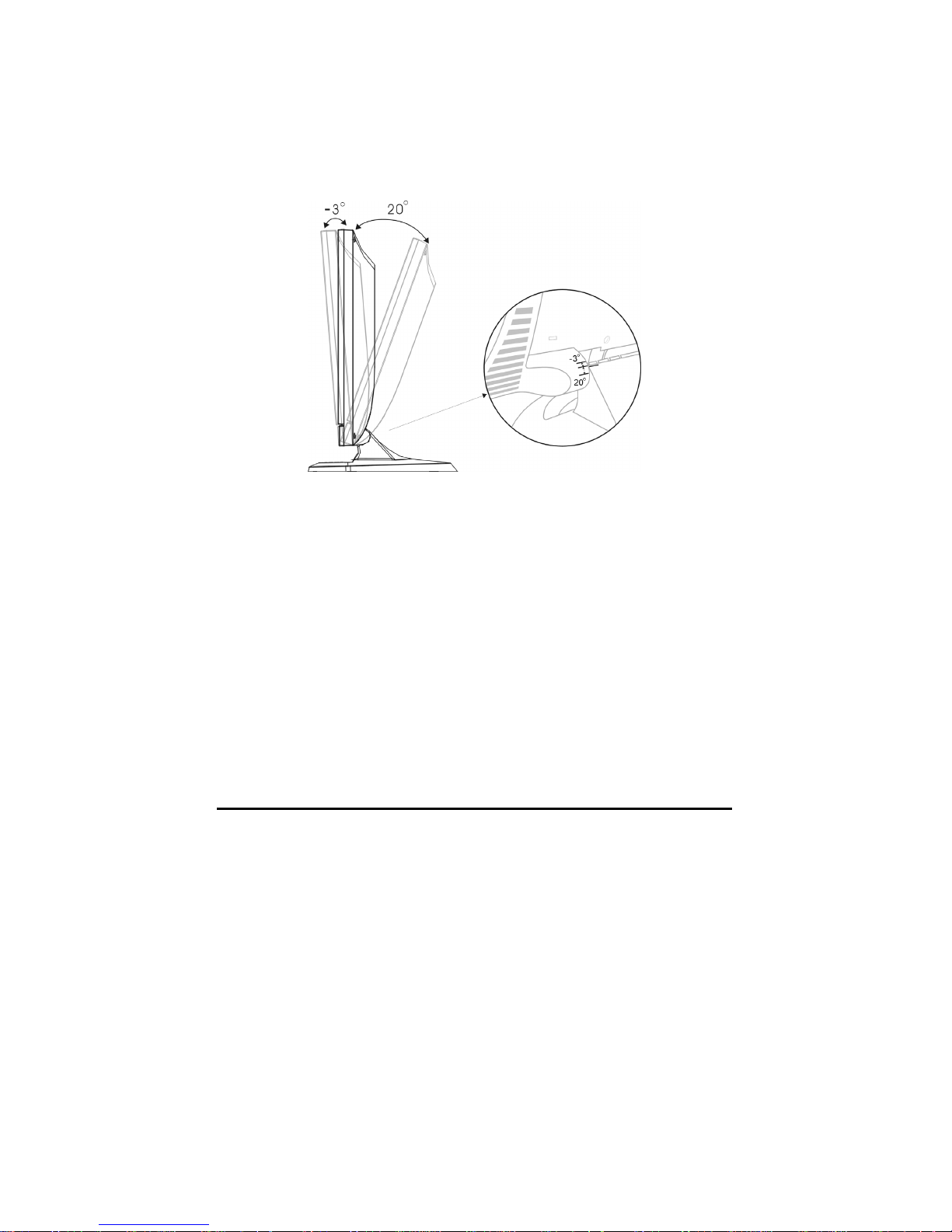
The LCD Monitor’s vertical angle setting range is from -3°to 20°. Please
see Figure 1-3.
Figure 1-3: Angle Settings
Inhaltsverzeichnis
Sprachen:


