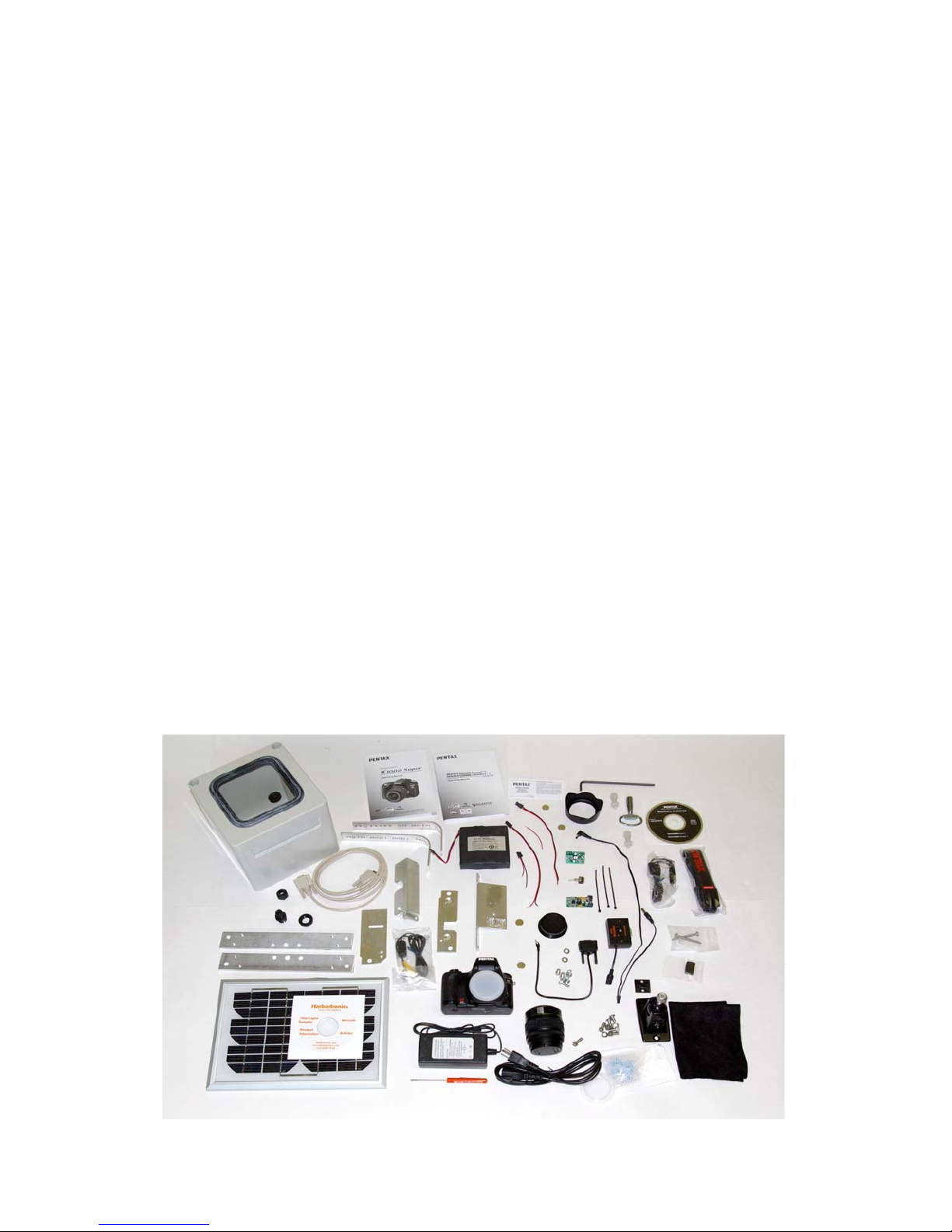
Time-Lapse Package
Revision E
time-lapse. Most Nikon SLR cameras have an external power connector… they are proprietary to Nikon so we would have to buy
their expensive AC adapter simply to cut off the connector. When powered externally we have found that Nikon SLRs never shut
off the metering… the camera continues to draw some power all the time which is a battery killer! If powered via the camera's
internal battery compartment it doesn't draw this excess power. However getting power to the battery terminals is not easy either
and Nikon now has a proprietary battery sensor to ensure that only their batteries are used. Shutter release is another issue. The latest
small Nikon SLRs are sized perfectly for the housing but they do not have a shutter release connection. Those that do have a shutter
release jack use proprietary connectors… again making the system more expensive. Nikon makes fine cameras but they make it
very difficult to use their cameras in this application!
We have less experience with Canon SLRs. The Digital Rebel series use an industry standard connector for the shutter release but
their ‘professional’ SLR cameras use a proprietary connector. Many Canon SLRs do not have an external jack for power but most
have a dummy battery pack adapter which allows for external power albeit at a small additional expense. If you have a camera you
would like to use we may need to borrow your camera for a day to see if we can come up with the proper connections. The Digital
Rebel series cameras would seem to be an excellent choice for a long term time-lapse camera. Unfortunately some of our customers
that have used these cameras have reported intermittent 'lockup' of the camera during long term operation. We have also heard
anecdotally of other systems using the Canon Rebel series camera with the same issue. Again we have less experience with these
cameras and the lockup issue may apply to a small percentage of cameras but at this point we still have some concern with the
Rebel series.
Given some extra effort and cost we may be able to use your current camera but we’d like to very strongly recommend using
suggest using our recommended camera model. These cameras use industry standard connectors draw negligible power between
pictures and yield equivalent image quality to Nikon and Canon cameras.
Pentax K200D
The standard package (as of 10/7/2008) will include the latest generation Pentax Digital SLR camera the K200D which use a 10
MPixel APS sized sensor with the standard ‘kit’ lens from Pentax providing a good range of usable zoom. The lens has a focal
length of 18-55mm which is equivalent to a 27-82mm in the old 35mm reference format. While we typically sell these cameras as
part of this entire package we can sell the K200D with lens for $725. These are excellent cameras for 'normal' use as well!
We install a 4 GB memory card in the camera as well as a set of AA lithium batteries. Our large battery pack will power the system
so the internal batteries are only needed to maintain the camera settings and camera clock when the external power is disconnected
such as in shipping or storage.
A second 4 GB memory card is also included to allow ‘hot swapping’ of cards during long-term applications. The card access door
on the camera must be closed to operate and the space is limited in the housing so the camera must be pulled out to swap cards.
Given our pivoting plate arrangement this is a very easy operation and the camera will be re-installed with an identical orientation
each time. If you desire you can attach the supplied USB cable and leave it attached in the housing. This would allow you to
download the images directly to a laptop computer in the field without touching the camera.
For the lowest power consumption please configure the following camera settings. Refer to the camera manual for more details on
these settings. Instant Review : Off Auto power off : 1 minute Manual focus Shake Reduction Off
As far as photographic settings are concerned we only have basic suggestions. For most applications you may find that using the
Program mode (P) is perfectly adequate. The camera will adapt the aperture and shutter speed to suit the lighting conditions. This
does mean that there may be visible variations in the exposure from frame to frame. If your project requires consistent exposures
from frame to frame accurately reflecting the changing light conditions then you may need to set the camera up for manual
exposures. This could take a few days of experimenting to determine the proper settings however! There may be some advantage to
setting the camera for a fixed white balance rather than using the camera’s auto white balance. We also suggest setting the ISO to
the lowest setting for the minimum noise.
Our standing recommendation is to take pictures at high resolution and take more pictures as you think you will need. It’s very easy
to downsize or discard images but you can’t get more of them after the fact. Given the very high resolution of the images you can
do some very interesting post-processing ending up with movies with in-frame pan and zoom effects.
Ideally you will set up the system a week or two ahead of time collect lots of test images and adjust the exposure before the ‘event’
you are monitoring actually occurs. If you have this luxury congratulate yourself for thinking ahead… you are in a minority!
Operating Temperature
Note that the operating temperature of most digital SLR cameras is specified for 0C to +40C. While neither we nor the camera
manufacturer can warrant operation beyond this range you will undoubtedly find that it works just fine over much a wider range! As
of late 2008 there are several hundred systems in the field some for about 3 years using the Pentax K100D series camera and we
have relatively few reports from customers of camera failures. This is not a perfect failure rate but not unexpected for commercial
equipment used in harsh environments.
Harbortronics Inc 6 10/7/2008