Hydrover Oxymatic Bedienungsanleitung

BASIC
Installation,Programmingand
MaintenanceUserGuide

User Guide Oxymatic Basic
Rev.Apr 2013
Hydrover Water Solutions S..L.U.2
HYDROVER WATER SOLUTIONS
Summary
1.INTRODUCTION.......................................................................................................................3
2.CONTENT.................................................................................................................................6
3.OXYMATIC SYSTEM INSTALLATION........................................................................................8
4.OXYMATIC START..................................................................................................................13
5.PRESENTATIONOFOXYMATICBASIC....................................................................................15
6.INSTALLATIONANDPUTTINGINMARCH,STEPWISE............................................................18
7.MAINTENANCE......................................................................................................................19
8.INCOMPATIBILITIES AND POSSIBLE PROBLEMS WITH THE SYSTEM OXYMATIC.............19
9.PROBLEMS AND SOLUTIONS...............................................................................................20

User Guide Oxymatic Basic
Rev.Apr 2013
Hydrover Water Solutions S..L.U.3
1. INTRODUCTION
1.1. Oxymatic Technology
The Oxymatic system generates the most powerful and effective disinfectant, it is one – two thousand times
faster to react and more effective than chlorine and lies a close second in power to fluoride which is forbidden
in recreational waters.
OXYMATIC combines two technologies: the hydrolysis of water and the electrolysis of copper. When the two
processes act in synergy water is automatically disinfected. Maintaining residual copper levels allows water to
be disinfected and ensures that the residual copper is more stable than chlorine. The process eliminates
anything that may cause irritation and eradicates any flavour or scent.
No additional disinfecting is required. Any legal requirements concerning levels of disinfectants within public
pools is no longer a concern as disinfected water runs through the system prior to chlorination/bromination,
thus eradicating potential problems
Automated installation and low maintenance cost
The methodology most commonly in existence relies on chemical disinfectants to prevent waterborne diseases
that can grow to epidemic proportions. Chlorination (water treatment method) has a proven ability to control
infectious diseases such as cholera, typhoid and dysentery. The use of disinfection with chlorine and chemicals
has proven useful and essential but not without cost. There is a high price to pay for the benefits of chemical
control not only financially but the side effects can be harmful: chlorine, bromine, aluminum, phosphates or
chromates etc. can cause harmful side effects on human health. Chlorine is coming under attack from health
organizations and federal governments are beginning to layout new legislation to minimize and eliminate the
use of toxic chemicals and disinfectants within water. The U.S. Registered Center for Disease Control
recognizes Chloroform and dioxin (two bi-products of chlorination) as toxic. Growing awareness and concerns to
the environment and human health due to the use of chlorine is forcing agencies to rethink the strategy and use
of chlorine, bromine and other halogens for all types of water treatment.
1.2. The process of hydrolysys
Hydrolysys is a Bipolar Oxidation Technology (A.B.O.T). It is referred as "bipolar" due to the fact that it has two
electrodes 1.the positive pole or anode, and 2. the negative or cathode.
Every four minutes there occurs an automatic change of polarity which allows the copper electrodes to operate
independently and intermittently whilst self cleaning.
Hydrolysis is the process by which the water molecule is dissociated into various species due to the application
of an electric current. The main reaction of the hydrolysis process is as follows:
2 H2O (OH-) + H3O+
The dissociation of water molecule implies a standard oxidation-reduction potential (E0) of 1.8 V. In the case of
pure water, the dissociation that is produced is very weak, so there must be a certain level of dissolved solids
and conductive molecules (corresponding to the TDS and conductivity parameters, respectively, in the routine
analysis of water) for this process to effectively act as a disinfectant.
There are many secondary chemical reactions, which produce ionic species with an oxidant and disinfectant
power, such as ozone (O3), monatomic oxygen (O1) and hydrogen peroxide (H2O2).
OXYMATIC circuits transform the standard electrical current (220 V, 50 Hz) DC low voltage and amperage by its
titanium electrodes (plated precious metals), creating ionized water, disinfectant chemical species.
The aforesaid results in the creation of a combination of the most powerful oxidizers available for water
disinfection, which avoids the use of chemicals. In the case of hydroxyl ions (oxidation-reduction potential of
2.05, exceeded only by fluorine, but because of its high toxicity can’t be used as a disinfectant).
Table 1 shows the key values of redox potential.

User Guide Oxymatic Basic
Rev.Apr 2013
Hydrover Water Solutions S..L.U.4
* Oxidants produced by the system OXYMATIC.
1.3. Ionization
From the copper electrodes OXYMATIC system generates copper ions Cu2 +, which effectively remove algae,
bacteria and viruses. Contrary to what happens with various forms of chlorine here is no scientific evidence that
the organisms are developing immunity to copper ions.
An added advantage is that the system has a certain OXYMATIC disinfectant effect. The calcium in the water is
kept in the form of bicarbonate (water soluble), with a pH around 7 and a maximum temperature of
approximately 50 º C. The aforesaid avoids the fouling inside the pipe and reduces the tendency to corrosion.
This phenomenon was tested by ETL Laboratories / EPA and developed by OXYMATIC in 1995.
N.B. It is necessary to take special care where a pool has Line’s covering. PH should not exceed 7.6 due to the
fact that from this point the copper starts precipitating the characteristics of the line. The pool becomes dirty
with blue spots which are difficult to eliminate
OXIDATION REDUCTION POTENTIAL (ORP)
Chemical name
Symbol
ORP Value
Fluorine F2
2.25
Hydroxyl Ion
OH-
2.05
Atomic Oxygen
O-
1.78
Ozone O3
1.52
Hydrogen Peroxide
H2O2
1.30
Permanganate
KMn2O7
1.22
Hypochlorous
Á
cid
HClO
1.10
Chlorine (Gas)
Cl2
1.00
Oxygen O2
0.94
Sodium Hypochlorite
NaClO
0.69

User Guide Oxymatic Basic
Rev.Apr 2013
Hydrover Water Solutions S..L.U.5
Copper ion concentration (ppm) required for the elimination of some micro organisms:
Copper (ppm)
Copper (ppm)
Chlorophyceane
Protozoa
Bursaria
Cladophora 0.50
Ceratium
0.33
Closterium 0.17
Chlamydomonos
0.50
Coelastrum 0.05 -
0.33
Cryptomonas
0.50
Conferva 0.25
Dinobryan
0.18
Desmidium 2.00
Euglena
0.50
Draparnaldia 0.33
Glenodinium
0.50
E. COLLI 0.20
Mallomonas
0.50
Entomgplprn 0.50
Nematodes
0.70
Eudorins 10.00
Peridinium
0.50 -
2.00
Hydrodictyon 0.10
Synura
0.12 -
0.25
Microspora 0.40
Uroglena
0.05 -
0.20
Palmella 2.00
Fungus
Pandorina 10.00
Leptornitus
0.40
Raphidiiun 1.00
Sappolagnia
0.18
Scenedesmus 1.00
Miscellaneous
Spirogyra 0.12
Chara
0.10 -
0.50
Starastrom 1.50
Nitella, flexilis
0.10 -
0.18
Ulothrix 0.20
Potamogeton
0.30 -
0.80
Volvox 0.25
Diatomeas
Zygnema 0.60
Asterionella
0.12 -
0.20
- -
Fragilaria
0.25
- -
Melosira
0.20
- -
Navicitia
0.07
- -
Nitzchia
0.50
- -
Synedra
0.36 -
0.50
- -
Stepbanodiwus
0.33
- -
Tabellaiia
0.12 -
0.50
TABLE 2: Destruction of microorganisms by the system OXYMATIC
The Water Check National Testing Laboratories (Ypsilanti, MI), Spectrum Labs (Minneapolis, MN) and MN
Department of Health have observed the destruction of E Coli from 0.1 to 2.0 ppm at pH ranges from 6.5 to 8.0.
In addition municipal public health inspectors and private companies have conducted additional investigations
into E Coli and have found that copper ion in pipelines has stability until fixed. At present this solution has
proven to be the market leader for the removal of coli forms and E.Coli.

User Guide Oxymatic Basic
Rev.Apr 2013
Hydrover Water Solutions S..L.U.6
2. OXYMATIC - CONTENT
2.1. Included Items

User Guide Oxymatic Basic
Rev.Apr 2013
Hydrover Water Solutions S..L.U.
7
2.2. Excluded Items
NOT INCLUDED but necessary for installation:
•Adhesives:
•PVC pipes
•By-pass valves
•Motor Protection
•Fastening screws Oxymatic
2.3. Dimensions oxymatic
Length 29cm
Depth 23cm
High 10cm
Length 47cm
Depth 12,5cm
High 35cm

User Guide Oxymatic Basic
Rev.Apr 2013
Hydrover Water Solutions S..L.U.8
3. OXYMATIC SYSTEM INSTALLATION
3.1. Plumbing
It is of the upper most importance that correct/careful plumbing is carried out when installing the Oxymatic
system – this is the basis of a good installation. It is important that the camera is installed after the filtering
circuit and heating - see diagram below
The titanium electrodes should be connected to the entry of the water and the copper electrodes to the output.
Depending on the Oxymatic model, connection of the injection point of pH and chlorine peroxide should be
carried out on a case by case basis.
Copper Systems

User Guide Oxymatic Basic
Rev.Apr 2013
Hydrover Water Solutions S..L.U.9
H2O2/ Cl Systems
For correct installation and easy maintenance we recommend the installation of the camera with a by-pass as
shown in the figure below.
* The material of the camera is compatible with any PVC glue
3.2. Electricity
The equipment is shipped ready for use via 100v to 240v. There is no requirement for a power adapter but we
recommend installing a motor protector before connecting to the mains. This avoids any possible increase in
the tension which will severely affect the electronics of Oxymatic, (not covered by the warranty). (See image)
We OXYMATIC only has one power input – “the computer to the network” and therefore it is important not to
connect the pump or any other components to the mains.

User Guide Oxymatic Basic
Rev.Apr 2013
Hydrover Water Solutions S..L.U.10
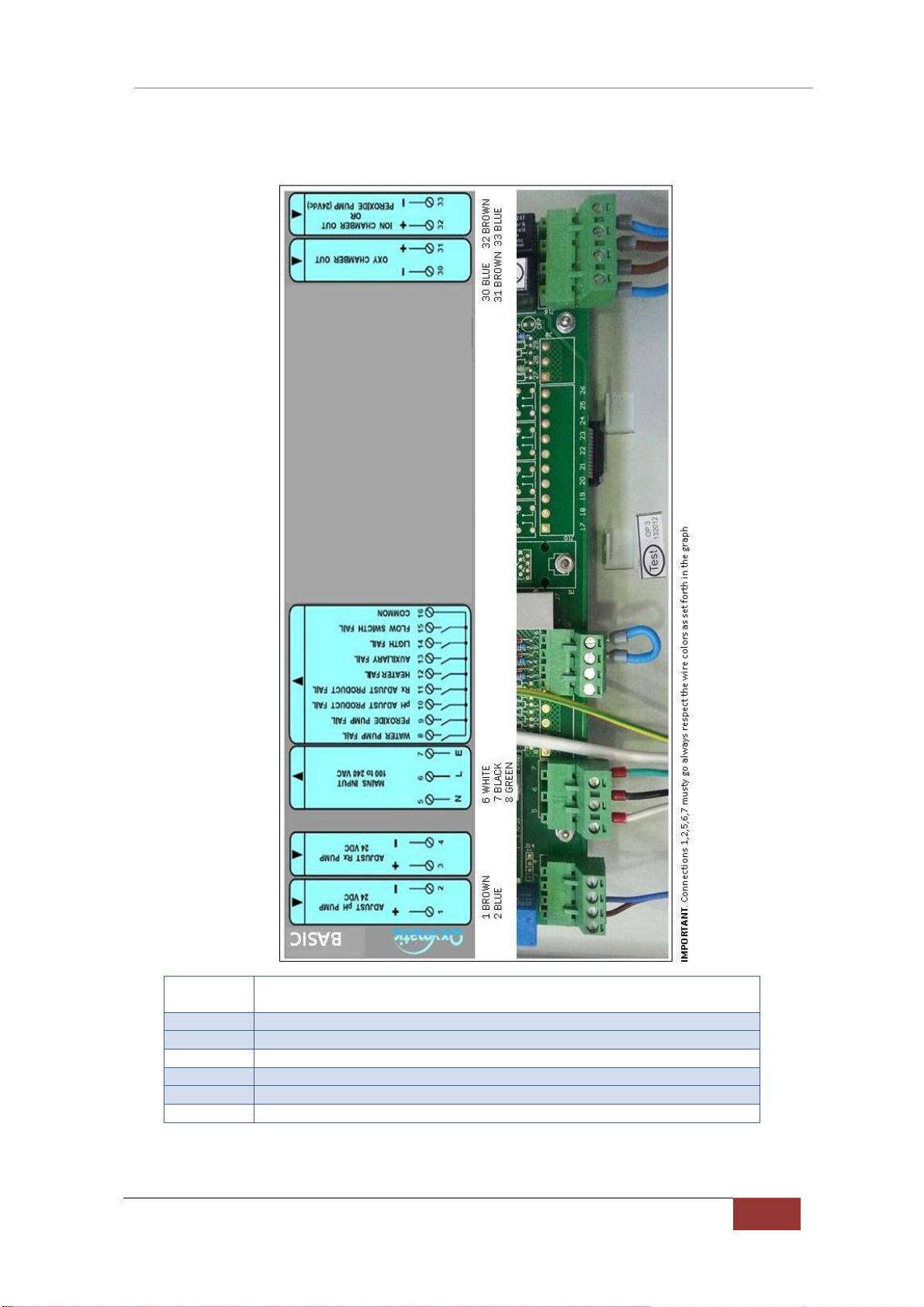
3.2. Connections Table
See below the connections that are permitted via Oxymatic
Nº
Conector
Descripción
1 y 2 Connecting the pH injection pump (24V)
5, 6 y 7 Main power connection to the network (Max. 240V)
8 -14 Connections indicators
15-16 Flow Switch
30 y 31 Connecting to the Ti electrode
32 y 33 Connecting Copper electrodes peroxide or Chlorine
Inhaltsverzeichnis
Beliebte Schwimmbadfilter Handbücher anderer Marken

Davey
Davey EcoPure DEP2140 Bedienungsanleitung

JUWEL Aquarium
JUWEL Aquarium EccoSkim Bedienungsanleitung

POLYGROUP LIMITED
POLYGROUP LIMITED SFS600 Filter System with F600C Pump Bedienungsanleitung

Pentair Pool Products
Pentair Pool Products Filter CFW Series Bedienungsanleitung

Oase
Oase Skimmer 250 Bedienungsanleitung

Oase
Oase CrystalSkim 350 Bedienungsanleitung