
jobmate YT7602-01 Bedienungsanleitung


2
Know Your Product.................................................................................................3
Technical Specications......................................................................................... 3
Description of Symbols...........................................................................................4
Contents of Li-ion Pole Pruner ............................................................................. 5
General Safety Instructions.................................................................................... 6
Additional Safety Instructions for Li-ion Pole Pruner ......................................... ... 8
Assembly Instructions............................................................................................ 9
Operation.............................................................................................................. 12
To Turn The Tool On....................................................................................... 12
Basic Cutting Procedure................................................................................. 13
Tips for Using Your Li-ion Pole Pruner........................................................... 14
Maintenance..........................................................................................................16
Warranty ..............................................................................................................18
CONTENTS

3
1On/Off Switch 2Telescoping Handle
3 Motor 4Chain Oil Cap
5Bar 6Chain
7Adapter Sleeve Assembly 8 Foam Grip
9 Battery
Battery: 18V Li-ion, 1500mAH
No load speed: 1800/min
Working time: 15 minutes
Bar length: 20cm
KNOW YOUR PRODUCT
TECHNICAL SPECIFICATIONS
7
1
2
34
8
9
56
4
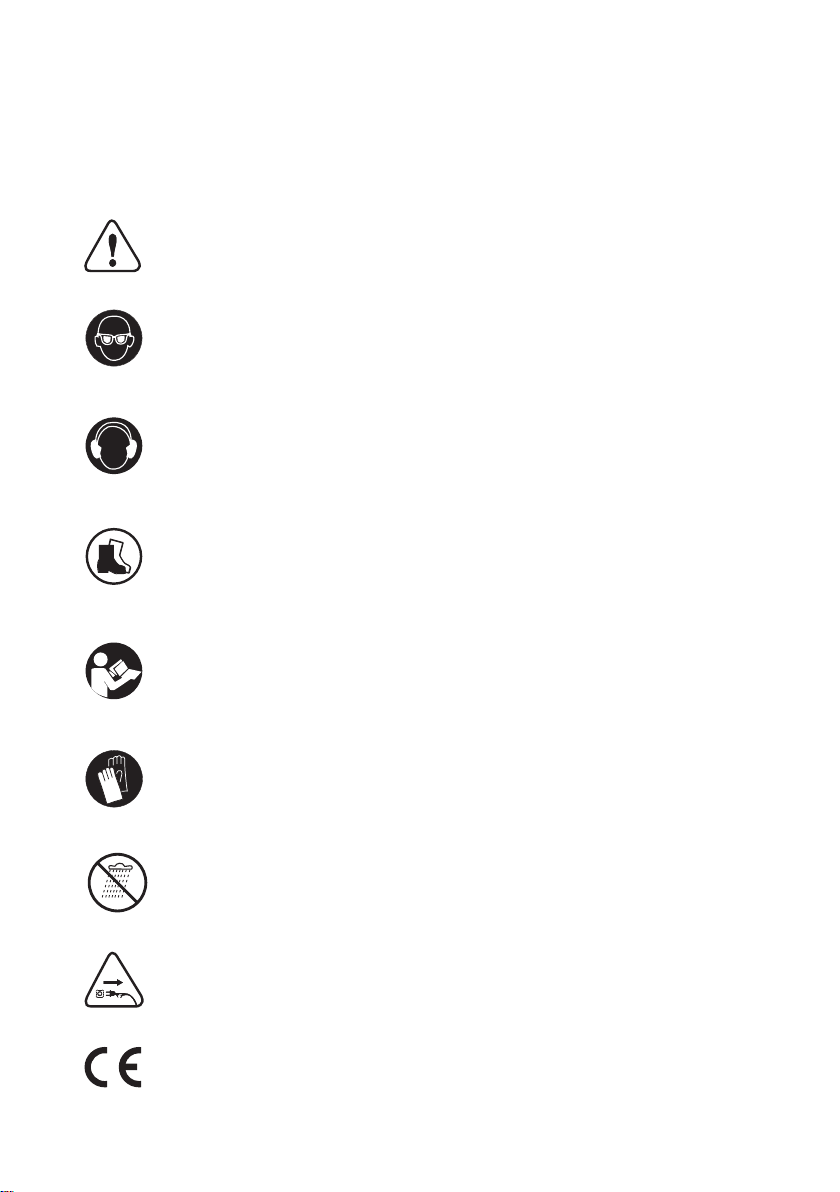
The rating plate on your tool may show symbols. These represent important
information about the product instruction on its use.
Conforms to all relevant European Directives.
DESCRIPTION OF SYMBOLS
Disconnect from mains power immediately if the power cord becomes
damaged.
Use eye protection.
Use ear protection.
Wear sturdy, non-slip footwear.
Read the user manual.
Do not expose to rain.
Use protective gloves.
Denotes risk of personal injury, loss of life, or damage to the tool in case
of nonobservance.
5
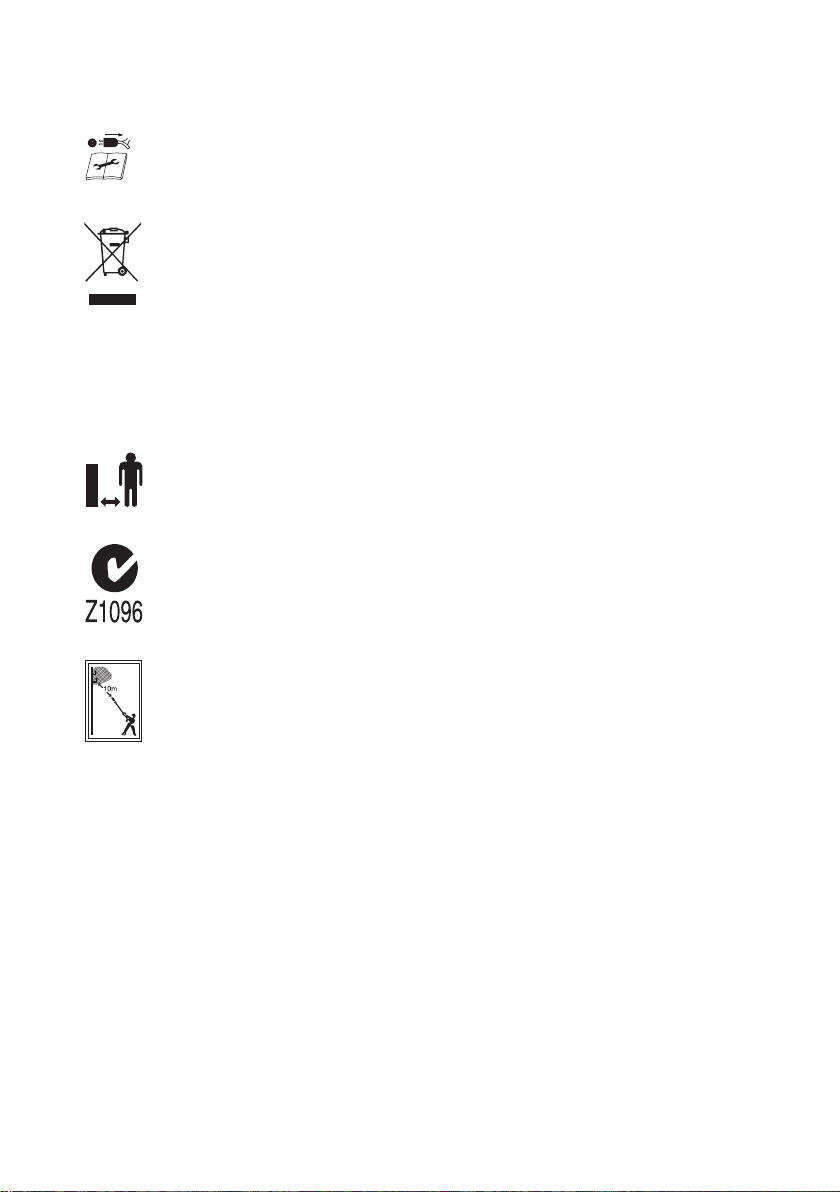
This symbol is known as the ’Crossed-out Wheelie Bin Symbol’.
When this symbol is marked on a product or battery, it means that it
should not be disposed of with your general household waste. Some
chemicals container within electrical/electronic products or batteries
can be harmful to health and the environment. Only dispose of
electrical/electronic/battery items in separate collection schemes,
which cater for the recovery and recycling of materials container within.
Your co-operation is vital to ensure the success of these schemes and
for the protection of the environment.
1* Battery pack and charger
1* Chain and bar
1* Blade cover
1* Unit
1* Instruction manual
1* Wrench
Conforms to relevant standards for electromagnetic compatibility.
Warning! Danger from overhead electric-power lines! Keep at least 10m
distance.
DESCRIPTION OF SYMBOLS (CONT.)
CONTENTS OF LI-ION POLE PRUNER
Keep children at a distance of no less than 5m from the work area.
Disconnect from power supply when tool needs repairs.

6
WARNING! Read all instructions. Failure to follow all the instructions listed
in all of the warnings listed below refers to your mains operated (corded) power tool
or battery operated (cordless) power tool.
SAVE THESE INSTRUCTIONS
1) Work area
• Keep work area clean and well lit. Cluttered or dark areas can lead to accidents.
• Do not operate power tools in explosive atmospheres, such as in the presence of
dust or fumes.
• Keep children and bystanders away while operating a power tool. Distractions can
cause a loss of control.
2) Electrical safety
• Power tool plugs must match the outlet. Never modify the plug in any way. Do not
matching outlets will reduce risk of electric shock.
• Avoid body contact with earthed or grounded surfaces, such as pipes, radiators,
ranges and refrigerators. There is an increased risk of electric shock if your body
is earthed or grounded.
• Do not expose power tools to rain or wet conditions. Water entering a power tool
will increase the risk of electric shock.
• Do not abuse the cord. Never use the cord for carrying, pulling or unplugging the
power tool. Keep cord awayfrom heat, oil, sharp edgesor moving parts. Damaged
or entangled cords increase the risk of electric shock.
• Replacement of the supply cord. If the supply cord is damaged, it must be repl aced by
an electrician or a power tool repairer.
• When operating a power tool outdoors, use an extension cord suitable for outdoor
use. Use of a cord suitable for outdoor use reduces the risk of electric shock.
• If operating a power tool in a damp location is unavoidable, use a residual current
device (RCD) protected supply. Use of an RCD reduces the risk of electric shock.
• Have your tool repaired by an electrician or a power tool repairer. This power tool
complies with relevant safety requirements. To avoid danger, electrical appliances
this may result in considerable damage to the user.
3)Personal safety
• Stay alert, watch what you are doing and use common sense when operating a
drugs, alcohol or medication. A moment of inattention while operating power tools
may result in serious personal injury.
• Use safety equipment. Always wear eye protection. Safety equipment such as a
dust mask, non-skid safety shoes, hard hat, or hearing protection used whenever
conditions require will reduce personal injuries.
• Avoid accidental starting. Ensure the switch is in the ‘off’ position before plugging
GENERAL SAFETY INSTRUCTIONS

7
GENERAL SAFETY INSTRUCTIONS (Cont.)
that have the switch may cause an accident.
• Remove any adjusting key or wrench before turning the power tool on. A wrench
or key left attached to a rotating part of the power tool may result in personal
injury.
• Do not overreach. Keep proper footing and balance at all times. This enables
better control of the power tool in unexpected situations.
• Dress properly. Do not wear loose clothing or jewellery. Keep your hair, clothing
and gloves away from moving parts. Loose clothes, jewellery or long hair can be
caught in moving parts.
• If devices are provided for the connection of dust extraction and collection
facilities, ensure these are connected and properly used. Use of these devices
can reduce dust related hazards.
4)Power Tool Use and Care
• Do not force the power tool. Use the correct power tool for your application.
The correct power tool will do the job better and safer at the rate for which it was
designed.
• Do not use the power tool if the switch does not turn it on and off. Any power tool
that cannot be controlled with the switch is dangerous and must be repaired.
• Disconnect the plug from the power source before making any adjustments,
changing accessories or storing power tools. Such preventive safety measures
reduce the risk of starting the power tool accidentally.
• Store idle power tools out of the reach of children and do not allow persons
unfamiliar with the power tool or these instructions to operate the power tool.
Power tools are dangerous in the hands of untrained users.
• Maintain power tools. Check for misalignment or sticking of moving parts,
breakage of parts and any other condition that may affect the power tool’s
operation. If damaged, have the power tool repaired before use. Many accidents
are caused by poorly maintained power tools.
• Keep cutting tools sharp and clean. Properly maintained cutting tools with sharp
cutting edges are less likely to stick and are easier to control.
• Use the power tool, accessories and tool bits etc. in accordance with these
instructions, and in the manner intended for the particular type of power tool,
taking into account the working conditions of the work to be performed. Use of the
power tool for operations different from intended use could lead to a hazardous
situation.
5)Service
replacement parts. This will ensure that the safety of the power tool is maintained.

8
• Keep all parts of the body away when the saw is operating. Before starting the
saw, ensure that the saw chain is not touching anything. While working with a
chainsaw, one instant of negligence may result in clothing or body parts being
caught by the saw chain.
• Always hold the chainsaw with your right hand at the rear handle and your left
hand on the front handle. Holding the chainsaw the other way round enhances
the risk of injuries and should not be used.
• Wear safety goggles and ear muffs. It is recommended to use other protective
gear for the head, hands, legs and feet. Appropriate protective clothing reduces
saw chain.
• Do not work with the chainsaw on a tree. There is risk of injuries when operating
the saw on a tree.
• Always ensure a stable stance and posture and use the chainsaw only if you are
as on a ladder, may lead to loss of balance or loss of control of the chainsaw.
• Reckon with the fact that while cutting a branch under tension, it is likely to recoil
branch may hit the operator and/or snatch control of the chainsaw .
• Be particularly careful while cutting under-growth and young trees. The thin
material may get caught in the saw chain and hit you or make you lose your
balance.
• Carry the saw chain at the front handle when it is switched off so that the saw
chain is turned away from your body. Always pull the protective cover over
the saw chain when transporting it or storing it away. Working with the saw chain
carefully and diligently reduces the likelihood of touching it inadvertently while it is
operating.
• Follow the instructions for lubrication, tightening the chain and replacing
accessories. A chain that has not been tightened or lubricated properly may either
snap or enhance the risk of a rebound or recoil.
• Keep the handles dry, clean and free from oil and grease. Greasy and oily
handles are slippery and can cause loss of control. Use it to saw only wood. Do not
use the chainsaw for work that it is not designed or intended for e.g. Do
not use the chainsaw to saw plastics, brickwork or construction materials that are
not made of wood. Using the chainsaw for work that it has not been designed or
intended for may lead to hazardous situations.
without approval.
• Please note that in the case of devices that have been discharged, there is a
basic risk of injury caused by residual charge.
• These devices are not meant to be used by persons with little experience and/or
knowledge or by those with physical, sensory or mental limitations, unless they
are supervised by persons in charge of their safety or have received instructions
ADDITIONAL SAFETY INSTRUCTIONS FOR
LI-ION POLE PRUNER

9
ASSEMBLY INSTRUCTIONS
UNPACKING
This product requires assembly.
Carefully remove the product and any accessories from
the box. Make sure that all items listed in the packing list
are included.
Inspect the product carefully to make sure no breakage or
damage occurred during shipping.
Do not discard the packing material until you have
carefully inspected and satisfactorily operated the product.
WARNING: If any parts are damaged or missing, do not rotate the head knob as
directed, this could result in personal injury.
WARNING: Failure to lock telescopic pole collars could result in personal injury.
Install the Guide Bar and Chain
Danger: Never start the motor before installing the guide bar, chain and chain cover lock
to possible serious injury.
Warning: To avoid serious personal injury, read and understand all the safety
instructions provided.
Warning: Before performing any maintenance, make sure the battery pack has
been removed. Failure to heed this warning could result in serious personal injury.
Caution: Always wear gloves when handling the bar and chain; these
components are sharp and may contain burrs.
Warning: Never touch or adjust the chain while the motor is running. The saw
chain is very sharp; always wear protective gloves when performing maintenance to
the chain to avoid possible serious lacerations.
ADDITIONAL SAFETY INSTRUCTIONS FOR
LI-ION POLE PRUNER (CONT.)
from them about how these devices are to be used.
• Youth below 16 years of age should not operate the devices.
• Using the device must be avoided under poor weather conditions, particularly
when there is the risk of lightning.
exposing the user

10
ASSEMBLY INSTRUCTIONS (Cont.)
Loosen the guide bar screw.
Remove the chain cover.
Note: Make certain of the direction of chain.
• Position the chain so there is a loop at the back of the bar. (5)
• Hold the chain in position on the bar and place the loop around the sprocket.
•
slot of the bar. (6)
Note: When placing the bar on the bar studs, ensure that the adjusting pin is in the
chain tension pin hole.
• Tightening the chain tensioner. (7)
• .tnemtsujdanoisnetrofevomoteerfrabehtevaeltub,wercsrabediugehtnethgiT
(8)
• Remove all slack from the chain by turning the chain tensioner clockwise until the
chain sits snugly against the bar with the drive links in the bar groove. (9)
• Tighten the guide bar screw. (10)
The chain is correctly tensioned when there is no sag on the underside of the guide
bar, the chain is snug, but it can be turned by hand without binding.
Note: If chain is too tight, it will not rotate. Loosen the guide bar screw slightly and
turn the chain tensioner 1/4 turn counter clockwise screw. Ensure that the chain will
rotate without binding.
Note: A new chain tends to stretch, check chain tension frequently and tension as
required.
Dieses Handbuch passt für folgende Modelle
1
Inhaltsverzeichnis
Andere jobmate Stangensäge Handbücher


