
Kruger KH 300 Bedienungsanleitung

1
USER & INSTALLATION MANUAL
MODEL(S) KH 300
KH360
CAREFULLY READ THIS USER MANUAL BEFORE USING

2
CONTENTS
READ AND SAVE THESE INSTRUCTIONS.......................................................3
INSTALLATION....................................................................................................5
OPERATION INSTRUCTIONS..........................................................................11
SPECIFICATIONS .............................................................................................14
HOOD DIMENSIONS.........................................................................................14
ELECTRICAL DIAGRAMS.................................................................................15
TROUBLESHOOTING.......................................................................................16

3
IMPORTANTSAFETYINSTRUCTIONS
1. Installation work and electrical wiring must be done by a qualified person(s) in accordance with all applicable codes
and standards, including fire-rated construction codes and standards.
2. When cutting or drilling into a wall or ceiling, be careful not to damage hidden electrical wiring and other utilities.
3. Before servicing or cleaning the unit, switch power off at the service panel and lock the service disconnection to
prevent power from being switched on accidentally. When the service disconnection cannot be locked, securely fasten
a prominent warning device, such as a tag, to the service panel.
4. Don’t get the power lines restructured, stretched, connected, imposed with weights or pinched etc. The power lines
can be easily damaged leading to electrical shock or fire.
5. It is prohibited to change the internal wiring of the range hoods without authorization; it may result in abnormal
functioning which may lead to personal injury. Improper maintenance may lead to electric shock and fire.
Ducted fans must always be vented to the outdoors. Clean all grease laden surfaces frequently. To reduce the risk
of fire and to disperse air properly, make sure to vent air outside. DO NOT vent exhaust air into wall spaces, attics,
crawl spaces or garages.
NOTE: If there is no invoice issued by the authorized agency or the damage of the components is due to misuse,
improper installation, improper use, improper handling, negligence or other uncontrollable factors by our authorized
agency, warranty services cannot be obtained.
Any maintenance done without the consent of our authorized agency will make the warranty card invalid. For any
direct or indirect damage caused by our product such as personal property, real property loss and personal injury due
to the above mentioned misuse reasons, our company will not be liable.
WARNING:TO REDUCE THE RISK OF A RANGE TOP GREASE FIRE
1. Never leave surface units unattended at high settings. Boil-overs cause smoke and grease spills may ignite. Heat
oils slowly on low or medium settings.
2. Clean ventilation fans frequently. Grease should not be allowed to accumulate on the fan or filter.
3. Use proper pan sizes. Always use cookware appropriate for the size of the surface element.
4. Always use ventilation when cooking.
WARNING:
TO REDUCE THE RISK OF INJURY TO PERSONS IN THE EVENT OF A RANGE TOP GREASE FIRE,
OBSERVE THE FOLLOWING: To Reduce The Risk Of Fire Or Electric Shock, Do Not Use This Fan With Any
Solid-State Speed Control Device.

4
5. Use high settings on cooking range ONLY when necessary.
6. Do not leave cooking range unattended when cooking.
7. Use this unit only in the manner intended by the manufacturer.
8. Before servicing, switch power off at service panel and lock service panel (if possible) to prevent power from
switching on accidentally.
What to Do In The Event Of a Range Top Grease Fire
SMOTHER FLAMES with a close-fitting lid, cookie sheet, or metal tray, then turn off the burner. BE CAREFUL
TO PREVENT BURNS. If the flames do not go out immediately, EVACUATE AND CALL THE FIRE
DEPARTMENT.
NEVER PICK UP A FLAMING PAN – You may get burned.
DO NOT USE WATER, including wet dishcloths or towels to extinguish a grease fire – a violent steam
explosion will result.
Use a fire extinguisher ONLY if:*
(a) You know you have a Class ABC extinguisher, and you already know how to operate it.
(b) The fire is small and contained in the area where it started.
(c) You have already called the fire department.
(d) You can fight the fire with your back to an exit.
* Based on “kitchen fire safety tips” published by NFPA
CAUTION:
Important - Observe all governing codes and ordinances:
* For general ventilating use only. Do not use to exhaust hazardous or explosive materials and vapors.
* Do not run cord under carpeting. Do not cover cord with throw rugs, runners, or any other coverings. Do not route cord
under furniture or appliances. Arrange cord away from high traffic areas and so it will not be tripped over.
* Follow the heating equipment manufacturer’s guideline and safety standards such as those published by the National
Fire Protection Association (NFPA), and the American Society of Heating, Refrigeration and Air Conditioning Engineers
(ASHRAE), and your local code authorities.
* To reduce the risk of fire, use only metal ductwork.
* Do not let children use the hood unattended.
*The temperature of the environment for range hood use should not be higher than 40°C.

5
INSTALLATION
Unplug the appliance from the power supply before servicing.
NOTE: This procedure will require 2 people for easier installation.
Please read all instructions carefully before installing.
1. If you are renovating your kitchen, be careful to protect your range hood. Volatile gases from building
materials, dust, paint and coatings can corrode and tarnish the surface of your range hood. Instead, install your
range hood after your kitchen renovation is complete.
2. The stainless steel may have very sharp edges; wear protective gloves when removing the range hood for
installing, cleaning or servicing.
3. Be careful not to damage any hidden wire sets when drilling into a wall. Unplug the range hood from the power
supply before installation; the main power box should be switched off.
4. If it is needed to move the gas stove before installing the range hood, switch off the gas valve entirely before
moving the gas stove.
5. Always use a power socket with reliable grounding. Half-way links of the power line, the use of extension cords
and multi-port wiring devices may lead to electric shock, plugs and sockets overheating and fire. Make sure the
operation is done by professional electricians, and strictly abide by the national and local electric laws and
regulations. Switch the power off and take measures to prevent the power switch from automatically tripping
before wiring.
6. To ensure a safe and smooth installation, use our accessories for installation and make sure the expansion tube
stays closely within the wall hole when installing it. Do not make the drill hole too large; doing so will cause the
expansion tube to be loose which may result in accidental damage.
7. Try to make the two sides of the range hood balanced when installing.
8. If there are no abnormal occurrences during a qualified test run after installation, read the instruction manual
carefully and keep it in a safe place.

6
The following tools and materials are needed to finish the installation:
Electric drill
Drill bit
Cross head screwdriver
Flat head screwdriver
Pencil and ruler, to mark the position for installation
Pre-Installation Calculations:
Stand-alone installation(table 1)
SAFETYWARNING
THE HOOD MAY HAVE VERY SHARP EDGES; PLEASE WEAR PROTECTIVE GLOVES WHEN REMOVING ANY
PARTS FOR INSTALLING, CLEANING OR SERVICING.
Preparation before Installation:
NOTE: TO AVOID DAMAGE TO YOUR HOOD, PREVENT DEBRIS FROM ENTERING THE VENT OPENING.

7
Determine the installation height of the range hood (refer to figure 1).
Figure 1
If there is a gas stove under the range hood, the minimum distance
between the cooking area and the hood should be 30".
If there is an electric stove under the range hood, the minimum
distance should be 24" to 30".
Figure 2
Determine the location of the exhaust pipe which discharges to the outside. (Refer to
figure 2) A linear and short air outlet can make the range hood work more smoothly.
Avoid using too long and too bent of an exhaust pipe, the use of these pipes can
affect the performance of the hood and even shorten the service life.
Use duct tape to firmly seal the joints of the pipe, make sure the exhaust pipe and the
vent outlet are firmly connected.
Figure 3
8
Equipment installation:
It is necessary to do turn on the range hood and do a test run, to make sure it is working normally.
Remove all protective film on the hood before installation.
1. By using the reference of Figure 1 and the measured values on page 14-15, mark four mounting holes and two
security holes on the mounting surface of the hood then drill. Firmly embed the expansion pipe (refer to figure 3).
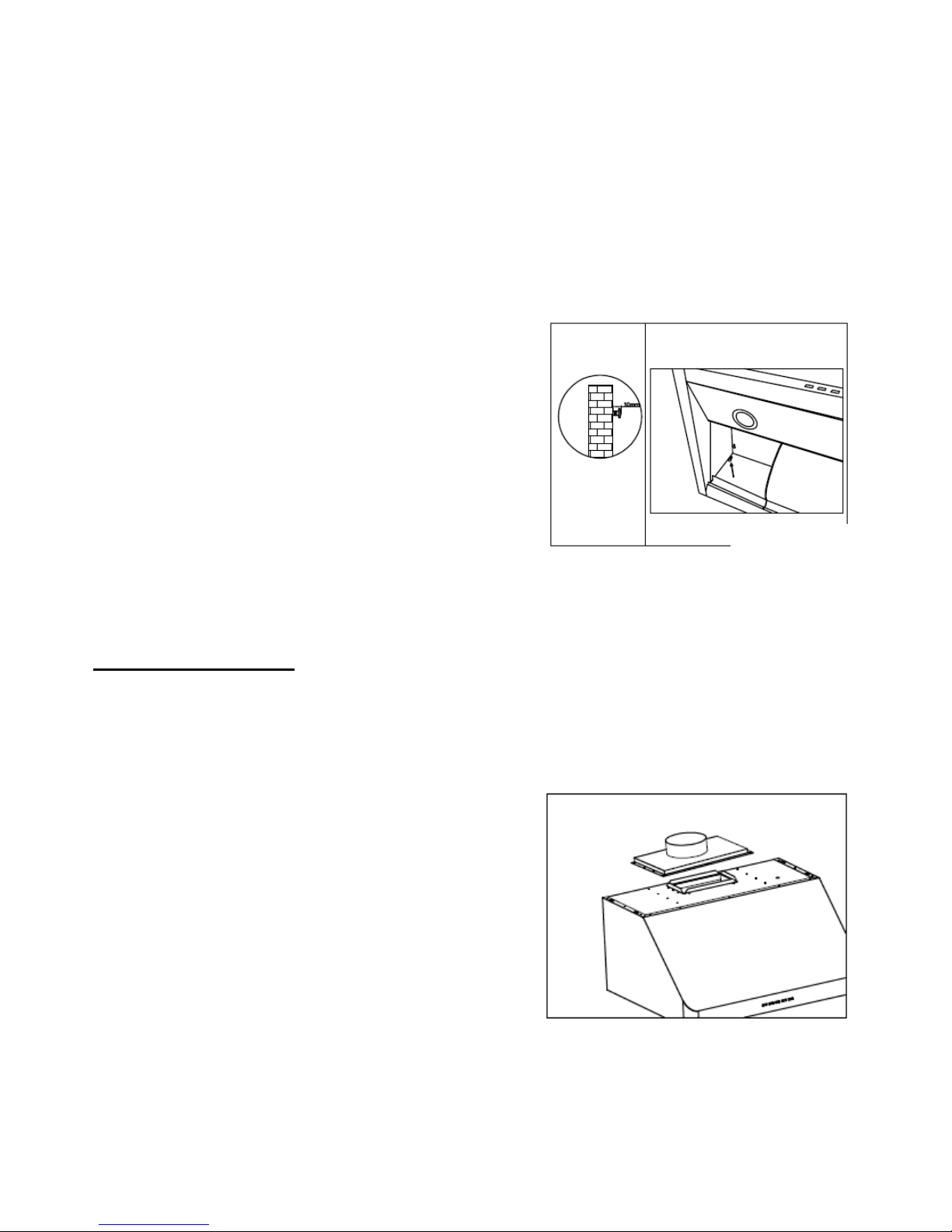
2. Use a cross screwdriver to screw in 4 mounting screws.
Note: the distance between the wall and screw is 10mm (refer to
figure 4).
3. Hang the hood onto the installed screws with precise alignment to
the mounting hole of the hood.
4. Install the hood firmly onto the wall by tightening the four mounting
hole screws.
5. For safety, it is necessary to drill in screws in the two security
holes and make sure they are tightened.
Note: make sure the hood has been installed firmly before letting go.
Piping system installation:
IMPORTANT:TO REDUCE THE RISK OF FIRE, USE ONLY METAL DUCTWORK.
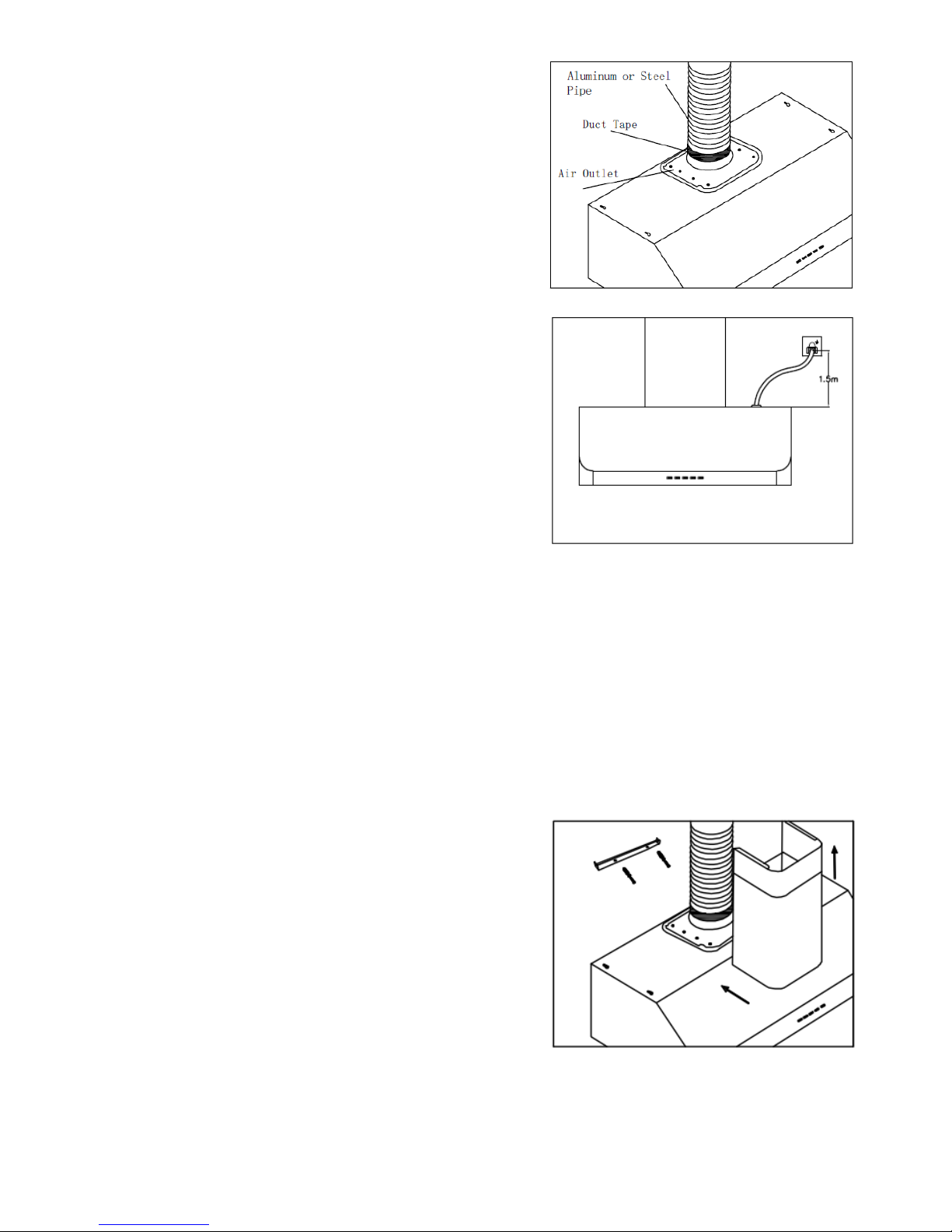
1. Attach the duct outlet to the range hood.
Figure 4
9
2. Attach the exhaust pipe to the duct outlet and use
duct tape to firmly seal all the joints.
3. If you are equipped with a chimney, install the
chimney according to figure 7. Power source needs to
be within 1.5m to the unit.
Power Connection:
WARNING: Improper grounding can result in the risk of electric shock.
Consult a qualified electrician if the grounding instructions are not completely understood, or if doubt exists as to
whether the appliance is properly grounded.
Do not use an extension cord. If the power supply cord is too short, have a qualified electrician install an outlet near the
appliance.
The farthest distance between the power line and the power
socket should be no more than 59". Make sure the power
line has a reliable power supply system (refer to figure 8).
After installation, range hood is ready for use.
Figure 8

10
Important: the power cord should be replaced by professionals if damaged.
GROUNDING INSTRUCTIONS
This appliance must be grounded. In the event of an electrical short circuit,
grounding reduces the risk of electric shock by providing an escape wire for the
electric current. This appliance is equipped with a cord with a grounding wire with
a grounding plug. The plug must be plugged into an outlet that is properly installed
and grounded.
Dieses Handbuch passt für folgende Modelle
1
Inhaltsverzeichnis
Andere Kruger Dunstabzugshaube Handbücher

Kruger
Kruger KM300 Bedienungsanleitung

Kruger
Kruger Ecowatt Drive K354 Series Installationsanleitung

Kruger
Kruger ALTO-T Bedienungsanleitung

Kruger
Kruger ALTO-H Bedienungsanleitung

Kruger
Kruger KA300 Bedienungsanleitung

Kruger
Kruger KCE 140PA Bedienungsanleitung

Kruger
Kruger KR-300 Alto-R Bedienungsanleitung

Kruger
Kruger KCE 100PA Bedienungsanleitung

Kruger
Kruger KA300 Bedienungsanleitung

Kruger
Kruger KM300 Bedienungsanleitung


