Normally Energized Models (-FS) Detects Ground Faults and loss of control power
CONTROL POWER APPLIED
NO POWER No Fault Fault Detected
Output Style Output LED Output LED Output LED
N.C. Normally Closed CLOSED Off OPEN ON CLOSED OFF
N.O. Normally Open OPEN Off CLOSED ON OPEN OFF
Normally De-Energized Models (-NF) Detects Ground Faults only.
CONTROL POWER APPLIED
NO POWER No Fault Fault Detected
Output Style Output LED Output LED Output LED
N.C. Normally Closed CLOSED Off CLOSED OFF OPEN ON
N.O. Normally Open OPEN Off OPEN OFF CLOSED ON
Description
Operation
Principal of Operation
AG Series ground fault detectors work in the same environ-
ment as motors, contactors, heaters, pull-boxes, and other
electrical enclosures. They can be mounted in any posi-
tion or hung directly on wires with a wire tie. Just leave at
least one inch distance between detector and other magnetic
devices.
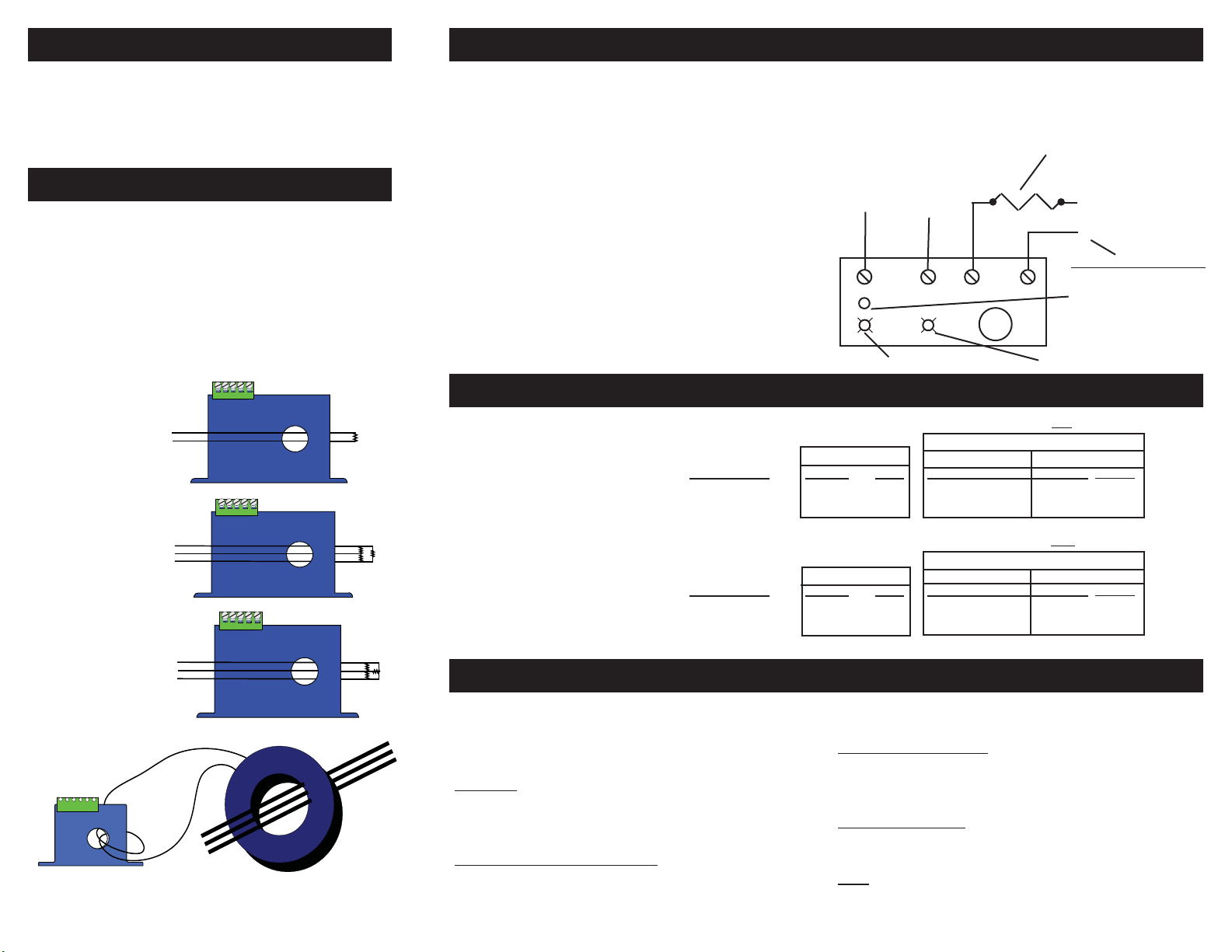
Run all current carrying conductors through the detector
aperture in the same direction. (See “Principal of Opera-
tion)
Connect power wiringto the detector. Be sure that the power
supply matches the power rating on the detector label. Use
22 to 14AWG copper wire and tighten terminals to 7 inch-
pounds torque.
Connect controlled load to terminals. Be certain the output
current draw is lower or equal to the output rating on the
detector label.
Installation & Wiring
To test operation,gently pressthe
TEST button. This simulates a
faultandteststheinternalsensing
circuits. You should observe the
following operation.
CAUTION: Any circuit con-
nected to the detector will be
operated.
Power Output
G
X
Control Power
Match Detector Rating
(See Label)
Setpoint Adjust
Factory calibrated &
covered. Remove cover,
adjust & relabel if required.
Load
Contactor, Relay, Shunt Trip Breaker, etc.
Do not exceed Rating (See Label)
Output Power
Match Detector Rating
(See Label)
TEST
(+)
(_)
For DC Output Version
Observe Polarity
Setpoint Adjustment
AG1 &AG2 Series detectors are factory calibrated to trip
atthesetpointspecifiedat thetimeorder. We highly recom-
mend leaving this factory calibrated setpoint alone. If you
must change the factory setpoint, follow these steps:
A. Setup
Connect control power and output circuits. Run a conduc-
tor through the aperture with current equal to your desired
set point .
B. Adjust Setpoint to Maximum
Remove the Setpoint Cover. Turn the adjustment pot 4
revolutions CCW (Counter Clockwise) to the maximum
(least sensitive) setpoint. The Status LED should be OFF.
The adjustment pot has a slip clutch so you cannot feel or
damage the end point.
C. Dial in new Setpoint
Turn the pot slowly CW (Clockwise) until the LED turns
ON. The detector is now adjusted to trip at the current that
is passing through the aperture. Reset the detector.
D. Relabel Detector
Relabelthedetectorwiththenewsetpoint. Usealabelmaker
or tape with a permanent marker.
AG3 Move the jumper to the desired setpoint as shown on
the label. No other adjustment can be made.
Under normal conditions, the current in one wire of a two
wire load is equal in strength but opposite in sign to the cur-
rent in the other wire. The two wires create magnetic fields
that cancel, acondition known as“Zero Sum Current”.If any
current leaks to ground (Ground Fault), the two currents be-
come unbalanced and there is a net resulting magnetic field.
The AG detector detects this minute field and changes the
output state. This concept extends to three phase systems
such as 3 wire Delta and to 4 wire Wye.
AG Series ground fault detectors monitor all current carry-
ing wires in single or three phase systems to detect ground
faults. They provide a contact output that can operate
relays, contactors or signal automation systems.
Contact Status LED
Power Supply LED
Single Phase (Phase
& Neutral or Phase to
Phase)
3 Phase Delta (Include
neutral if the load uses
neutral)
3 Phase Wye (Include
neutral if load uses
neutral)
3 Phase Load, using an auxiliary Current Transformer. Contact
factory for details.



