
One-Touch Drinks Rio Technisches Dokument
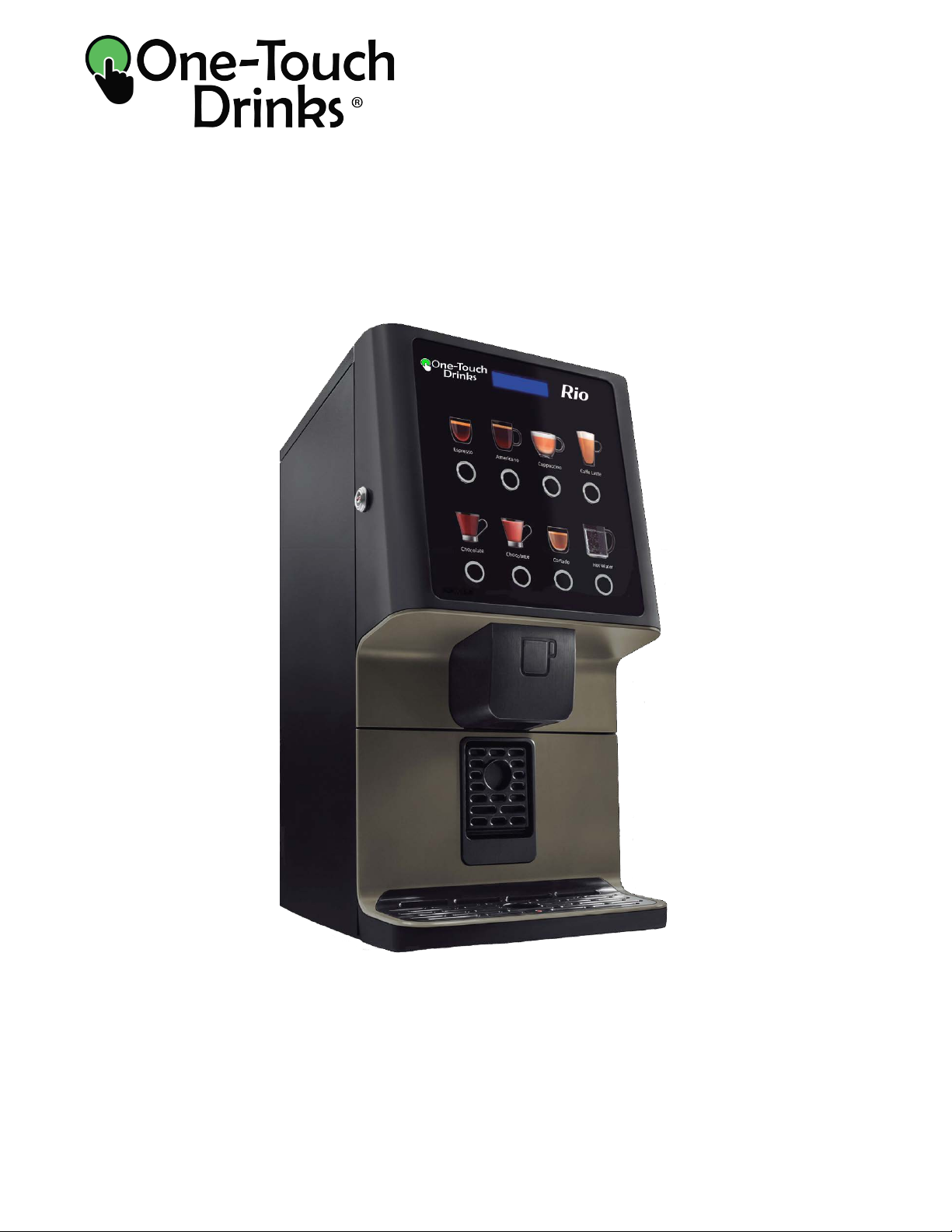
Technical
Information Manual
Rio
Espresso & Chocolate


Rio Technical Principles
Edition 06 – 2
019
2
I N E X
1. INTRO UCTION
1.1. DEFINITIONS
1.2. MODELS
1.3. PRINCIPAL TECHNICAL CHARACTERISTICS
2. ESCRIPTION OF COMPONENTS
2.1. PRINCIPAL COMPONENTS
2.2. HYDRA LIC CIRC IT
3 INSTALLATION AN SWITCHING ON
3.1. INSTALLATION
3.2. WATER CONNECTION
3.3. ELECTRIC CONNECTION AND START P
3.4. FILLING CANISTERS
3.5. FILLING BOILER
4. ERROR MESSAGES ON ISPLAY
5. CONTROL POINTS
6. CLEANING AN MAINTENANCE
7. WORKING CON ITIONS AN NORMS
8. IMENSIONS
One-Touch Drinks
P.O Box 118300
Carrollton, TX 75011-8300
(800) 560-5062
(972)522-8805
onetouchdrinks.com

Rio Technical Principles
06 – 2019
3
1. INTRO UCTION
The semiautomatic machine Rio is one in a series created for making fresh
ground espresso coffee and soluble drinks through the mixing of warm water
and powder or granulated product from the canisters.
In the rest of the book and for briefness, the elements
that are indicated will be named like:
The machines of the series Rio: machine or machines.
The coffee brewer or coffee group: group or brewer.
The electroválvulas (solenoid valves): EV
1.1. EFINITIONS
Espresso coffee: Infusion of coffee created according to the following conditions:
-7 g of ground coffee.
-The temperature of the infusion water between 92º C and 96º C.
-The water pressure at 8 kg/cm²
-The delivery water pressure at a 9 kg/cm².
-The infusion time of the coffee between 12 and 20 seconds.
-The volume of water in the infusion 50 ml.
Infusion: this is the name given to the process of passing hot water through the ground
coffee to extract its oils and essences.
Volumetric infusion: when the process of infusion uses a constant volume of water.
Coffee tablet: the residual compressed coffee grounds after the infusion process.
Programming mode: when the machine is ready for any of its functions or parameters to be
programmed.
Working mode: when the machine is in the working state and ready to prepare any of the
services it offers.

Rio Technical Principles
06 – 2019
4
1.2 MO ELS
The Rio range is made up of three models to create espresso
coffee and instant beverages.
•The models with espresso coffee group produce espresso coffee
and instant beverages.
•The instant models only create instant beverages.
1.3 PRINCIPLE TECHNICAL CHARACTERISTICS
To push a button is enough to create any service; espresso or instant.
It grinds the coffee when it is ordered.
Characteristics of each machine model:
Model Coffee
beans
Instant
coffee
Decaffeinated
Chocolate Milk Hot
water
Espresso
Yes Yes
Espresso+2
Yes Yes Yes Yes
Instant
Yes Yes Yes Yes Yes
The water temperature is programmable.
The ground coffee dose is programmable between 5 g and 8 g.
Water pump for water pressure is incorporated in the machine.
Volume dosage of water in the different espresso coffee services is programmable.
Electrical consumption:
Rio espresso and soluble
Voltage Power Longitud
Mains voltage See characteristics
plate
Heating element See characteristics
plate
1100 W
Mains flex 1.800 mm
Rio Models: Espresso, Espresso +2, & Instant

Rio Technical Principles
06 – 2019
5
2.ESCRIPTION OF COMPONENTS
2.1. MAIN COMPONENTS

Rio Technical Principles
06 – 2019
6
A1.
Coffee beans hopper
This has a capacity of 2.4 lb or 1.1 kilograms.
A manual lock allows the user to remove the canister
without loosing any beans. Before removing the canister,
you must unlock the top cabinet panel which is connected
with 4 screws.
A2. Instant product hopper
Each one of the hoppers of instant for instant products has a capacity of 1.6 litres.
The approximate weight of the product (depending on the product) is:
Rio Capacity in ounces/ grams
Product
Espresso Rio Espresso+2
Instant
coffee
14.1 oz/ 400 gr
ecaffeinatted
14.1 oz/ 400 gr
Milk
21.2 oz/ 600 gr 21.2 oz/ 600 gr
Chocolate
28.2 oz/ 800 gr 28.2 oz/ 800 gr
A3. Product extractor
This motor will move the spindle inside the canister to move instant powder out into
the mixing bowls. The motors are from Componenti.
Motor manufacturer: Componenti
Voltage: 24 V cc
Speed: 140 rpm
A4. Beaters/Mixers/Whippers
The mixing of the products with hot water from the boiler is done with these elements.
B1. Assembly beater motor
B2. Mixer blade impellor
B3. Whipper chamber
B4. Stream hood
B5. Screw
B6. Mixer fixing pivots
B7. Mixing motor clips
2.4 lb or 1.1 kg

Rio
Technical Principles
06 – 2019
7
A motor spins the mixing blade. Motor technical data:
Motor manufacturer Mabuchi
Voltage 34 Vcc
Power 20 w
Speed 15.000 rpm
Mixing assy can be removed by pulling untill free the clipping pivots. Then
unscrew the fixing screw and twist the motor to the right to set free the clips.
In case of total dissambly; pay
attention to the details shown in
the pictures next to this text.
As shown in the pictures, grey inside base must be moved to the motor. If not, the
base will cause friction provoking a break in the motor.
The tool reference 10040130 can be used as a help.
A5. Extractor
Extractor
The steam and vapour that is generated by
the beaters can reach the product
containers and if they become damp they
form lumps in the powder. This
consequently results in the irregular
extraction of the product. To avoid this, the
extractor is used to remove the steam and
vapour from the interior of the machine.
It works on 24 Vdc

Rio Technical Principles
06 – 2019
8
A6. Coffee grinder
The M03 One-Touch Drinks model
: . Technical Characteristics
Turning the handle anti-clockwise gives a coarser grind and moving it clockwise
gives a finer grind. The grinder used in Rio is regulated by time. Grinder
programming in function 315 (check details in programming manual)
To get the desired amount of coffee for your Service: first adjust the
“grinding point” using the handle. After set a time for the grinder in the function
315 “grinding time”. It is advised to scale the ground coffee in each Service. Last,
adjust the piston washers in the best position (check in section A7. Coffee Group
+Piston).
Turning the handle that adjusts the grinding point will have an effect on
ground coffee granulometry, but also on ground coffee Flow. Remember that
grinder is controlled by time: 3 seconds of coarse coffee will make more
grams than 3 seconds of thin coffee.
It can be said that turning right or left the grinding point handle will vary the amount of
coffee ground for your service. In that case, the grinding time set in function 315
must be modify as well to keep getting the desired amount of coffee for each service.
A7. Espresso Group+Piston/Brewer
Made of resin, it is the element that the machine uses to make the espresso coffee.
The group has moving parts that are activated by a 24 Vdc motor that moves
a crank which moves the coffee from the dosage element to the piston. At the
same time it also moves a lever that activates a micro switch; this indicates the
position of the infusion element to the control board.
Voltage 230 Vac
Nominal power 400 w
Speed 1250 rpm
Diameter of the grinders 63 mm
Grind points 0.026 mm
Rio Technical Principles
06 – 2019
9
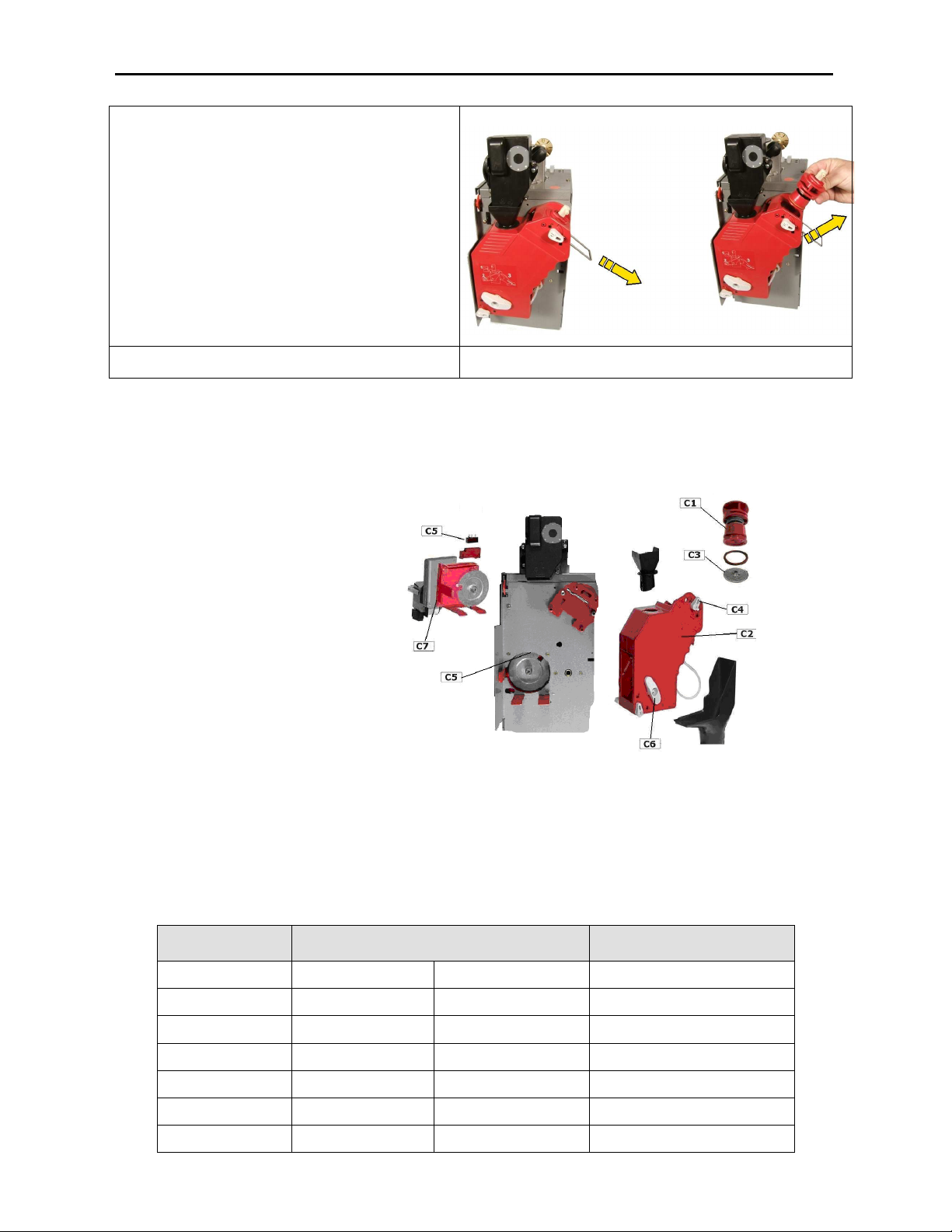
To remove the espress group from its
anchor position, both white levers must be
turned as indicated in the photograph.
If the group was in the brewing position,
to remove it, it is necessary to remove the
piston first, as indicated a side.
Pull out the clip Remove the piston
To put the group back on the machine, it can be in any position and does not matter that it has
been turned out of the machine. Just put it in its place and fix its two
anchor levers; the engine of the group will position it correctly.
C1. Piston
C2. Group
C3. Filter
C4. Holding handle
C5. Position microswitch
C6. group movement handle
C7. Group motor
The piston has a spring and tow spacers that, depending on how it is placed, will
vary the capacity of ground coffee the chamber will hold.
The possible regulation of the capacity of the infusion element, using the washer,
and the position of the dosage handle are shown in the table below:
Dose Piston washer position Dosage position
5 g nder nder 1
5.5 g
nder nder 2
6 g nder Over 3
6.5 g
nder Over 4
7 g nder Over 5
7.5 g
Over Over 6
8 g Over Over 7
Andere Handbücher für Rio
1
Inhaltsverzeichnis
Andere One-Touch Drinks Kaffeemaschine Handbücher


