5 / 13
1. Hints on operational safety
1.1 Daily operation
The appliance must only be operated
- by trained staff,
- under supervision,
- for the purpose specified in the operating instructions.
- Outdoors the appliance may only be operated under a cover and with adequate wind
protection! Keep the appliance dry!
- Do not use the appliance for storage purposes!
- Do not use cookware that covers the whole surface!
- Only use cookware suitable for gas cookers.
- The appliance must not be used for deep-frying!
- If a malfunction cannot be rectified by following the instructions in the troubleshooting section
(section 5), close the gas control knob (position ), close the gas tap, and notify customer
service.
1.2 Risk of injury
Risk of burns!
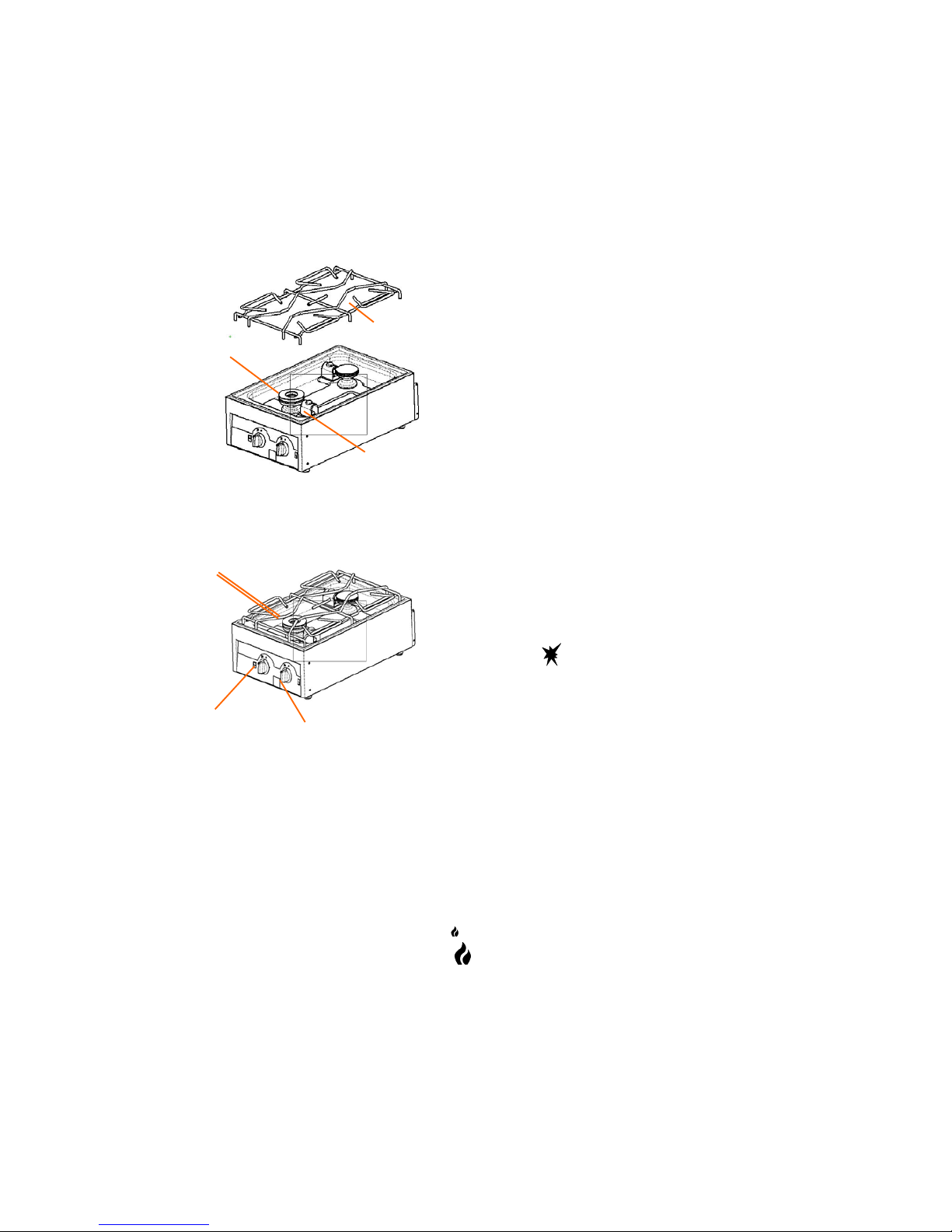
The upper part of housing and the sliding grate become hot during operation!
Existing combustion air supply and exhaust gas installations must not be modified, e.g.:
- Reducing the installation space;
- Subsequent sealing of windows and doors;
- Closing or removing the combustion air supply openings.
1.3 Fire hazard
Do no place inflammable objects on the appliance!
Fire extinguishers approved for cooking oil and fat fires must be made available.
1.4 Risk of damage
Do no allow liquids to enter the burner or pilot burner!
Risk of blocking the nozzles!
Do not place any empty saucepans or frying pans on the hob when the appliance is switched on
in order to prevent damaging your cookware or the glass ceramic hob.
Do not place hot cookware on stainless steel tabletops or work surfaces in order to prevent
permanent deformation.
Do not hose down or clean the appliance with a water hose, high-pressure cleaner, steam high-
pressure cleaner or steam cleaner!
After prolonged periods of non-use the functionality of the appliance should be checked as part of
a service!
1.5 Connection, changeover, maintenance
The appliance must be connected by an approved gas installer!
In commercial kitchens work on gas equipment such as:
- Changeover to other gas type
- Inspection, maintenance
- Repairs
- Commissioning
may only be carried out by:
- the gas supply company;
- a competent representative of the manufacturer;
- an installation contractor; or
a distribution agency authorised by a liquid gas supplier.