
SmartTrunk Systems SmarTrunk II Installationsanleitung

SmarTrunk II
System Overview
Revision 9
March 2004
Benelec Pty Ltd
Unit 2 / 581-587 Gardeners Rd
Mascot NSW 2020

System Overview
2
About SmarTrunk Systems, Inc.
SmarTrunk Systems, Inc., was founded in 1979 as Selectone Corporation, a
privately held California corporation, and quickly became a leading manufac-
turer of tone signaling and voice encryption equipment for the mobile com-
munications industry.
In 1992, the company introduced the original SmarTrunk system as a low-
cost trunking protocol for radiotelephone systems in developing countries. In
1994, a second- generation system was introduced,
SmarTrunk II, with more features and a faster, more secure digital signaling
protocol. Since then, SmarTrunk II has become an industry standard radio
trunking protocol in more than 98 countries.
Recognizing the growing importance of the SmarTrunk II product line, the
company’s corporate name was changed to SmarTrunk Systems, Inc., in
early 1996. In June 2000, the company’s original Selectone product line was
sold to Communications Specialists, Inc.
In July, 2001, after nearly 30 years in the land mobile business, SmarTrunk’s
founder and CEO retired and sold the company to Ranger Communications,
Inc. SmarTrunk Systems, Inc., is now a wholly owned subsidiary of Ranger
Communications, Inc. of National City (San Diego), California. Ranger’s 30+
years of experience in the manufacturing business, furthers SmarTrunk’s
position as the leading supplier of radio trunking systems. Since 2001, the
ST-510 SmarTrunk II Switch and the SmarTrunk II feature set has been
greatly expanded.

3
SmarTrunk Systems, Inc.
Table of Contents C
Section 1 • Things You Always Wanted to Know About Trunking…5
Introduction ....................................................................................................................... 5
What is Trunking? ............................................................................................................. 5
Trunking in Land Mobile Radio (LMR) Systems ................................................................. 5
The Trunking Advantage ................................................................................................... 6
Rules Regarding VHF and UHF Trunking in the United States ........................................... 7
Centralized vs. Decentralized Trunking Systems ............................................................... 8
Section 2 • System Highlights ................................................... 9
Wireless Solutions Supported by SmarTrunk II .................................................................. 9
System Requirements .................................................................................................... 10
Section 3 • Types of Calls and Methods of Operation .................11
Using SmarTrunk II For Radio Dispatch Applications ................................... 11
Mobile to Group Call ....................................................................................................... 11
Mobile to Mobile Private Call .......................................................................................... 12
Mobile Operator Call ...................................................................................................... 12
Using SmarTrunk II for Telephone Interconnect Applications ....................... 13
Mobile to Telephone (Landline) Call ................................................................................ 13
Telephone (Landline) to Mobile Call ................................................................................ 14
Emergency Telephone Number Call ................................................................................ 14
Section 4 • SmarTrunk II Controller ..........................................15
Expanded Capacity ........................................................................................................ 16
Databus Communication between Controllers ................................................................16
Greater Ease of Programming .......................................................................................17
Enhanced Telephone Interconnect Features .................................................................... 17
Options and Accessories ............................................................................................... 18

4
SystemOverview
Section 5 • SmarTrunk II Logic Boards with Omni™ Features .....19
Channel Banks ...............................................................................................................19
Multiple PTT Groups ....................................................................................................... 20
Multiple Receive Groups ................................................................................................. 21
SmartScan™ .................................................................................................................21
Dialed Number Display .................................................................................................. 21
Positive Radio Kill .......................................................................................................... 21
Turbo SpeeDial™ ........................................................................................................... 22
Memory Speed Dial........................................................................................................ 22
Caler ID .......................................................................................................................... 22
Speech Scrambler .......................................................................................................... 22
Section 6 • Beyond the simple “Controller only” System ............23
Introduction ..................................................................................................................... 23
Key system features ....................................................................................................... 23
ST-510 Components ...................................................................................................... 24
System Operation .......................................................................................................... 25
System requirements...................................................................................................... 26
Features and services provided ..................................................................................... 26
SmarTrunk II upgrades ....................................................................................................33
Network Interconenction..................................................................................................36
Linking to remote areas ..................................................................................................37
Optional Features ........................................................................................................... 38
Section 7 • Frequently Asked Questions ....................................39
Appendices .............................................................................43
Appendix A - The SmarTrunk II Logic Board Compatibility Chart ................. 44
Appendix B - SmarTrunk System Application Notes (SANS) ........................ 50
Appendix C - SmarTrunk vs. LTR ..................................................................52
Appendix D - SmarTrunk Network Diagram ................................................... 57

5
SmarTrunk Systems, Inc.
1
SECTION
Things You Always Wanted to Know
About Trunking…
Introduction
This section is directed to the system owner who is considering
converting conventional 450 MHz repeaters to trunked operation.
Perhaps you are an operator of shared community repeaters who would
like to achieve higher customer loading (and greater profits) from your
existing system. Or perhaps you operate a private “campus” system of
two or more VHF or UHF conventional channels used for plant security
or maintenance. Either way, converting your conventional channels to
trunked operation will significantly increase your system capacity while
providing privacy, system security, and advanced features such as
selective and emergency calling.
What is Trunking?
The term “trunking” originated decades ago in the telephone industry to
describe the process of selecting one clear communications path from
many possibilities. It is based on the premise that if 100 users are
sharing a certain communications network, only 10 users will actually
use the network at any one time. Therefore, it is not necessary to install
100 trunk lines to serve 100 telephone customers; only 10 lines will be
sufficient to provide a high level of service.
Trunking in Land Mobile Radio (LMR) Systems
Trunked LMR systems were introduced in the early 1980’s on the same
premise. By “trunking” together groups of frequencies (channels), a
communications network could serve a large number of users with a
very high level of service.
The efficiencies and features of trunked radio are well known to
experienced 800 MHz system operators.
“The Trunking Advantage”
¨Efficiency
¨Privacy
¨Selective Calling

System Overview
6
Figure 1 - Which kind of line would you prefer to stand in?
A. B.
Queues Clerks Single Queue Clerks
The primary advantages of any trunked radio system can be
summarized as follows:
¨Automatic selection of a clear channel: In a conventional radio
system, the user may only have access to a single channel. By FCC
regulation, if the user wishes to make a call, he must first monitor the
channel to make sure it’s clear. If the channel is busy, the user must
continue to monitor the channel until the co-channel user has
terminated the conversation. By contrast, in a trunked system the
channel selection is automatic. When the user initiates a call, the
trunking system electronically “monitors” each channel and selects one
clear (unused) channel from many possible channels.
¨Channel Privacy: In a conventional system, other co-channel users
can easily eavesdrop on conversations. In fact, channel monitoring is
required by the FCC when initiating a call, as described above. In a
trunked system, other system users cannot listen in on other
conversations. A radio can only join a conversation when directed by
the trunking controller.
¨Channel Exclusivity: In a conventional system, discourteous co-
channel users can “jump” on a channel in the middle of another
conversation, thereby interrupting the call in progress. In a trunked
system, once a channel is selected, it becomes exclusive for the
duration of the transmission. Other users cannot interrupt or interfere
with the call.
¨Selective Calling: In most conventional radio systems, selective
calling is an expensive add-on option or may not be available at all. On
the other hand, some trunked radio systems provide extensive
selective calling capabilities as a standard feature. This means that
users can selectively call different groups or individuals in the system.
Each user is typically assigned a unique individual ID code and one or
more group ID codes. These codes can be dialed by other users in the
system to select only the specific groups or individuals with whom they
wish to communicate.
The Trunking Advantage
The advantages of trunking can be illustrated by a very simple
example. Most of us are familiar with problem of standing in line for a
bank teller or at a ticket window, as illustrated in Figure 1 below.
Queuing analysis shows that more people (customers) can be handled
with the same level of service when all servers (channels) are available
to all customers.

7
SmarTrunk Systems, Inc.
Rules Regarding VHF and UHF Trunking in the United States
The FCC has authorized the use of “centralized” trunked systems for
VHF and UHF frequency bands
where at least one frequency must have
a Protected Service Area (PSA). This frequency is identified with a station
class designation of FB8 for the Repeater. While FB8 codes are used only
with trunked (YG or YW) systems, an FB8 frequency may not be used for
conventional systems.
Centralized trunking refers to trunking systems that use dedicated
(exclusive) control channels for data communication between the
mobiles and the trunked repeaters. In such systems, the mobiles
constantly monitor the control channel for channel assignment
instructions. When a group call is initiated, the trunking controller
transmits instructions telling the mobiles in the group to switch to a
voice channel assigned for that conversation. Thus, the “brains” of the
system are in the system controller at the repeater site.
Most trunking systems such as MPT-1327, Motorola’s Smartnet, E. F.
Johnson’s LTR. Trident’s Passport, etc are centralized systems. As they
are designed to use clear frequencies, these trunking formats are not
as well suited as SmarTrunk or as easy to license at VHF and UHF
frequencies because of the lack of exclusive channels in those bands.
To get around this problem, the FCC requires potential centralized
system operators. . . “to obtain some form of exclusivity in their
respective service areas”. This requires the operator to obtain written
permission from all other licensees within a 70 mile radius of the
proposed base station, similar to the FCC rules for telephone
interconnect in major metropolitan areas. However, due to the
frequency congestion in these bands, this requirement is extremely
difficult to meet. All other users on the proposed trunked channels and
immediately adjacent channels would have to agree to convert to trunked
operation. Since, by definition, centralized trunked systems require
exclusive channels, the other affected users would have to agree to a
simultaneous conversion of their radio systems, which would require
scrapping their conventional equipment and purchasing all new mobile
radios.
1 • Things you always wanted to know about trunking…

CentrCentr
CentrCentr
Centralizaliz
alizaliz
alized vsed vs
ed vsed vs
ed vs. Decentr. Decentr
. Decentr. Decentr
. Decentralizaliz
alizaliz
alized Ted T
ed Ted T
ed Trr
rr
runkunk
unkunk
unking Sying Sy
ing Sying Sy
ing Systemsstems
stemsstems
stems
Unlike centralized trunking systems, decentralized (scan based)
systems such as SmarTrunk II do not require exclusive channels.
Because the channel selection intelligence is in the mobiles,
decentralized systems can co-exist with conventional users on the
same channels. When a call is initiated by a mobile unit, the channel
assignment is determined by the logic in the mobile, not by a controller
at the repeater site. So if the channel is busy with a conventional user
(or even a co-channel user on another system), the mobile will consider
the channel as busy and select another channel.
Per FCC rules, all
frequencies of a de-centralized trunked system would use the less restrictive
station class designation of either FB6 or FB2, which does not require a
Protected Service Area (PSA). FB6 is for private carrier systems such as
radio dealers that would place additional users on the system. FB2 is for
private in house systems such as a manufacturing facility that would use the
system for their own use.
The advantages of decentralized system can be summarized as
follows:
¨Since they do not require exclusive channels, the onerous FCC
frequency coordination requirements described above do not apply.
¨Decentralized trunking systems have always been “legal” for use below
800 MHz because they fully comply with the FCC requirements to
monitor the channel before transmitting and do not utilize dedicated data
channels for system control.
¨Decentrallzed trunking is the only trunking protocol which will operate
on non-exclusive channels. This not only allows the system to operate
in the presence of conventional users on the same channel, but it also
allows a system operator to gradually convert conventional users to
trunked operation.
¨They are more economical due to the lower cost of both the trunking
controllers and the mobile radio equipment.
¨They require less technical training to install and maintain.
SmarTrunk Systems, Inc.
8

9
SmarTrunk Systems, Inc.
SmarTrunk II is a decentralized two way radio trunking system that is widely used both for
telephone interconnect and business dispatch applications at frequencies below 800 MHz.
First introduced in 1994, SmarTrunk II combines a proprietary digital signalling format
with existing two way radio technology—creating a communications system that is low cost, yet
provides many of the features of higher cost trunked radio systems.
Today SmarTrunk II provides local area wireless solutions to over 500,000 subscribers in
over 98 countries throughout the world. Due to its growing popularity, SmarTrunk II is sold in
partnership with international radio manufacturers such as ICOM, Kenwood, Motorola and Vertex.
Wireless Solutions Supported by SmarTrunk II
Virtually any organization which seeks to provide local area communi-
cations can benefit from SmarTrunk II
:
X
Community repeater operators can upgrade to group dispatch and
selective mobile to mobile calling to existing customers or expanding
markets.
X
Rural telephone operators can provide telephone service to individual
subscribers in remote areas without investing in the enormous cost of a
wireline or cellular infrastructure.
X
Radio dealers can offer a combination of telephone and radio dispatch
services, depending on the needs of individual customers.
X
Large industrial companies can use SmarTrunk II as a wireless PABX,
connecting all employees, in addition to supporting group calling
capabilities.
APPLICATIONS
•Small police and fire departments •Government agencies
•Public telephone systems •Mining operations
•Large industrial manufacturing facilities •Oil & gas pipeline operations
•Colleges or university campuses •Petro chemical operations/oil refineries
•Airports •Forestry and fishing fleets
•Casinos and Hotels •Hospitals
SECTION
2
System Highlights
System Requirements
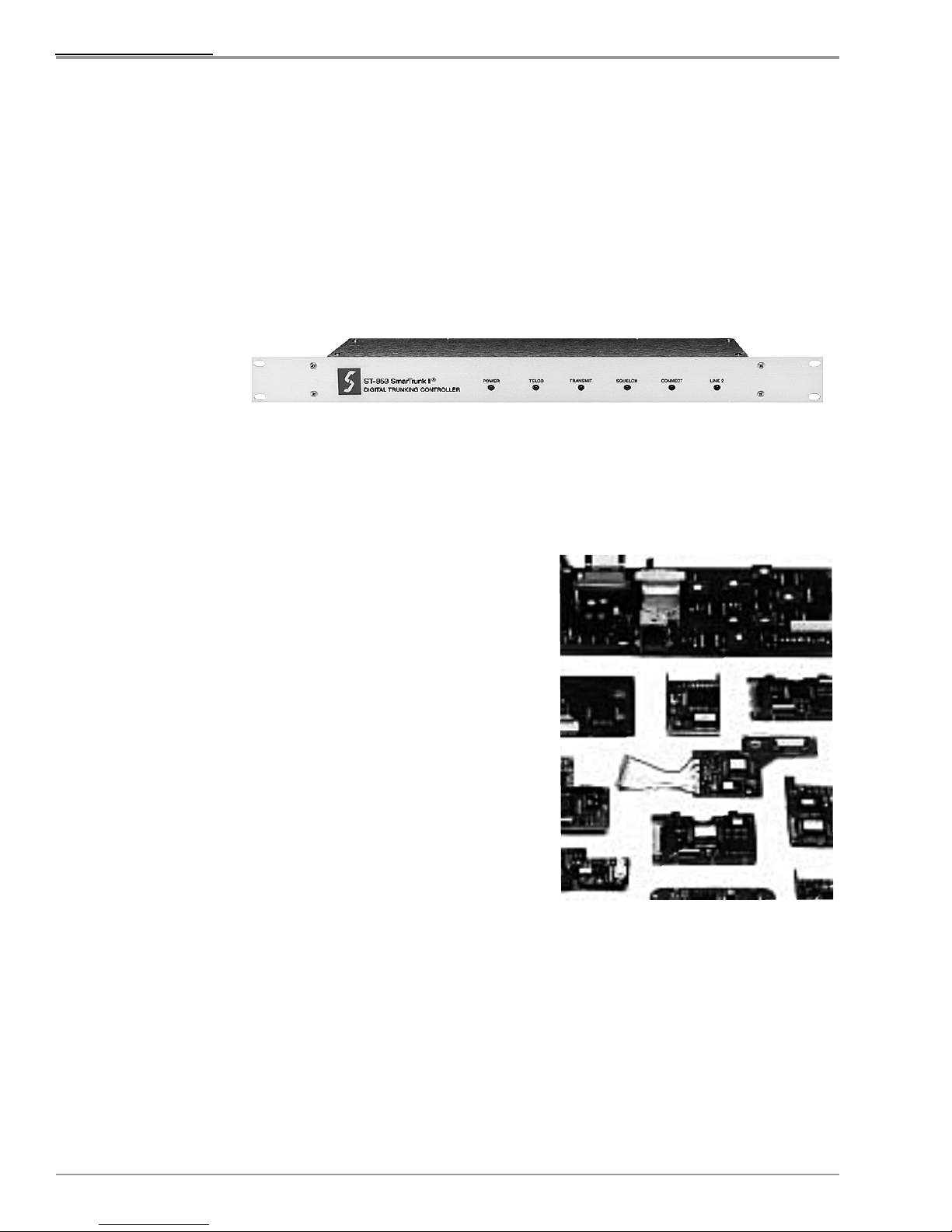
A SmarTrunk II radio trunking system employs low cost radio
communications equipment and SmarTrunk II technology, which is
installed at both the base station and the subscriber radios.
The base station equipment required for each channel consists of a
SmarTrunk II controller connected to a standard VHF or UHF radio
repeater. For telephone interconnect applications, the controller is
also connected directly to a standard telephone line via a RJ-11 jack.
Each channel can support one individual conversation. Therefore, a
three channel system can support
three simultaneous private
conversations.
Since SmarTrunk II is an “overlay”
system, each of the subscriber
radios must have a customized
logic board to control the radio’s
operations. SmarTrunk Systems,
Inc. manufacturers customized
logic boards for over many
different radios. Please see the
“SmarTrunk II Logic Board
Collection” (Appendix A) which
lists all the mobile and portable
radio models that are compatible
with SmarTrunk II.
10
System Overview
Inhaltsverzeichnis


