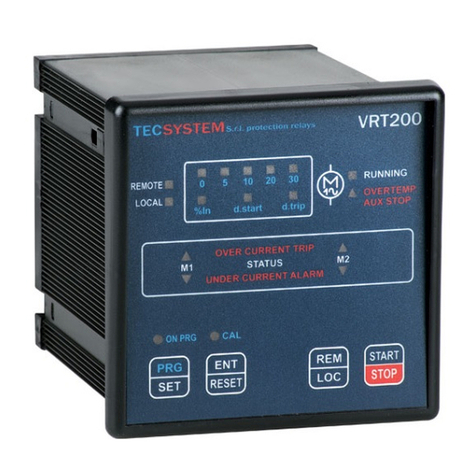
DISPLAY
The first display is dedicated to temperatures.
The second display to the monitored channel.
When the device is switched on or after a reset, the model of the control unit, the type of sensors, VER "00" (firmware
version) and the temperature range of the device and the identification abbreviation are always shown on the display.
Pressing the MODE key, the display modes can be set:
•SCAN: the control unit shows in scanning (every 2 seconds) all the enabled (°C) and disabled (NO) channels.
•AUTO: the control unit displays the hottest channel automatically.
•MAN: manual reading of the channel temperature using the up/down keys
•T.MAX: The display shows the maximum temperature of the channel selected with the cursor keys.
In the event of a fault, the Tmax value is replaced with the type of fault stored (fcc-foc-fcd).
Turning on the Trip Alarm-Fault LED warns of any events that have occurred.
The recordings are always successive to the moment in which the T.Max is reset (by pressing RESET).
OPERATING PROGRAM CONTROL
To control the protection levels programmed, press the PRG key twice to access the VIS programme. Repeatedly pressing
the PRG key, you can scroll through all the previously loaded values in sequence.
After 1 minute's keyboard inactivity, the programming display procedure is automatically abandoned.
To stop the display, press the ENT key.
SCAN AND MAN FUNCTION NOTES
During the SCAN and MAN modes, the operation of the NT935 can be displayed.
1) RUN cPU:
RUN cPU: This message appears upon ignition of the device.
2) Ech Err:
This message appears when damage in the EEPROM memory is detected.
Pressing Reset will cancel the message and restore the original default parameters, listed in the programming
paragraph on pages 13-14. Return the control unit to TECSYSTEM for repairs.
3) CAL Err:
This message appears when damage is found in the measurement circuit.
The temperature values displayed might be incorrect. Return the control unit to TECSYSTEM for repairs.
4) Pt Err :
This message appears when it is detected that one or more PT100 sensors are not working correctly, FOC, FCC
and FCD indications in the temperature sensor diagnostics paragraph on page 16.
5) BH Err:
This message appears when damage is found in the measurement circuit.
FLT RS1: communication failure with the B1 control box
FLT RS2: communication failure with the B2 control box
FLT B1: failure of at least one motor on the B1 bar
FLT B2: failure of at least one motor on the bar B2
FLT B1-B2: failure of at least one motor on the B1 bar and B2 bar
The above messages will be displayed following the 1-2-3-4-5 priority stated.
In case of Err the FAULT relay will be de-energised.
NOTE: in any display mode in the event of a fault, the control unit will automatically set itself in SCAN mode (PRIVILEGED
SCAN), thus allowing the immediate display of the fault condition on the relevant CH channel or on the fans (the Mode
button will be disabled).
LED TEST
We suggest carrying out the control unit LED test regularly.
For this operation, press the TEST key briefly; all the displays turn on for 2 seconds.
If one of the LEDS does not work, please return the control unit to TECSYSTEM for repair.
ALARM RELAY TEST
This function allows you to carry out a test of the relay operation without having to use further devices. To start the test
procedure, press and hold the TEST button for approximately 5 seconds: the TST indication appears for 2 seconds
confirming entry into the Relays Test mode.
The LED that is lit shows the relay to be tested; use the cursors to select the desired relay.
Press the SET and RESET keys to energise and de-energise the relay to be tested; the display will show ON-OFF.
After 1 minute's keyboard inactivity, the RELAY TEST procedure will be automatically abandoned.
To stop the RELAY TEST procedure, press the TEST key.
Alternatively it is possible to use the PT100 model simulator: SIM PT100.
ALARM RELAY SILENCING
To silence the ALARM signal, press the RESET key: the relay will de-energise and the ALARM LED, which is on steady, will
start to flash. Silencing is automatically disabled when the temperature goes below the ALARM threshold.