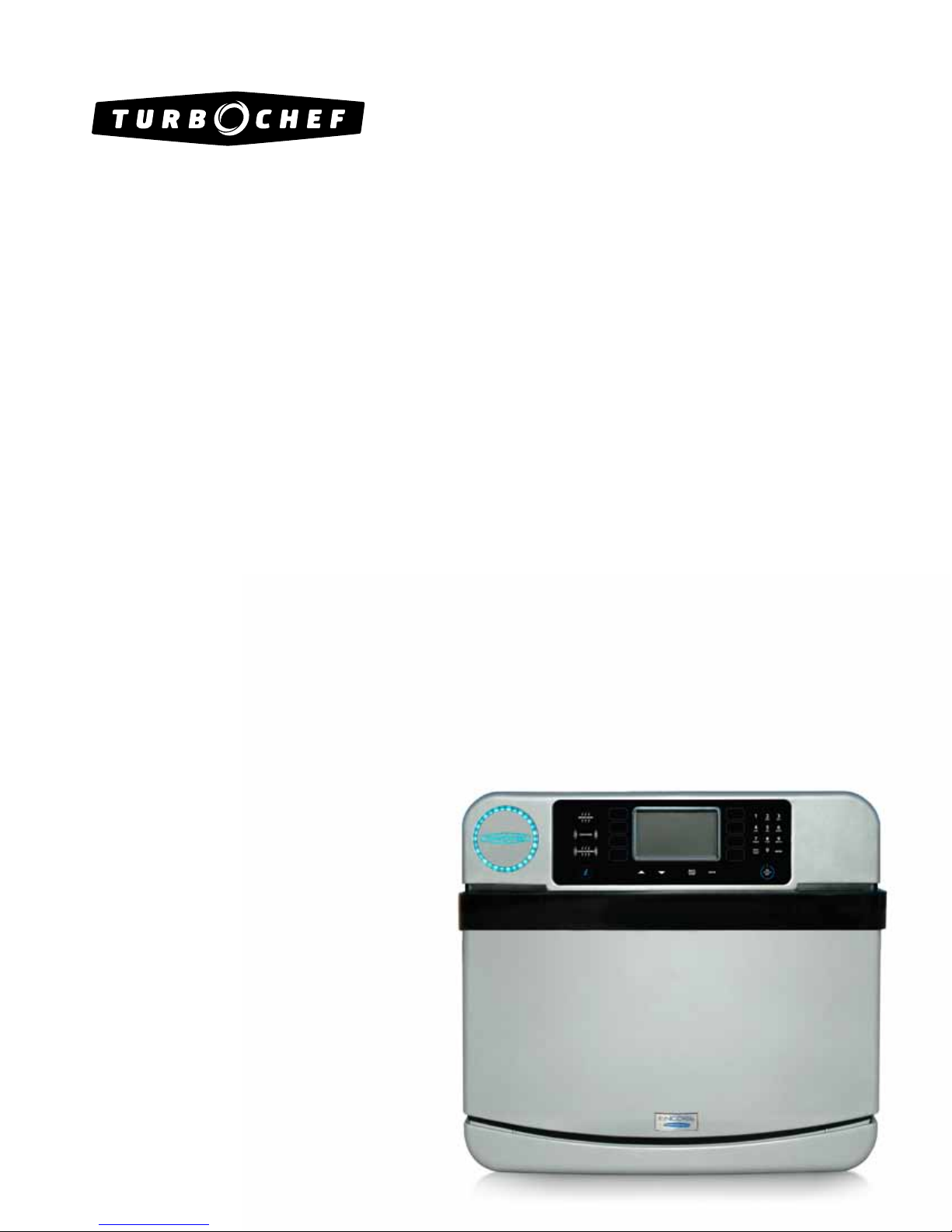
TurboChef ENCORE Bedienungsanleitung

TM
©2012 TurboChef Technologies, Inc.
Service Manual
TM

The information contained in this manual is important for the proper installation, use, maintenance,
and repair of this oven. Follow these procedures and instructions to help ensure satisfactory baking
results and years of trouble-free service.
Errors – descriptive, typographic, or pictorial – are subject to correction. Specifications are subject to
change without notice.
Please carefully read this manual and retain it for future reference.
For further information, call
800.90TURBO
or
+1 214.379.6000

Important Safety Instructions
General Safety Information i
Reducing Fire Risk i
Grounding Instructions ii
Power Cord Replacement ii
Precautions to be Observed Before and During Servicing to Avoid Possible Exposure to
Excessive Microwave Energy ii
RF Interference Considerations ii
Specifications and Installation
Theory of Operation 1
Dimensions 1
Certifications 2
Oven Construction 2
Electrical Specifications 2
Installation 2
Unpacking Instructions 2
Installation Warnings - Read Before Lifting Oven 2
Installing the Oven 3
Installation Near Open Heat Source 3
Oven Restraint Kit 4
ChefComm Pro® 4
ChefComm LimitedTM 4
Oven ConnectTM 4
Voltage Selection 4
Ventilation 4
Oven Maintenance
Daily Maintenance 5
Quarterly Maintenance 7
Oven Controls and Cooking
Oven Controls 9
Cooking 10
Info Mode
Last Temperature Selected 13
Serial Number 13
Menu Version 13
Firmware Version 13
Cook Counters/Time Logs 13
Voltage - View Incoming 13
Fault Log 13
Service Numbers 13
Test Mode 13
Continued on next page...
Table of Contents

Set Options 13
Cook More / 13
Edit Mode / 13
Load Menu / 14
Network Setup 14
Auto Off / 14
Auto On / 14
Demo Mode / 14
Light Ring / 14
Set Date and Time 14
Load Menu from USB or Smart Card 15
Save Menu to USB or Smart Card 15
Sound Volume 15
Electrical Temperature 15
Reset the Oven 15
Firmware Update 16
Edit Mode
Set Temperature Edit 17
Baking Stone Use YES/NO 17
Bottom Temperature Offset 17
Select Groups and Items to Edit 17
Recipe Edit 18
Test Mode
Status Indicators 19
Magnetron Test 19
Blower Motor Test 19
Top Heater Test 20
Bottom Heater Test 20
Electrical Compartment (Ctl) Fan Test 20
Diagnostic Mode 20
Manufacturing Mode 20
Microwave Leakage Test 21
Burn in 21
Serial Number Edit 21
Self Test 21
Volt On 22
Erase/Default Oven Settings 22
Changing Temperature Measurement: F or C 22
Oven Systems
Impingement System 23
Blower Motor 23
Blower Motor Speed Controller (BMSC) 23
Heater - Top 23
Heater - Bottom 23
High Limit Thermostat 23
Jetplate - Bottom 23
RTD - Top and Bottom 23
Solid State Relay - K4/K5 Heaters 23
Troubleshooting 23

Oven Door 24
Removing/Reinstalling the Oven Door 24
Adjusting the Oven Door 24
Interlock Switches 25
Relay - K3 Monitor 25
Adjusting the Primary, Secondary, and Monitor Switches 25
Measuring RF Leakage for Microwave Safety 26
Troubleshooting 26
Microwave System 27
Capacitors 27
Testing a Capacitor 27
Filament Transformers 27
Wiring the Filament Transformers 27
High-Voltage Transformers 28
Wiring the High-Voltage Transformers 28
Testing a Filament or High-Voltage Transformer 28
High-Voltage Diodes 28
Testing a High-Voltage Diode 29
Magnetrons 29
Magnetron Cooling Fans 29
Magnetron Thermostats 30
Testing a Magnetron for an Open/Shorted Filament 30
Relay - K1 Filament 30
Relay - K2 Anode 30
Relay - K7 Magnetron Cooling Fans 30
Waveguides 30
Troubleshooting 30
Control System 31
Control Board 31
Display 31
Ethernet Extension Cable 31
Keypad 31
LED Light Ring 31
Speaker 31
USB/Smart Card Reader 31
Troubleshooting 31
Power Components 32
Electrical Compartment Cooling Fan 32
Electrical Compartment Thermostat 32
Electrical Compartment Thermocouple 32
EMI Filter 32
Fuses 32
Power Supply 32
Relay - K6 Voltage 32
Relay - K8 EC Cooling Fan 32
Voltage Sensor 32
Wire Harnesses 32
Troubleshooting 32
Continued on next page...

Filtering System 33
Catalytic Converter 33
Air Filter 33
Vent Catalyst 33
Troubleshooting 33
Troubleshooting
Overview of Troubleshooting 35
Fault Code Descriptions 35
F1 Blower Running Status Bad 37
F2 Cook Temperature Low 38
F3 Magnetron Current Low 39
F4 Door Monitor Defective 40
F5 Magnetron Over Temperature 40
F6 Electrical Compartment Temperature High 41
F7 RTD Open 41
F8 Heat Low 42
F9 Cook Cavity Temperature High 42
No Keypad Input 43
“Cook Door Open” Message when Door is Closed 43
No Display (Screen is Blank) 44
Food Not Cooking Properly 45
Troubleshooting: “Failed 240,” “No Card,” or “Write Fail” Message when Loading or Saving a Menu 46
Steam Present During or After Cooking 46
Oven Schematic and Wire Harnesses
Relay Schematic 47
Oven Schematic 48
Wire Harness: HV Microwave Circuit 1 50
Wire Harness: HV Microwave Circuit 2 50
Wire Harness: Low Voltage 52
Wire Harness: Heater 52
Wire Harness: Cooling Fans 54
Wire Harness: Main Line Voltage 56-59
Appendix - Replacing Oven Components
Replacing Oven Components A-1
Oven Exterior A-2
Impingement System A-4
Microwave System A-6
Oven Door and Related Parts A-8
Control System A-10
Power Components A-12 – A-15

SAFETY INSTRUCTIONS
SAVE THESE INSTRUCTIONS
IMPORTANT SAFETY INSTRUCTIONS
WARNING: When operating this oven, strictly adhere to the following safety precautions to
reduce the risk of burns, electric shock, fire, injury, damage to oven or property near oven, or
possible exposure to excessive microwave energy.
GENERAL SAFETY INFORMATION
a Read all instructions before using this appliance.
a Read and follow the specific “Precautions to be Observed to Avoid Possible Exposure to Excessive
Microwave Energy” found on page ii.
a This appliance must be grounded. Connect only to a properly grounded outlet. See “Grounding
Instructions” on page ii.
a Install or locate this appliance only in accordance with the provided installation instructions.
a This appliance should be serviced by qualified service personnel only. Contact the nearest authorized
service facility for examination, repair, or adjustment.
a Keep the cord away from heated surfaces.
a Liquids, such as water, coffee, or tea are able to be overheated beyond the boiling point without
appearing to be boiling. Visible bubbling or boiling when the container is removed from the microwave
oven is not always present.
.
a : The contents of feeding bottles and baby food jars must be stirred or shaken and the
temperature checked before consumption, in order to avoid burns (IEC 60335-2-90).
a Use this appliance only for its intended uses as described in this manual.
a Only use utensils that are suitable for use in microwave ovens (IEC 60335-2-90).
X use corrosive chemicals or vapors in this appliance; it is not designed for industrial/laboratory use.
X : heat liquids or other foods in sealed containers (e.g., jars, whole eggs, etc.) since
they are liable to explode.
X allow children to use this appliance.
X operate this appliance if it has a damaged cord or plug, is not working properly, or has been
damaged or dropped. See “Power Cord Replacement” found on page ii.
X cover or block any openings on this appliance.
X store this appliance outdoors.
X use this product near water (e.g., near a kitchen sink, in a wet basement, near a swimming pool).
X immerse the cord or plug in water.
X let the cord hang over the edge of a table or counter.
X use a water jet for cleaning. See pages 5-7 in this manual for proper cleaning procedures.
X use this product without the bottom jetplate installed. The oven will not cook properly and
damage to the oven may occur.
X This appliance is not to be used by children or persons with reduced physical, sensory or mental
capabilities, or lack of experience and knowledge, unless they have been given supervision or instruction.
REDUCING FIRE RISK
a Remove wire twist-ties from paper or plastic bags used to facilitate cooking in the oven.
a If materials inside the oven ignite, keep the oven door closed, turn the oven off, and disconnect the
power cord or shut off power at the fuse or circuit breaker panel.
a If smoke is observed, switch off or unplug the oven. Keep the door closed to stifle any flames.
X use the cook cavity for storage purposes.
X overcook food. Carefully attend to the oven if paper, plastic, or other combustible materials are
placed inside the oven to facilitate cooking.
X leave paper products, cooking utensils, or food in the cavity when the oven is not in use.
i

ii SAFETY INSTRUCTIONS
GROUNDING INSTRUCTIONS
This appliance must be grounded. In the event of an electrical short circuit, grounding reduces the risk of
electric shock by providing an escape wire for the electric current. This oven is equipped with a cord that has
a grounding wire with a grounding plug, which must be plugged into an outlet that is properly installed and
grounded. Consult a qualified electrician or serviceman if uncertain about the ability to follow grounding
instructions or if in doubt as to whether the appliance is properly grounded.
X use an extension cord. If the power cord is too short, have a qualified electrician or
serviceman install an outlet near the appliance.
WARNING:Improper grounding can result in risk of electric shock.
POWER CORD REPLACEMENT
If the power cord is damaged, it must be replaced by the manufacturer, its service agent, or a similarly
qualified person.
PRECAUTIONS TO BE OBSERVED BEFORE
AND DURING SERVICING TO AVOID POSSIBLE
EXPOSURE TO EXCESSIVE MICROWAVE ENERGY
(a) Do not operate or allow the oven to be operated with the door open.
(b) Make the following safety checks on all ovens to be serviced before activating the magnetron or other
microwave source, and make repairs as necessary: (1) interlock operation, (2) proper door closing,
(3) seal and sealing surfaces (arcing, wear, and other damage), (4) damage to or loosening of hinges and
latches, (5) evidence of dropping or abuse.
(c) Before turning on microwave power for any service test or inspection within the microwave
generating compartments, check the magnetron, wave guide or transmission line, and cavity for
proper alignment, integrity, and connections.
(d) Any defective or misadjusted components in the interlock, monitor, door seal, and microwave
generation and transmission systems shall be repaired, replaced, or adjusted by procedures described
in this manual before the oven is released to the owner.
(e) A microwave leakage check to verify compliance with the Federal Performance Standard should be
performed on each oven prior to release to the owner. Refer to page 26 for leakage test procedures.
RF INTERFERENCE CONSIDERATIONS
The Encore oven generates radio frequency signals. This device has been tested and was determined to be
in compliance with applicable portions of FCC part 18 requirements and to the protection requirements
of Council Directive 89/336/EEC on the approximation of the laws of the Member States relating to elec-
tromagnetic compatibility at the time of manufacture. However, some equipment with sensitivity to signals
below these limits may experience interference.
If your equipment experiences interference:
a Increase the physical separation between this oven and the sensitive equipment.
a If the sensitive device can be grounded, do so following accepted grounding practices.
a If battery-powered microphones are being affected, ensure that the batteries are fully charged.
a Keep sensitive equipment on separate electrical circuits if possible.
a Route intercom wires, microphone wires, speaker cables, etc. away from the oven.
SAVE THESE INSTRUCTIONS

Specifications and
Installation

Andere Handbücher für ENCORE
5
Inhaltsverzeichnis