YARDMAX 154FS-1 Bedienungsanleitung

Gasoline Engine
Owner’s Manual
154F(D)S-1/156F(D)S-1

Keep this owner's manual handy, so you can refer to it at any time.
This owner's manual is considered a permanent part of the engine and should
remain with the engine if resold.
The information and specifications included in this publication were in effect at the
time of approval for printing.
Only the D Type is equipped for both electric and manual starting.
READ THIS OWNER’S MANUAL CAREFULLY. Pay special attention to these
symbols and any instructions that follow:
Indicates serious injury or death will result if instructions are not
followed.
Indicates a strong possibility that serious injury or death could
result if instructions are not followed.
Indicates a possibility that minor injury or an result if instructions
are not followed.
Indicates that equipment or property damage can result if
instructions are not followed.
NOTE: Gives helpful information.
If a problem should arise, or if you have any questions about your engine, consult
your engine dealer.

CONTENTS
- 1 -
CONTENTS
1.ENGINE SAFETY.......................................................................................................2
2.COMPONENTS & CONTROL LOCATIONS……………………………………........…3
3.CONTROLS................................................................................................................4
4.CHECK BEFORE OPERATION .................................................................................6
5.OPERATION.................................................................................................................8
6.MAINTENANCE………………………………………………………... ..........................11
7.STORAGE/ TRANSPORTING………….………………………………………………….17
8.TECHNICAL & CONSUMER INFORMATION …..……………………….…….…….…19
9.ENGINE PARAMETER…………………………………………………………….………..22
10. WIRING DIAGRAMS………………………………………………………………………..23

ENGINE SAFETY
- 2 -
1. ENGINE SAFETY
IMPORTANT SAFETY INFORMATION
Most accidents with engines can be prevented if you follow all instructions in this
manual and on the engine. Some of the most common hazards are discussed below,
along with the best way to protect yourself and others.
Owner Responsibilities
⚫The engines are designed to give safe and dependable service if operated according
to instructions. Read and understand this owner’s manual before operating the engine.
Failure to do so could result in personal injury or equipment damage.
⚫Know how to stop the engine quickly, and understand the operation of all controls.
Never permit anyone to operate the engine without proper instructions.
⚫Do not allow children to operate the engine. Keep children and pets far away from the
area of operation.
Refuel With Care
Gasoline is extremely flammable, and gasoline vapor can explode. Refuel outdoors, in
a well-ventilated area, with the engine stopped. Never smoke near gasoline, and keep
other flames and sparks away. Always store gasoline in an approved container. If any fuel
is spilled, make sure the area is dry before starting the engine.
Hot Exhaust
⚫The muffler becomes very hot during operation and remains hot for a while after
stopping the engine. Be careful not to touch the muffler while it is hot. Let the engine
cool before storing it indoors.
⚫To prevent fire hazards and to provide adequate ventilation for stationary equipment
applications, keep the engine at least 3 feet (1 meter) away from building walls and
other equipment during operation. Do not place flammable objects close to the engine.
Carbon Monoxide Hazard
Exhaust gas contains poisonous carbon monoxide. Avoid inhalation of exhaust gas.
Never run the engine in a closed garage or confined area.
Other Equipment
Review the instructions provided with the equipment powered by this engine for any
additional safety precautions that should be observed in conjunction with engine startup,
shutdown, operation, or protective apparel that may be needed to operate the equipment.

COMPONENTS & CONTROL LOCATIONS
- 3 -
Priming pump
2. COMPONENTS&CONTROLLOCATIONS
OIL DRAIN PLUG
MUFFLER
FUEL TANK
RECOIL STARTER
CHOKE LEVER
AIR box
SPARK PLUG
OIL DIPSTICK
CYLINDER
HEAD COVER
IGNITION SWITCH
STARTER GRIP
STARTER MOTOR
FUEL FILLER CAP

CONTROLS
- 4 -
3. CONTROLS
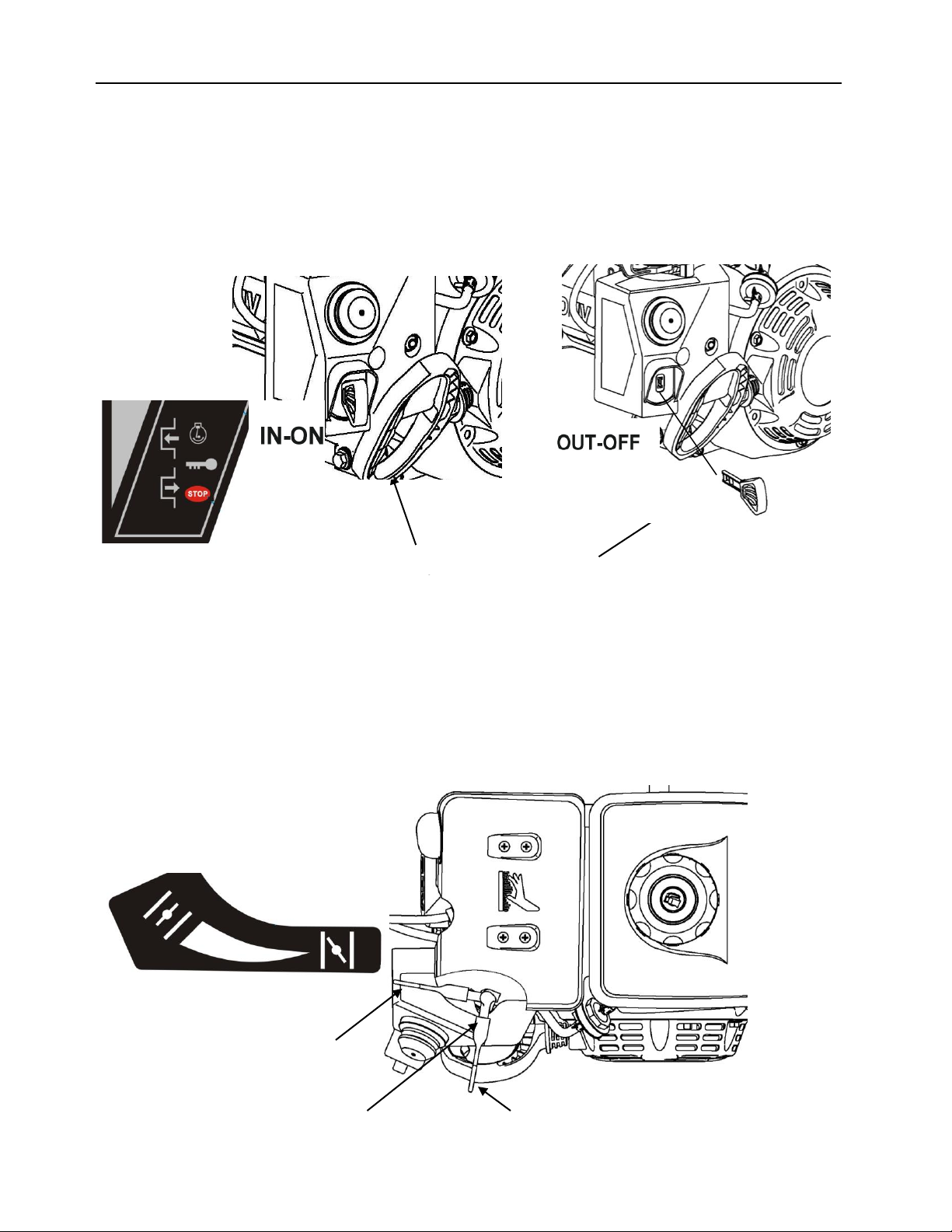
1) Engine Switch
The engine switch enables and disables the ignition system.
The engine switch key must put in for the engine to run.
Putting out the engine switch key stops the engine.
2) Choke Lever
The choke lever opens and closes the choke valve in the carburetor.
The CLOSE position enriches the fuel mixture for starting a cold engine.
The OPEN position provides the correct fuel mixture for operation after starting, and for
restarting a warm engine.
Some engine applications use a remotely-mounted choke control rather than the
engine-mounted choke lever shown here.
Choke lever
The engine switch
key
Open
Close
Open
Close

CONTROLS
- 5 -
3) Recoil Starter Grip And Starter Motor
Pulling the starter grip or using the starter motor operates the recoil starter to crank the
engine.
Don’t let the lever suddenly rebound, lightly put the lever back.
4)Priming pump
The Priming Pump supply more fuel to the carburetor when starting the engine in the low
temperature.
When you put the Priming Pump ,you should not put more than three times.
Engines applied in snow blowers, are suggested using between -30°C to
4.4°C. If it operates below or above this temperature scope, engines
couldn't start or work normally.
CAUTION
Starter grip
OR
starter switch

CHECK BEFORE OPERATION
- 6 -
4. CHECK BEFORE OPERATION
IS YOUR ENGINE READY TO GO?
For your safety, and to maximize the service life of your equipment, it is very important to
take a few moments before you operate the engine to check its condition. Be sure to take
care of any problem you find, or have your servicing dealer correct it, before you operate
the engine.
Improperly maintaining this engine,
or failing to correct a problem
before operation, could cause a
malfunction in which you could be
seriously injured.
Always perform a preoperation
inspection before each operation,
and correct any problem.
Before beginning your preoperation checks, be sure the engine is level and the engine
switch is out off the key hole.
1) Check the General Condition of the Engine
⚫Look around and underneath the engine for signs of oil or gasoline leaks.
⚫Remove any excessive dirt or debris, especially around the muffler and recoil starter.
⚫Look for signs of damage.
⚫Check that all shields and covers are in place, and all nuts, bolts, and screws are
tightened.
2) Check oil
When stopping the engine at horizontal place, check the oil
1) Take the oil dipstick and clean
2) Insert the oil dipstick in and check the oil lever without screwing down.
3) If the oil is too low, add the recommenced oil in the high safe limits position.
4) After finishing, reassemble and screw the oil dipstick down.
CAUTION

CHECK BEFORE OPERATION
- 7 -
Running the engine with a low oil level can cause engine
damage,so always check the engine oil level before startup.
3) Check fuel
First stop the engine, open the fuel cover, and check oil level., if the oil level is too low, add
the fuel to full, after finishing, screw the fuel cover down.
Refuel in a well-ventilated area before starting the engine. If the engine has been running,
allow it to cool. Refuel carefully to avoid spilling fuel. Don’t add the fuel over the shoulder
of the carburetor when fueling (maximum oil level).
Never refuel the engine inside a building where gasoline fumes may reach flames or
sparks. Keep gasoline away from appliance pilot lights, barbecues, electric appliances,
power tools, etc.
Spilled fuel is not only a fire hazard, it causes environmental damage. Wipe up spills
immediately.
Fuel tank volume:1.4 L
Recommended octane rating over 90 unleaded gasoline for unleaded gasoline, can make
carbon deposit muck less and enhance exhaust system service life
Don’t use used and contaminated or gasoline with oil , Avoid the dirt and water entering
into fuel tank.
4)Check the Equipment Powered by This Engine
Review the instructions provided with the equipment powered by this engine for any
precautions and procedures that should be followed before engine startup.
Lower limit
Maximum
fuel oil level
Upper limit
Oil
dipstick

OPERATION
- 8 -
5. OPERATION
SAFE OPERATING PRECAUTIONS
Before operating the engine for the first time, please review the IMPORTANT SAFETY
INFORMATION and the chapter titled BEFORE OPERATION.
Carbon monoxide gas is toxic.
Breathing it can cause
unconsciousness and even kill you.
Avoid any areas or actions that
expose you to carbon monoxide.
Review the instructions provided with the equipment powered by this engine for any safety
precautions that should be observed in conjunction with engine startup, shutdown, or
operation.
STARTING THE ENGINE
1) Put the engine switch in the key hole.
The engine switch
key
Andere Handbücher für 154FS-1
2
Dieses Handbuch passt für folgende Modelle
3
Inhaltsverzeichnis
Andere YARDMAX Motor Handbücher

YARDMAX
YARDMAX R210-S Bedienungsanleitung

YARDMAX
YARDMAX 154FS-1 Bedienungsanleitung

YARDMAX
YARDMAX H200 Bedienungsanleitung

YARDMAX
YARDMAX LC152F-1 Bedienungsanleitung

YARDMAX
YARDMAX LC1P65FE-2 Bedienungsanleitung

YARDMAX
YARDMAX YT5565 Bedienungsanleitung

YARDMAX
YARDMAX RV170-S PRO Bedienungsanleitung

YARDMAX
YARDMAX 154FS-1 Bedienungsanleitung

YARDMAX
YARDMAX G200FA Bedienungsanleitung

YARDMAX
YARDMAX RV 170-S Bedienungsanleitung