Air TEc CYPRES Bedienungsanleitung

Cypres
User’s Guide

MILITARY CYPRES USER'S GUIDE
Airtec GmbH Page 1
C ngratulati ns n y ur ch ice f CYPRES, the safest and m st accurate AAD
currently available. CYPRES is the nly c mpletely electr nic aut matic pener n
the market, as well as the smallest and the lightest.
Like m st parachutists, y u pr bably assume y u will always have time t depl y
y ur reserve can py y urself, and that situati ns requiring use f an aut matic
pener always happen t thers. We d h pe that y u will never have such tr uble,
and that y ur CYPRES will never have t take acti n t save y ur life.
Sh uld CYPRES ever have t pen y ur reserve, it will m st pr bably happen at a
m ment which justifies, n matter h w experienced and cauti us y u are, that y u
haven't left y ur safety t chance.
Airtec GmbH, Safety Systems
Ce manuel est disp nible en français.

MILITARY CYPRES USER'S GUIDE
Page 2 Airtec GmbH
Contents
1. Functi n ........................................................................................................ 4
1.1 Design phil s phy ........................................................................................ 4
1.2 C mp nents ................................................................................................. 5
1.3 H w CYPRES w rks ................................................................................... 6
1.4 Energy supply .............................................................................................. 8
1.5 Operati nal safety ....................................................................................... 9
2. Pr duct Overview ...................................................................................... 10
2.1 Military CYPRES versi ns ........................................................................... 11
3. Installati n .................................................................................................. 12
3.1 Pr cessing unit .......................................................................................... 13
3.2 Release unit ............................................................................................... 14
3.3 C ntr l unit ................................................................................................. 15
4. H w t Operate CYPRES .......................................................................... 18
4.1 Handling the c ntr l unit ............................................................................ 18
4.2 Switching CYPRES n ............................................................................... 19
4.3 When t switch n r re-set ..................................................................... 21
4.4 Changing altitude reference ...................................................................... 22
4.4.1 Changing altitude reference (relative adjustment meth d) ....................... 22
4.4.1.1 Example f altitude adjustment in aircraft .....................................................
(Military CYPRES with relative adjustment meth d) .................................. 24
4.4.1.2 Altitude adjustment using the calculat r .......................................................
(relative adjustment meth d) ..................................................................... 25
4.4.2 Changing altitude reference (abs lute adjustment meth d) ..................... 27
4.4.2.1 Example f altitude adjustment in aircraft .....................................................
(Military CYPRES with abs lute adjustment meth d) ................................ 29
4.4.2.2 Altitude adjustment using the calculat r .......................................................
(abs lute adjustment meth d) ................................................................... 30
4.5 CYPRES and water jumps ......................................................................... 32
4.5.1 The CYPRES Water Resistant Kit .............................................................. 32
5. Err rs Display ............................................................................................ 33
6. Maintenance ............................................................................................... 34
6.1 Rem val f the unit .................................................................................... 34
6.2 Replacing battery ....................................................................................... 35
6.3 Changing the release unit .......................................................................... 39
6.4 Technical service ....................................................................................... 40
7. Imp rtant N tes .......................................................................................... 41
7.1 Imp rtant n tes f r the standard m de ..................................................... 41
7.1.2 Imp rtant n tes f r users .......................................................................... 41
7.2 Imp rtant n tes f r the special m de ........................................................ 42
7.2.1 Imp rtant n tes f r jump pil ts .................................................................. 42
7.2.2 F r the user ............................................................................................... 42

MILITARY CYPRES USER'S GUIDE
Airtec GmbH Page 3
8. Repacking f Reserves ............................................................................. 43
8.1 Packing f ne-pin reserve c ntainers ..................................................... 45
8.2 Packing f tw -pin reserve c ntainers .................................................... 47
8.3 Packing f ne-pin P p T p reserve c ntainers ....................................... 48
8.4 Packing f tw -pin P p T p reserve c ntainers ...................................... 49
8.4.1 Additi nal n tes t the Racer and Racer Elite ........................................... 55
9. Abbreviated User's Guide ......................................................................... 56
10. Changing the C ntainer ............................................................................. 57
11. Regarding Air Travel .................................................................................. 58
12. Technical Data ............................................................................................ 59
13. Guarantee .................................................................................................. 61
14. Electr magnetic c mpatibility ..................................................................... 62
15. Disclaimer ................................................................................................... 63
16. Key W rds ................................................................................................. 64
17. Packing List ................................................................................................ 67
Trade Marks ............................................................................................... 68

MILITARY CYPRES USER'S GUIDE
Page 4 Airtec GmbH
1. Function
1.1 Design philosophy
The name "CYPRES" is an abbreviati n f "Cybernetic Parachute Release System".
It is designed t pen the reserve c ntainer five sec nds bef re impact, after
everything else has failed. Once installed in a rig, it neither takes up much space, n r
is its weight w rth menti ning. It is invisible and inaudible. Handling CYPRES d es n t
require any time-wasting m ti ns at all, and verifying its functi n is quickly d ne and
simple.
The Military CYPRES family has the same basic functi n f the civilian versi ns, but
with an easier meth d t set altitude adjustments t acc m date the specific
needs f special applicati n parachutes such as sm ke jumpers, pil ts, and military.
Switching the Military CYPRES n and d ing an altitude adjustment, i.e. entering the
air pressure difference between setting p int and dr p z ne manually, makes the unit
change t the special m de which pr vides extended perati n p ssibilities f r special
applicati ns. The altitude adjustment is explained in ne f the f ll wing chapters.
CYPRES is an invisible guardian f r days, weeks and years. It is designed t pen
y ur reserve c ntainer if y ur rate f descent is higher than 78 miles per h ur (35
meters per sec nd) at sea level as y u pass thr ugh an altitude f appr x. 1000 feet
ab ve gr und level. Als , if y u are l wer and descending at a rate f m re than 78
mph (e.g. because f a l w cutaway) r if CYPRES is w rking in special m de, if y ur
rate f descent is higher than tw third f freefallspeed. CYPRES is designed t pen
y ur reserve c ntainer d wn t 130 feet ab ve gr und level.
An activati n speed f 78 mph (35 m/sec) at sea level r higher was ch sen t ensure
that CYPRES d es n t restrict y ur p ssibilities under can py. A fully pen can py,
even in a d wnplane, will n t exceed a vertical descent speed f 78 mph. During
extensive test jumping in CYPRES' devel pment, we never bserved a vertical
descent speed higher than 69 mph (31 m/sec) nce the can py was fully pen.

MILITARY CYPRES USER'S GUIDE
Airtec GmbH Page 5
1.2 Components
CYPRES c nsists f a micr pr cess r-based, self-checking pr cessing unit, a c ntr l
unit thr ugh which prejump altitude adjustments are made, and a release unit (EOS).
Tw release units are used n dual-pin systems.
pr cessing unit
Never ever
- pull
- lift
- carry along or
- dare to throw around
CYP ES by one of its cables.
c ntr l unit release unit /
emergency pening
system (EOS)
Never attempt to lift or move
the plastic adapter on the end
of the release unit cable which
is plugged into the processing
unit.

MILITARY CYPRES USER'S GUIDE
Page 6 Airtec GmbH
1.3 How CYP ES works
The pr cessing unit c ntains a fact ry-pr grammed micr pr cess r that is capable
f real-time calculati ns f the jumper's altitude and rate f descent n the basis f
bar metric pressure.
By m nit ring this data, certain criteria are generated fr m which c nclusi ns are
drawn. Sh uld the c nclusi n be that the jumper is in a danger us situati n (i.e. still in
freefall at a l w altitude) the pr cessing unit triggers the release unit t pen the
reserve c ntainer.
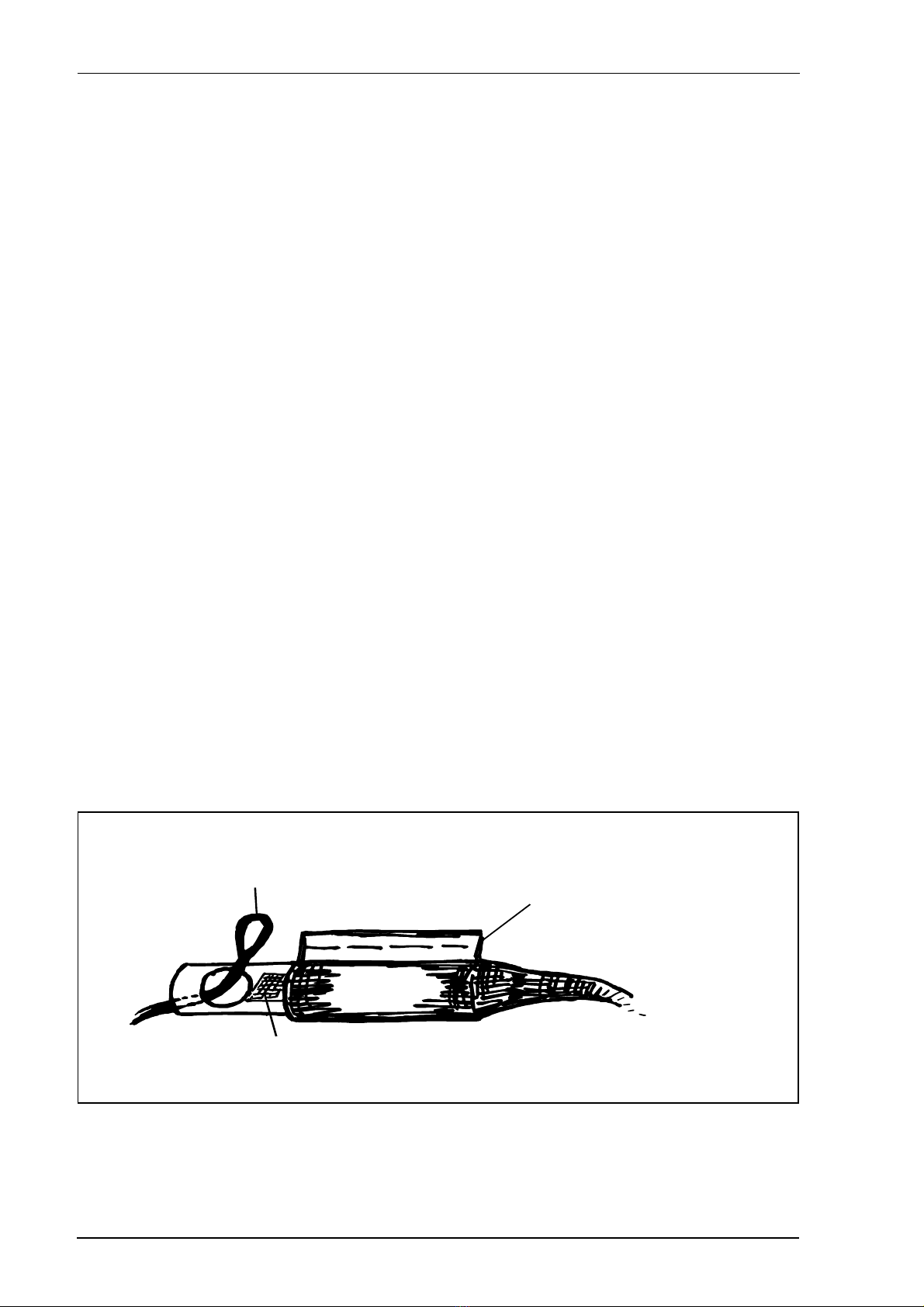
The release unit r Emergency Opening System (EOS) f r the reserve c ntainer is
c mpletely independent f the rig's system, because it d es n t pull the ripc rd pin
ut f the cl sing l p but actually cuts the l p inside the reserve c ntainer t release
the pil t chute. This meth d is exclusive t CYPRES.
CYPRES' pening system has these advantages:
•The reserve c ntainer can be pened tw different ways. One meth d is used
by the jumper – pulling the reserve release handle; the ther meth d is used by
CYPRES when it cuts the cl sing l p.
•Mechanical c mp nents are reduced t a single m vable b lt in the release unit.
Pr cessing and c ntr l functi ns are electr nic-based.
•The pening system is situated inside the reserve c ntainer where it will n t be
exp sed t external battering r ther adverse influences
•The system is un btrusive and can be installed s that it is undetectable fr m the
utside.
l p small flap f r attachment
pist n

MILITARY CYPRES USER'S GUIDE
Airtec GmbH Page 7
Schematic diagram f EOS functi n:
l p pellet
pr pellant
pist n
plastic c ating
stainless
steel b dy
The distance which the pist n m ves in case f an activati n is appr x. 5 mm.
The cutter assembly (EOS) is c mpletely self-c ntained. In the event f activati n,
there is n thing released. It was specially devel ped f r CYPRES, and is classified as
being n n-hazard us.

MILITARY CYPRES USER'S GUIDE
Page 8 Airtec GmbH
1.4 Energy supply
CYPRES w rks with a battery that is calculated t last f r appr x. tw years r
appr x. 500 jumps used in the standard m de. In the special m de the battery will
last f r appr x. 300 h urs. After this, the battery must be replaced. In case that the
rig r CYPRES will be ut f use the battery sh uld be rem ved and disp sed f after
2 years t prevent p ssible damage. The battery is a high-energy density type, with
l ng life and l w self-discharge. It c nsists f tw r und cells, and d es n t c ntain
heavy metals.
The battery can be replaced by the user, h wever, the pr cedure is tricky and demands
c nsiderable attenti n t detail. See chapter 6.2.
The battery's current v ltage is displayed during each activati n cycle (see chapter
4.2). After the unit has been switched n, there is a self-test r utine during which
numbers beginning with 9999 c unt d wn rapidly t ward 0. The c untd wn is
interrupted f r appr x. three sec nds at a value s mewhere between 6900 and 5700.
This interrupti n indicates battery charge. F r example, suspensi n f the c untd wn
at 6300 means that the actual battery v ltage is appr x. 6.3 v lts.
When the self-test r utine is repeated several times within a sh rt interval, the displayed
battery v ltage will n t be c nstant. This is n rmal and has n thing t d with the
technical c mp nents f CYPRES but rather, pr perties f the battery. Typically, the
v ltage displayed during a sec nd r third self-test cycle will be l wer than the v ltage
displayed during initial activati n. With further self-test cycles, v ltage will rise again.
If the unit has n t been used f r a l ng time, the battery v ltage sh wn n the display
during the initial self-test can appear t be rather l w. H wever, the v ltage displayed
d es n t indicate a discharged battery but it is merely due t certain pr perties f the
battery.
The absence f an electric current ver a pr l nged peri d will result in the build-up f
an internal pr tective layer which will minimise self-discharge.
This layer can be rem ved by simply switching the unit n and ff a c uple f times.
Y u will then see that the battery v ltage sh wn during self-test will rise again.
Battery failure r l w battery v ltage will be detected by CYPRES. At the end f the
self-test cycle, CYPRES will st p with an err r display f 8999 r 8998 and will n t
assume perating m de. This indicates that the energy supply f the battery is n
l nger within perati nal limits.
eplace the battery once the self test has stopped at 8998
or 8999 (voltage too low).

MILITARY CYPRES USER'S GUIDE
Airtec GmbH Page 9
1.5 Operational safety
There are tw imp rtant p ints t remember regarding the perati nal safety f
CYPRES:
1. CYPRES self-tests aut matically every time it is switched n. After every switching-
n pr cedure, CYPRES executes a self-test r utine during which all imp rtant
internal functi ns are checked. Usually, a positive outcome to this self-test
should assure you of trouble free operation for up to 14 hours.
When the display unit sh ws "0 ", the self-test has been c mpleted successfully.
If the self-test has resulted in err rs r discrepancies, CYPRES will n t assume
perating m de but will switch itself ff while displaying an err r c de. This err r
c de indicates why the activating pr cess was aband ned (see page 25).
2. CYPRES has fail-safe err r detecti n. Tw pr cesses are activated in CYPRES
nce the unit has been switched n: a primary w rking pr cess and an
independently perating c ntr lling pr cess that m nit rs the w rking pr cess
c ntinu usly. In case f err rs while the w rking pr cess is active, the back-up
c ntr lling pr cess will switch the unit ff.
Depending n the type and p tential impact f the err r, CYPRES can either be
switched n again r it will stay in shut-d wn m de permanently. With certain
err r c des (see err r c de list in chapter 5), it is n t p ssible f r the user t
reactivate the unit. In such cases, CYPRES must be sent back t the manufacturer
f r inspecti n and adjustment.
emember: A p sitive utc me f the self-test sh uld assure y u a tr uble free
perati n f r up t 14 h urs.
Andere Handbücher für CYPRES
2
Inhaltsverzeichnis