
Predator 63406 Bedienungsanleitung

!"#"$%&'(%)*+#"$*%,$-%.$$/-00)))1.,(+&(2(*"3.$14&5
65,"7%&'(%*83"8*%#'//&($%,$-%/(*9,$&(:.,(+&(2(*"3.$14&5
;&%8&$%(*$'(8%$."#%
/'5/%$&%$.*%#$&(*1%
<,77%=>?@@>@=A>B=@=
C#"83%,8%*83"8*%"89&&(#%
<DE%FGHH%IJC%GE%KGECL6M1
683"8*%*N.,'#$%4&8$,"8#%4,(+&8%5&8&N"9*1%%
L."#%"#%,%/&"#&8%O&'%4,88&$%#**%&(%#5*771
E6!6P%'#*%"8#"9*%
,%.&5*%&(%3,(,3*Q%
6!6E%GR%9&&(#%,89%
)"89&)#%,(*%&/*81
J87O%'#*%JCLMG;6%
,89%2,(%,),O%2(&5%
)"89&)#Q%9&&(#Q%
,89%S*8$#1
Owner’s Manual & Safety Instructions
Save This Manual Keep this manual for the safety warnings and precautions, assembly,
operating, inspection, maintenance and cleaning procedures. Write the product’s serial number in the
back of the manual near the assembly diagram (or month and year of purchase if product has no number).
Keep this manual and the receipt in a safe and dry place for future reference. 18l
When unpacking, make sure that the product is intact
and undamaged. If any parts are missing or broken,
please call 1-888-866-5797 as soon as possible.
Copyright© 2016 by Harbor Freight Tools®. All rights reserved.
No portion of this manual or any artwork contained herein may be reproduced in
any shape or form without the express written consent of Harbor Freight Tools.
Diagrams within this manual may not be drawn proportionally. Due to continuing
improvements, actual product may differ slightly from the product described herein.
Tools required for assembly a nd service may not be i ncluded.
Read this material before using this product.
Failure to do so can result in serious injury.
SAVE THIS MANUAL.

Page 2 R&(%$*4.8"4,7%T'*#$"&8#Q%/7*,#*%4,77%=>???>?AA>UVBV1 ITEM 63406
L,+7*%&2%<&8$*8$#
Specifications ............................................. 2
Safety ......................................................... 3
Setup .......................................................... 6
Operation ................................................... 10
Maintenance .............................................. 14
Troubleshooting ......................................... 18
Warranties ................................................. 20
Parts Lists and Diagrams .......................... 22
M/*4"2"4,$"&8#
Pump
Suction & Discharge Size 3" NPT
Maximum Flow at 0’ 290 GPM
Maximum Head Lift at 0 Flow 85 ft.
Maximum Intake Lift at 0 26 ft.
Passable Soft Solid Size 3/4" Dia.
Mechanical Seal Ceramic
Included Accessories Intake Strainer, Hose Clamps, Spark Plug Wrench
Engine
Displacement 212cc
Engine Type Horizontal Single Cylinder 4 stroke OHV
EPA phase III compliant
Cooling System Forced air cooled
Fuel Type 87+ octane stabilizer-treated
unleaded gasoline
Capacity 0.9 Gallons / 3.6 Liters
Engine Oil Type SAE 10W-30 above 32° F
5W30 at 32° F or below
Capacity 0.5 Quarts / 0.5 Liters
Run Time @ 50% Load with full tank 3 hr.
Sound Level at 22 feet 104 dB
Bore x Stroke 70 mm x 55 mm
Compression Ratio 8.5:1
Rotation viewed from PTO
(power takeoff - the output shaft) Counterclockwise
Shaft
Shaft 3/4" x 2.41"
Keyway 3/16" (4.76 mm)
End Tapped 5/16 - 24 UNF
Spark Plug Type NGK® BP-6ES; NHSP® / Torch® F6TC
Gap 0.027" - 0.031"
Valve Clearance Intake 0.004" - 0.006"
Exhaust 0.006" - 0.008"
No Load Speed 3,800 RPM±100RPM
R7&)%WX,77&8#05"8'$*Y
;"#4.,(3*%Z*,9%W2$1Y
Page 3R&(%$*4.8"4,7%T'*#$"&8#Q%/7*,#*%4,77%=>???>?AA>UVBV1ITEM 63406
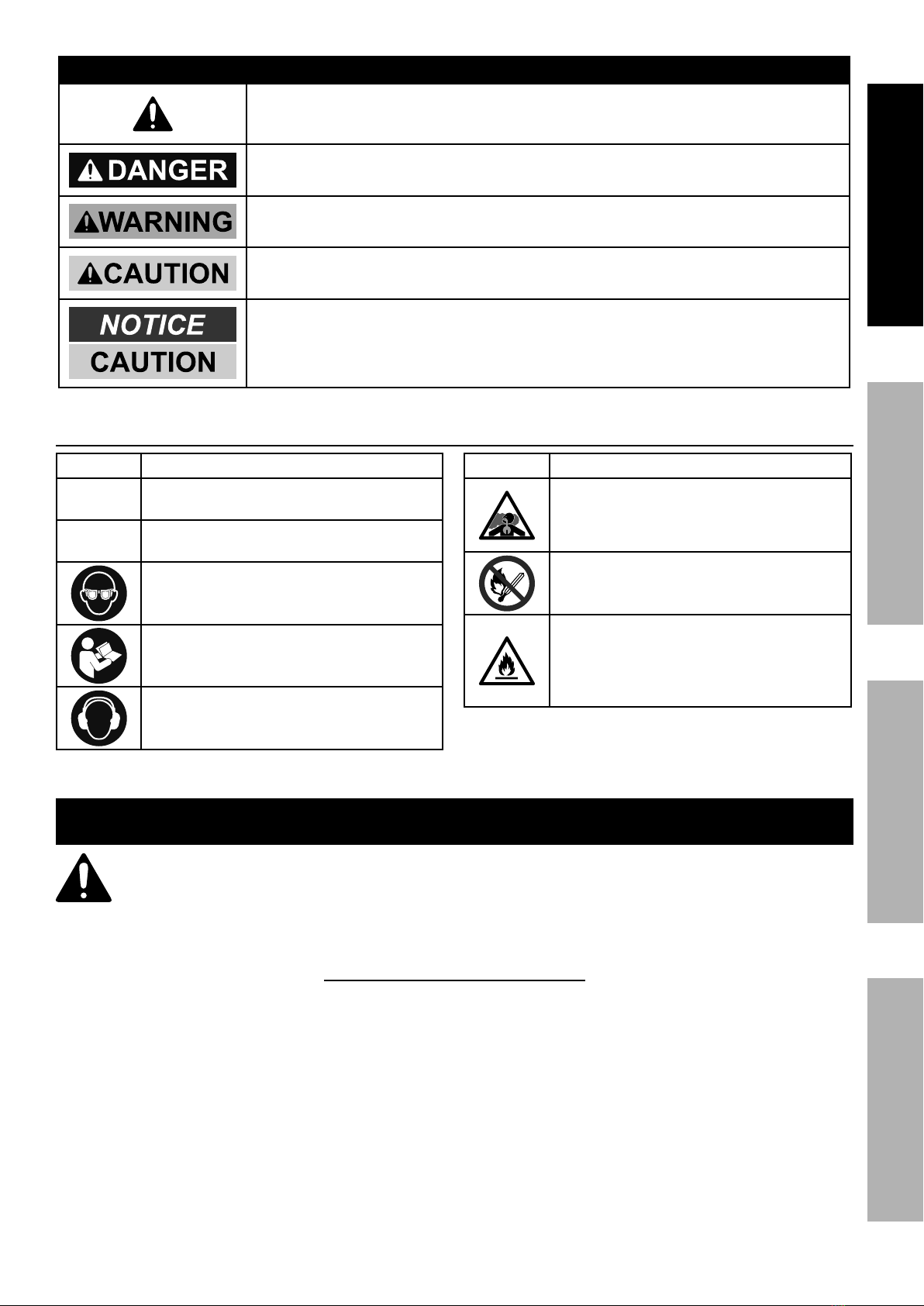
MDR6LIM6LC[J[6PDLGJEKDGEL6EDE<6
\DPEGEX%MIK]JHM%DE;%;6RGEGLGJEM
This is the safety alert symbol. It is used to alert you to potential
personal injury hazards. Obey all safety messages that
follow this symbol to avoid possible injury or death.
Indicates a hazardous situation which, if not avoided,
will result in death or serious injury.
Indicates a hazardous situation which, if not avoided,
could result in death or serious injury.
Indicates a hazardous situation which, if not avoided,
could result in minor or moderate injury.
Addresses practices not related to personal injury.
MO5+&7%;*2"8"$"&8#
MO5+&7 [(&/*($O%&(%M$,$*5*8$
P[K Revolutions Per Minute
Z[ Horsepower
WARNING marking concerning
Risk of Eye Injury. Wear ANSI-approved
safety goggles with side shields.
Read the manual before
set-up and/or use.
WARNING marking concerning
Risk of Hearing Loss.
Wear hearing protection.
MO5+&7 [(&/*($O%&(%M$,$*5*8$
WARNING marking concerning
Risk of Respiratory Injury.
Operate engine OUTSIDE and far away
from windows, doors, and vents.
WARNING marking concerning
Risk of Fire while handling fuel.
Do not smoke while handling fuel.
WARNING marking concerning
Risk of Fire.
Do not refuel while operating.
Keep flammable objects
away from engine.
M,2*$O%\,(8"83#
% \DPEGEX^%P*,9%,77%"8#$('4$"&8#1
R,"7'(*%$&%2&77&)%,77%"8#$('4$"&8#%5,O%(*#'7$%"8%2"(*Q%#*("&'#%"8_'(O%,890&(%;6DLZ1%
The warnings and precautions discussed in this manual cannot cover all possible conditions and
situations that may occur. It must be understood by the operator that common sense and caution
are factors which cannot be built into this product, but must be supplied by the operator.
MD!6%LZ6M6%GEMLPC<LGJEM

Page 4 R&(%$*4.8"4,7%T'*#$"&8#Q%/7*,#*%4,77%=>???>?AA>UVBV1 ITEM 63406
MDR6LI M6LC[ J[6PDLGJE KDGEL6EDE<6
M*$%'/%[(*4,'$"&8#
1. Gasoline fuel and fumes are flammable, and
potentially explosive. Use proper fuel storage
and handling procedures. Do not store fuel
or other flammable materials nearby.
2. Have multiple ABC class fire extinguishers nearby.
3. Operation of this equipment may create sparks
that can start fires around dry vegetation. A spark
arrestor may be required. The operator should
contact local fire agencies for laws or regulations
relating to fire prevention requirements.
4. Set up and use only on a flat, level,
well-ventilated surface.
5. Wear ANSI-approved safety goggles, heavy-duty
work gloves, and dust mask/respirator during set up.
6. Use only lubricants and fuel recommended
in the Specifications chart of this manual.
7. Do not use any reducer on the inlet or discharge
port. However, if any reducers were included
as part of this pump, they may be used.
J/*(,$"83%[(*4,'$"&8#
1. <DP]JE%KJEJ`G;6%ZDaDP;%
C#"83%,8%*83"8*%"89&&(#%<DE%FGHH%
IJC%GE%KGECL6M1%
Engine exhaust contains carbon
monoxide. This is a poison you cannot
see or smell.
NEVER use inside a home or garage,
EVEN IF doors and windows are open.
Only use OUTSIDE and far away from windows,
doors, and vents.
2. Keep children away from the equipment,
especially while it is operating.
3. Keep all spectators at least six feet
from the Engine during operation.
4. Fire Hazard! Do not fill gas tank while engine is
running. Do not operate if gasoline has been spilled.
Clean spilled gasoline before starting engine.
Do not operate near pilot light or open flame.
5. Do not touch engine during use.
Let engine cool down after use.
6. Never store fuel or other flammable
materials near the engine.
7. Only use a suitable means of transport and
lifting devices with sufficient weight bearing
capacity when transporting the Engine.
8. Secure the Engine on transport vehicles to
prevent the tool from rolling, slipping, and tilting.
9. Industrial applications must follow
OSHA requirements.
10. Do not leave the equipment unattended when it is
running. Turn off the equipment (and remove safety
keys, if available) before leaving the work area.
11. Engine can produce high noise levels.
Prolonged exposure to noise levels
above 85 dBA is hazardous to hearing.
Always wear ear protection when operating or
working around the gas engine while it is operating.
12. Wear ANSI-approved safety glasses, hearing
protection, and NIOSH-approved dust mask/
respirator under a full face shield along
with steel-toed work boots during use.
13. People with pacemakers should consult their
physician(s) before use. Electromagnetic fields in
close proximity to a heart pacemaker could cause
pacemaker interference or pacemaker failure.
Caution is necessary when near the
engine’s magneto or recoil starter.
14. Use only accessories that are recommended
by Harbor Freight Tools for your model.
Accessories that may be suitable for one
piece of equipment may become hazardous
when used on another piece of equipment.
15. Do not operate in explosive atmospheres,
such as in the presence of flammable
liquids, gases, or dust. Gasoline-powered
engines may ignite the dust or fumes.
16. Stay alert, watch what you are doing and
use common sense when operating this
piece of equipment. Do not use this piece
of equipment while tired or under the
influence of drugs, alcohol or medication.
17. Do not overreach. Keep proper footing and
balance at all times. This enables better control
of the equipment in unexpected situations.
18. Dress properly. Do not wear loose clothing or
jewelry. Keep hair, clothing and gloves away
from moving parts. Loose clothes, jewelry or
long hair can be caught in moving parts.
19. Parts, especially exhaust system components,
get very hot during use. Stay clear of hot parts.

Page 5R&(%$*4.8"4,7%T'*#$"&8#Q%/7*,#*%4,77%=>???>?AA>UVBV1ITEM 63406
MDR6LIM6LC[J[6PDLGJEKDGEL6EDE<6
20. Do not cover the engine or
equipment during operation.
21. Keep the equipment, engine, and
surrounding area clean at all times.
22. Do not smoke, or allow sparks, flames,
or other sources of ignition around the
equipment, especially when refuelling.
23. Use the equipment, accessories, etc., in
accordance with these instructions and in the
manner intended for the particular type of
equipment, taking into account the working
conditions and the work to be performed. Use of
the equipment for operations different from those
intended could result in a hazardous situation.
24. Do not operate the equipment with known
leaks in the engine’s fuel system.
25. When spills of fuel or oil occur, they must be
cleaned up immediately. Dispose of fluids and
cleaning materials as per any local, state, or
federal codes and regulations. Store oil rags in
a bottom-ventilated, covered, metal container.
26. Keep hands and feet away from moving parts. Do
not reach over or across equipment while operating.
27. Before use, check for misalignment or binding of
moving parts, breakage of parts, and any other
condition that may affect the equipment’s operation.
G2%9,5,3*9Q%.,S*%$.*%*T'"/5*8$%#*(S"4*9%
+*2&(*%'#"831 Many accidents are caused
by poorly maintained equipment.
28. Use the correct equipment for the application.
Do not modify the equipment and do not use the
equipment for a purpose for which it is not intended.
M*(S"4*%[(*4,'$"&8#
1. ]*2&(*%#*(S"4*Q%5,"8$*8,84*Q%&(%47*,8"83-
a. L'(8%$.*%*83"8*%#)"$4.%$&%"$#%bJRRc%/&#"$"&81
b. D77&)%$.*%*83"8*%$&%4&5/7*$*7O%4&&71
c. L.*8Q%(*5&S*%$.*%#/,(d%/7'3%
4,/%2(&5%$.*%#/,(d%/7'31
2. Keep all safety guards in place and in
proper working order. Safety guards include
muffler, air cleaner, mechanical guards,
and heat shields, among other guards.
3. ;&%8&$%,7$*(%&(%,9_'#$%,8O%/,($%&2%$.*%
*T'"/5*8$%&(%"$#%*83"8*%$.,$%"#%#*,7*9%+O%$.*%
5,8'2,4$'(*(%&(%9"#$("+'$&(1%%J87O%,%T',7"2"*9%
#*(S"4*%$*4.8"4",8%5,O%,9_'#$%/,($#%$.,$%5,O%
"84(*,#*%&(%9*4(*,#*%3&S*(8*9%*83"8*%#/**91
4. Wear ANSI-approved safety goggles,
heavy-duty work gloves, and dust
mask/respirator during service.
5. Maintain labels and nameplates on the equipment.
These carry important information.
If unreadable or missing, contact
Harbor Freight Tools for a replacement.
6. Have the equipment serviced by a qualified repair
person using only identical replacement parts.
This will ensure that the safety of the equipment
is maintained. Do not attempt any service or
maintenance procedures not explained in this
manual or any procedures that you are uncertain
about your ability to perform safely or correctly.
7. Store equipment out of the reach of children.
8. Follow scheduled engine and
equipment maintenance.
P*2'*7"83-
1. Do not refill the fuel tank while the
engine is running or hot.
2. Do not smoke, or allow sparks, flames,
or other sources of ignition around the
equipment, especially when refuelling.
3. Do not fill fuel tank to the top. Leave a little
room for the fuel to expand as needed.
4. Refuel in a well-ventilated area only.
5. Wipe up any spilled fuel and allow excess
to evaporate before starting engine.
L&%/(*S*8$%RGP6Q%9&%8&$%#$,($%$.*%*83"8*%
)."7*%$.*%#5*77%&2%2'*7%.,83#%"8%$.*%,"(1
%MD!6%LZ6M6%GEMLPC<LGJEM1
J/*(,$"83%[(*4,'$"&8#%W4&8$1Y

Page 6 R&(%$*4.8"4,7%T'*#$"&8#Q%/7*,#*%4,77%=>???>?AA>UVBV1 ITEM 63406
MDR6LI M6LC[ J[6PDLGJE KDGEL6EDE<6
M*$%C/
P*,9%$.*%6ELGP6%GK[JPLDEL%MDR6LI%GERJPKDLGJE%#*4$"&8%,$%$.*%+*3"88"83%&2%$."#%5,8',7%
"847'9"83%,77%$*N$%'89*(%#'+.*,9"83#%$.*(*"8%+*2&(*%#*$%'/%&(%'#*%&2%$."#%/(&9'4$1
LJ%[P6!6EL%M6PGJCM%GEeCPI-%
J/*(,$*%&87O%)"$.%/(&/*(%#/,(d%,((*#$&(%"8#$,77*91
J/*(,$"&8%&2%$."#%*T'"/5*8$%5,O%4(*,$*%#/,(d#%$.,$%4,8%#$,($%2"(*#%,(&'89%9(O%S*3*$,$"&81%
D%#/,(d%,((*#$&(%5,O%+*%(*T'"(*91%L.*%&/*(,$&(%#.&'79%4&8$,4$%7&4,7%2"(*%,3*84"*#%
2&(%7,)#%&(%(*3'7,$"&8#%(*7,$"83%$&%2"(*%/(*S*8$"&8%(*T'"(*5*8$#1
Z"3.%D7$"$'9*%J/*(,$"&8%D+&S*%fggg%2**$
WARNING! To prevent serious injury from fire:
Follow instructions in a well-ventilated area away from ignition sources.
If the engine is hot from use, shut the engine off and wait for it to cool before proceeding. Do not smoke.
NOTICE Warranty void if necessary adjustments are not made for high altitude use.
At high altitudes, the engine’s carburetor, governor (if so equipped), and any other parts that control the fuel-air
ratio will need to be adjusted by a qualified mechanic to allow efficient high-altitude use and to prevent damage
to the engine and any other devices used with this product. The fuel system on this engine may be influenced by
operation at higher altitudes. Proper operation can be ensured by installing an altitude kit at altitudes higher than
3000 ft. above sea level. At elevations above 8000 ft, the engine may experience decreased performance, even
with the proper main jet. Operating this engine without the proper altitude kit installed may increase the engine’s
emissions and decrease fuel economy and performance. The kit should be installed by a qualified mechanic.
1. Turn off the engine.
2. Close the fuel valve.
3. Place a bowl under the fuel cup to catch any spilled fuel.
<DCLGJE^ Carburetor bowl may have gas in it which will leak upon removing the bolt.
4. Unthread the bolt holding the fuel cup.
5. Remove the bolt, Bolt Seal, fuel cup, Fuel Cup Seal and Main Jet from the body of the carburetor assembly.
A carburetor screwdriver (not included) is needed
to remove and install the Main Jet.
E&$*- The mixing tube is held in place by the Main Jet and
might fall out when it is removed. If it falls out, replace it in
the same orientation before replacing the Main Jet.
6. Replace the Main Jet with the replacement Main Jet
needed for your altitude range (part 1a or 2a).
E&$*- The Fuel Cup Seal and Bolt Seal may be damaged during
removal and should be replaced with the new ones from the kit.
7. Replace the Fuel Cup Seal (4a), fuel cup,
Bolt Seal (3a), and bolt. Tighten in place.
EJLG<6- Do not cross thread bolt when tightening.
Finger tighten first and then use a wrench to
make sure the bolt is properly threaded.
8. Wipe up any spilled fuel and allow excess to evaporate
before starting engine. To prevent FIRE, do not start the
engine while the smell of fuel hangs in the air.
Z"3.%D7$"$'9*%F"$%[,($#%H"#$%>%D
[,($ ;*#4("/$"&8 h$O
1a Main Jet 3000-6000 ft. 1
2a Main Jet 6000-8000 ft. 1
3a Bolt Seal 1
[,($ ;*#4("/$"&8 h$O
4a Fuel Cup Seal 1
<,(+'(*$&(%
D##*5+7O
K,"8%e*$
R'*7%<'/%M*,7
K"N"83%L'+*
W5"3.$%(*5,"8%
"8#"9*%4,(+'(*$&(Y
R'*7%<'/
]&7$%M*,7
]&7$

Page 7R&(%$*4.8"4,7%T'*#$"&8#Q%/7*,#*%4,77%=>???>?AA>UVBV1ITEM 63406
MDR6LIM6LC[J[6PDLGJEKDGEL6EDE<6
<&8$(&7#
Fuel Tank Cap
Throttle
Choke
Fuel Valve
Starter Handle
Engine Switch
Oil Dipstick
Fuel Tank
Air Filter
Muffler
Water Drain Plug
Intake Port
Priming Cap
Discharge Port

Page 8 R&(%$*4.8"4,7%T'*#$"&8#Q%/7*,#*%4,77%=>???>?AA>UVBV1 ITEM 63406
MDR6LI M6LC[ J[6PDLGJE KDGEL6EDE<6
<&88*4$"83%Z&#*#
E&$*- Hoses not included.
EJLG<6-%%;&%8&$%'#*%,8O%(*9'4*(%&8%$.*%"87*$%&(%
9"#4.,(3*%/&($1%%Z&)*S*(Q%"2%,8O%(*9'4*(#%)*(*%
"847'9*9%,#%/,($%&2%$."#%/'5/Q%$.*O%5,O%+*%'#*91
E&$*- The Intake Hose (not included)
MUST be reinforced with non-collapsible
construction. Match hose diameter to port
diameters. Do not reduce hose diameter size.
1. Thread intake hose onto Intake Port.
EJLG<6- Use only a non-collapsible intake hose.
G8$,d*%Z&#*
2. Slide the Intake Strainer into the end of
the intake hose. Tighten until secure.
Intake Strainer
3. Thread discharge hose onto Discharge
Port. Tighten until secure.

Page 9R&(%$*4.8"4,7%T'*#$"&8#Q%/7*,#*%4,77%=>???>?AA>UVBV1ITEM 63406
MDR6LIM6LC[J[6PDLGJEKDGEL6EDE<6
H&4,$"83%$.*%\,$*(%['5/
Locate the Water Pump on a flat, level, sturdy surface
capable of supporting the weight of the Pump.
1. For best Pump performance, place the Pump
near the water level and use hoses that are no
longer than necessary. See diagram below.
L&$,7%Z*,9
M'4$"&8%%
Z*,9
\,$*(%['5/
;"#4.,(3*%Z*,9
As the head (pumping height) increases,
pump output decreases. A non-collapsible
suction hose must be used. The length, type,
and size of the suction and discharge hoses
can significantly affect Pump output.
Discharge head capability is always greater than
suction head capability. This means pumping height
for the Intake Hose (suction head) should be shorter
than the pumping height for the Discharge Hose.
Minimizing suction head (placing the Pump
closer to the water level) will also help make it
easier to prime the pump (fill it with water).
2. Route the Intake Hose with the Intake Strainer
fully immersed in the water supply source.
3. Place Strainer into water to be pumped.
NOTICE: Immerse strainer fully in water.
Do not operate Pump without Strainer connected
to end of suction hose. Keep Strainer out of sand
or silt by placing Strainer in a bucket or on stones.
EJLG<6- Air leaks must not appear in the
suction line. If there is an air leak in the suction
line, you will not be able to prime the pump.
Use a thread sealant to seal air leaks.
M$(,"8*(
4. Secure the Intake Hose in place to keep it
from moving once the Pump is turned on.
The Intake Hose should be as short as
possible for more efficient operation.
5. Route the discharge hose to the desired discharge
location. If necessary, connect additional discharge
hoses to direct the discharge to the desired location.
Make sure to secure the discharge hose in place
to keep it from moving once the Water Pump is
turned on. The discharge hose should be kept as
short as possible for more efficient operation.

Page 10 R&(%$*4.8"4,7%T'*#$"&8#Q%/7*,#*%4,77%=>???>?AA>UVBV1 ITEM 63406
MDR6LI M6LC[ J[6PDLGJE KDGEL6EDE<6
J/*(,$"&8%
P*,9%$.*%6ELGP6%GK[JPLDEL%MDR6LI%GERJPKDLGJE%#*4$"&8%,$%$.*%+*3"88"83%&2%$."#%5,8',7%
"847'9"83%,77%$*N$%'89*(%#'+.*,9"83#%$.*(*"8%+*2&(*%#*$%'/%&(%'#*%&2%$."#%/(&9'4$1
[(*>M$,($%<.*4d#
Inspect engine and equipment looking for damaged, loose, and missing parts before set up
and starting. If any problems are found, do not use equipment until fixed properly.
[("5*%$.*%['5/
Before starting the engine, fill the Pump with water.
To do this:
1. Unthread the Priming Water Filler Cap
by turning it counterclockwise.
2. Fill the unit with clean water up to the
top of the opening. Replace the Priming
Water Filler Cap and tighten securely.
GK[JPLDEL^ Always check for water in the
Pump Housing before each use. Never attempt
to run the Water Pump without the Pump
Housing FULL of water. Running the Water Pump
without water for an extended period of time will
damage the Water Pump and void the Warranty.
[("5"83%<,/
<.*4d"83%,89%R"77"83%683"8*%J"7
EJLG<6-%%I&'(%\,((,8$O%"#%!JG;%"2%$.*%*83"8*i#%
4(,8d4,#*%"#%8&$%/(&/*(7O%2"77*9%)"$.%&"7%+*2&(*%
*,4.%'#*1%%]*2&(*%*,4.%'#*Q%4.*4d%$.*%&"7%7*S*71
Engine%)"77%8&$%#$,($%)"$.%7&)%&(%8&%*83"8*%&"71
3. Make sure the engine is stopped and is level.
4. Close the Fuel Valve.
5. Clean the top of the Dipstick and the area around it.
Remove the Dipstick by turning it counterclockwise,
and wipe it off with a clean, lint free rag.
6.
Full level
Full level
Reinsert the Dipstick without threading it in and
remove it to check the oil level. The oil level
should be up to the full level as shown above.
7. If the oil level is at or below the low mark add the
appropriate type of oil until the oil level is at the
proper level. SAE 10W-30 oil is recommended for
general use. (The SAE Viscosity Grade chart on
page 15 in the Maintenance section shows other
viscosities to use in different average temperatures.)
8. Thread the dipstick back in clockwise.
EJLG<6-%%;&%8&$%('8%$.*%*83"8*%)"$.%$&&%7"$$7*%&"71
683"8*%)"77%#.'$%&22%"2%*83"8*%&"7%7*S*7%"#%$&&%7&)1
<.*4d"83%,89%R"77"83%R'*7
\DPEGEX^ LJ%[P6!6EL%M6PGJCM%
GEeCPI%RPJK%RGP6-
Fill the fuel tank in a well-ventilated area
away from ignition sources. If the engine is
hot from use, shut the engine off and wait
for it to cool before adding fuel. Do not smoke.
1. Clean the Fuel Cap and the area around it.
2. Unscrew and remove the Fuel Cap.
E&$*-%%;&%8&$%'#*%3,#&7"8*%4&8$,"8"83%5&(*%$.,8%
=gj%*$.,8&7%W6=gY1%%;&%8&$%'#*%6?U%*$.,8&71%%D99%2'*7%
#$,+"7"k*(%$&%$.*%3,#&7"8*%&(%$.*%\,((,8$O%"#%!JG;1
Inhaltsverzeichnis
Andere Predator Wasserpumpe Handbücher


Beliebte Wasserpumpe Handbücher anderer Marken


Sykes AmeriPumps
Sykes AmeriPumps GP100M Fehlerbehebungshandbuch

DUROMAX
DUROMAX XP WX Series Bedienungsanleitung

BRINKMANN PUMPS
BRINKMANN PUMPS SBF550 Bedienungsanleitung

Franklin Electric
Franklin Electric IPS Bedienungsanleitung

Xylem
Xylem e-1532 Series Bedienungsanleitung

Milton Roy
Milton Roy PRIMEROYAL Bedienungsanleitung