
SIAP+MICROS p099 PalB10 Leitfaden

p099 PalB10
10m height lowerable mast
Installation manual and user’s guide
User Manual Vers. 00

User’s Manual
p099-di PalB10.docx
27/02/2023 Pag.2 Vers. 00
Index
1List of materials..................................................................................................................................... 3
1.1 PalB10 .................................................................................................................................................. 3
2Preparation for installation.................................................................................................................... 5
2.1 Civil works (plinth) for PalB10............................................................................................................... 5
2.2 PalB10 .................................................................................................................................................. 5
2.3 Transducers, cables ............................................................................................................................. 6
3Mechanic parts assembly..................................................................................................................... 7
3.1 PalB10 weather mast............................................................................................................................ 7
3.2 Anemometer ....................................................................................................................................... 10
3.3 Directional antenna............................................................................................................................. 12
3.4 Ultrasonic level transducer ................................................................................................................. 12
3.5 Photovoltaic panel .............................................................................................................................. 14
3.6 Video camera...................................................................................................................................... 15
3.7 Devices on a 2m height bracket......................................................................................................... 16
3.8 Data logger cabinet............................................................................................................................. 17
4PalB10 tilting....................................................................................................................................... 19
5Revision history .................................................................................................................................. 21

User’s Manual
p099-di PalB10.docx
27/02/2023 Pag.3 Vers. 00
1 List of materials
1.1 PalB10
PalB10 elements:
Element 1
Features: square base 300x200mm, diameter 152mm, total height 2015mm
Element 2a
Features: diameter 133mm, total height 2235mm, tiltable head
Element 2b
Features: diameter 133mm, outline 65x42x5.5mm, total height 2030mm
Element 3
Features: diameter 102mm / 89mm, total height 1970mm

User’s Manual
p099-di PalB10.docx
27/02/2023 Pag.4 Vers. 00
Element 4
Features: diameter 76mm / 60mm, total height 2250mm
Element 5
Features: diameter 48mm, total height 2250mm
Element 6
Features: cross-section 100x50x6mm, total height 1980mm

User’s Manual
p099-di PalB10.docx
27/02/2023 Pag.5 Vers. 00
2 Preparation for installation
2.1 Civil works (plinth) for PalB10
The PalB10 be installed on an adequate foundation plinth with anchor bolts. In the Annex 1 is represented
the plinth to be performed with features suitable for most type of installations.
You should execute works for the digging and burying of plinths made of concrete, joining inspection wells
and the sheath of electrical connection between the different parts of the station (meteorological pole,
pluviometric pole, nivometric pole, etc.).
In addition to the plinths, to ensure proper maintenance and management of electrical connections, will be
used for connecting underground inspection wells (minimum size of 30x30x30cm) with exposed cover (not
buried to ensure the inspection) where arrive the sheaths (made with spiral ducts made of plastic) from other
elements of the station.
The works must be made "by the rule book" to ensure the adequate support of the mechanical parts of the
station according to the type of ground on which you want to install the station.
You should choose a suitable site which has a sufficiently solid ground, so you do not have time failures that
can lead to deterioration of the foundations themselves up to possible collapse of the mechanical parts of the
station.
Siap+Micros can not therefore be held responsible for any structural failure or malfunction of the station
caused by misinterpretation and / or arbitrary choices do not conform to those indicated in this manual.
2.2 PalB10
PalB10 is composed on the whole by 7 elements made of galvanized steel.
The elements insert into each others and then secured with M10 grub screws with conic shape point,
screwed onto relative nuts, welded on the mast itself.
Since the dimensions of the mast and the significant weight of different elements, please be extremely
careful handling and installing them. Use suitable tools, like cranes with people racks and/or swinging arms
of at least 10m high lift.
Important: during any given installation of an element, check with the levelling gauge that the element itself
is perfectly in vertical position, and this kind of setting is made by acting on M10 grub screw.

User’s Manual
p099-di PalB10.docx
27/02/2023 Pag.6 Vers. 00
2.3 Transducers, cables
All the sensors, or different electronic devices, directly
attached to the mast or by brackets must be wired putting
the cables into the right holes already placed onto the mast
and making them getting off at the base of the mast itself,
next to the three ø38mm holes just below the data logger in
the inner of a conduit.
Cables of devices sited on the bracket at 2m height should
come out from the upper hole; cables of other devices
(sited beyond the junction) should come out from the
central hole. Cables coming from the pole base (devices
not directly fixed to the pole, power supply 230Vac and LAN
cable) should come out from the lower hole.
Pay attention to the cables coming from the devices located
beyond the junction, in the mast tilting phase the cable must
be long enough not to tear when the mast is come to a
complete tilt; leave about a piece of cable 50cm long.
Pay attention to the cables coming from the well at mast base: they must be passed into the conduits and
inserted into the first element of the pole; they have to come out from the lower hole ø38mm before mast
installation.
At shown in the previous picture, insert the conduit into the mast making it bend downwards (that is useful
not to create water residual which could freeze and consequently break the conduit).
In the execution of wiring among the devices and the mast, is
a good rule, once you do the electric connection, to secure the
cable to the mast itself or to the brackets with some straps.
Then, before entering the cables into the fixation points
already placed on the mast, is warmly suggested letting the
cable be bended in order to avoid accumulation that could
drain up in mast base (see the picture by side).
Moreover, in order not to compromise the good working of the
electric connections, in the installation’s phases please be
careful to avoid every act which could damage cables and/or
connectors: don’t yank and don’t pinch the cables, don’t leave
the connectors at extended and direct contact with water, don’t
trample them and don’t roughly hit them.
User’s Manual
p099-di PalB10.docx
27/02/2023 Pag.7 Vers. 00
3 Mechanic parts assembly
Indication of the phases for mechanic and electric mounting of the different parts of the station
3.1 PalB10 weather mast
Materials :
-
Tools:
size 27 wrench for M18 hexagonal head
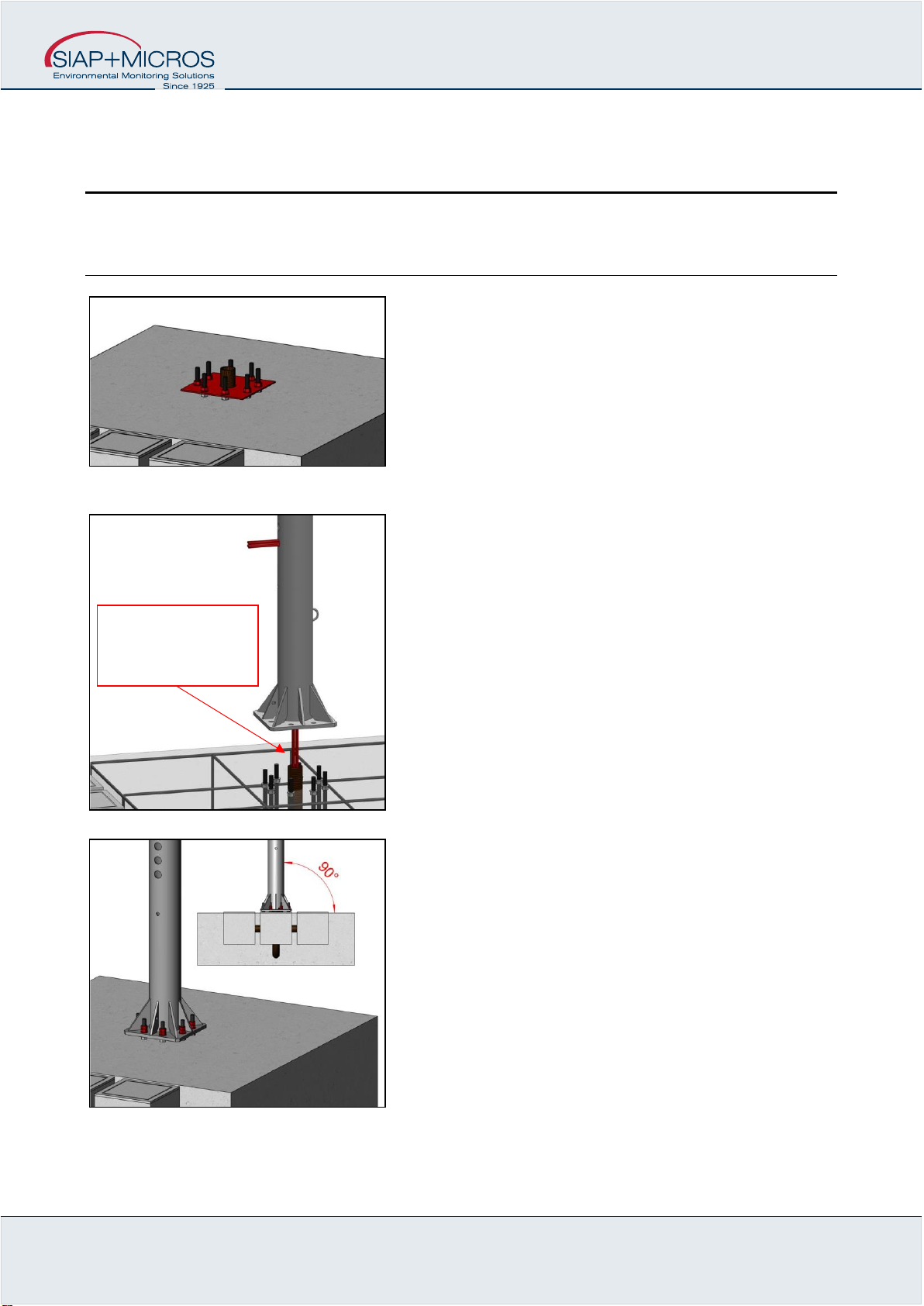
Act :
unscrew M18 eight nuts used for clogging the upper spacer
plate. Remove eight ø18 upper washer and the plate.
Materials :
-
Tools :
-
Act :
before installation of the element 1, insert the wires coming
out of the sheath on the top of the plinth inside in the pole
base and get them out of the bottom hole, ø38mm, of the
three present in the element 1.
Materials :
element 1 of PalB10
n° 8 M18 nuts
Tools :
spanner size 27 for M18 hexagonal head, levelling gauge
Act :
put the base of the mast (element n°1) pointing it correctly:
the three ø38 holes side is the frontal one, that has to be
pointed Southwards.
Place once again the eight ø18 washers and the eight M18
nuts previously removed. Check the shaft is perfectly in
vertical position using the levelling gauge and if it is not, have
some setting acting on nuts which stand below the base.
Cable coming out
from the conduit sited
in the center of the
plinth

User’s Manual
p099-di PalB10.docx
27/02/2023 Pag.8 Vers. 00
Once you do this, then strongly tighten up the upper nuts. Screw also the remaining eight M18 nuts
(counterlock).
Materials:
PalB10 element 2 (2a and 2b)
n° 6 M10x20 grub screws
Tools:
size 5 Allen key for M10 grub screws, levelling gauge
Act :
put element 2 (2a and 2b elements are already assembled)
into the base. Point it so that the ø30mm holes in both two
elements can match. Fasten it screwing the six M10 grub
screws, paying attention to check the right vertical position,
acting on the grub screws themselves.
Materials :
PalB10 element 2a and 2b
TE M20x110mm screw, M20 elastic washer, split pin
TE M16x40 screw, M16 flat washer per M16
Tools:
spanner size 30 for M20 hexagonal screws,
spanner size 24 for M16 hexagonal screws
Act :
elements 2a and 2b are already pre-assembled following
this instructions:
Put element 2b into 2a as shown in the picture, put the M20 screw as a kingpin and tighten up with an elastic
washer and a M20 nut. Insert the safety split-pin in the M20 screw hole.
Fasten element 2b by the M16 safety screw, and relative washer.

User’s Manual
p099-di PalB10.docx
27/02/2023 Pag.9 Vers. 00
Materials :
TE M16x230 screw with hole, M16 nut and M1 flat washer,
safety lock
Tools :
spanner size 24 for M16 hexagonal screw
Act :
for a safe tiltable mast phase, in the provision you’ll find a
screw (M16x230) with a hole for the key lock.
Once the mast is assembled, insert the M16x230 screw in the
hole placed at the base of the balancing arm and tighten up
with M16 nut and secure the whole system by the lock.
The two ring which are welded both on the balancing arm and,
immediately under, on mast need to hook a rope or similar
system (like a pulley) used as a servo-system to ease the
mast tilting.
Additionally, as a further safety locking, you can use the screw
placed higher, already inserted in element 2b.
Materials :
PalB10 elements 3, 4 and 5
M10x20 n° 18 grub screws
Tools :
allen key size 5 for M10 grub screws, levelling gauge
Act :
insert in this very order elements n°3, n°4 and n°5 (all with a
circular section of different diameters).
For every insertion, check the right vertical position of the
element, acting on the six M10 fasting grub screws. Once it’s
put vertical, fasten permanently the element, tightening up the
grub screws, making sure verticality is not altered.
User’s Manual
p099-di PalB10.docx
27/02/2023 Pag.10 Vers. 00
Materials :
PalB10 element 6
TE M10x35 n° 6 screws, M10 flat washer
Tools :
spanner size 17 for M10 hexagonal screw
Act :
fasten element n°6 on the extension of the previously
installed rocker arm (element 2b) with six M10 screws and
relative washers.
Pay attention to the hole placed in the bottom: it must match
with the ø18 hole placed on mast.
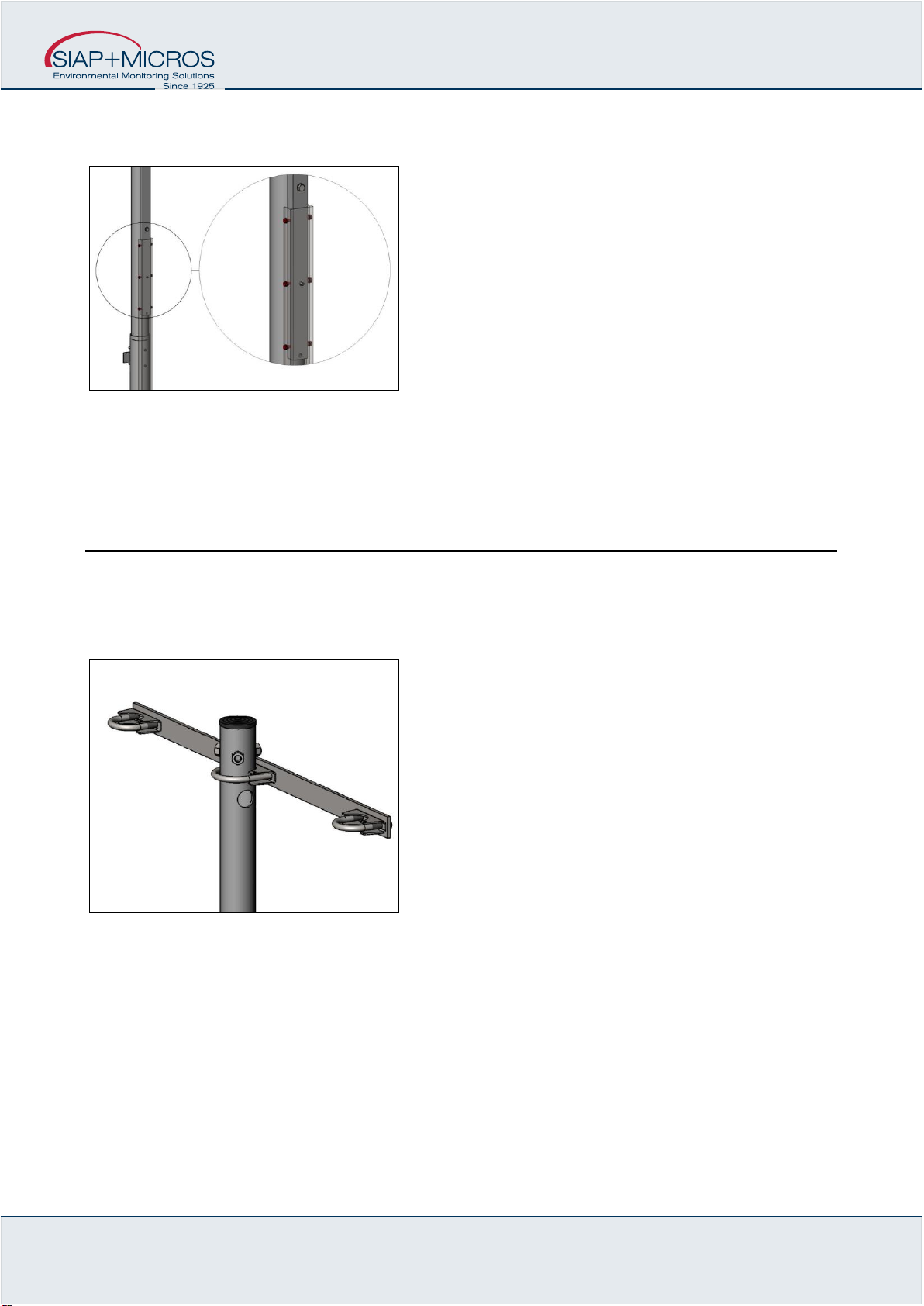
3.2 Anemometer
On the top of PalB10, on the last element of 48 mm diameter, brackets for anemometer transducer and for
transducers themselves are placed.
Materials :
bracket fitting two transducers, equipped with clevises
Tools :
spanner size 13 for M8 hexagonal screw
Act :
insert and fasten bracket as shown in the picture
(perpendicular to the capturing antenna’s brackets on the
North-South direction and close to holes placed on the top
of the mast). Fastening is made acting on two M8 nuts
placed in the opposite side from the clevis.
Inhaltsverzeichnis
Andere SIAP+MICROS Datenlogger Handbücher


