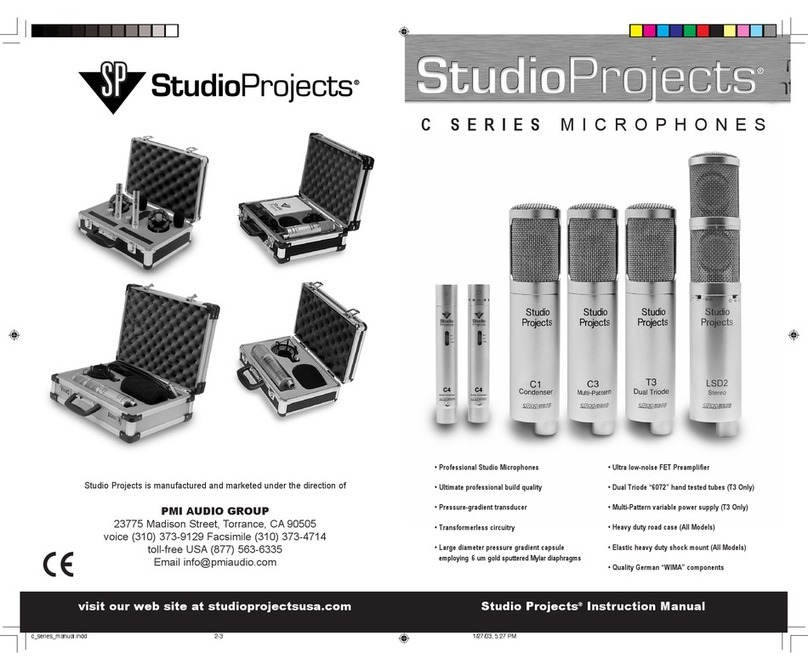
INSTRUCTION BOOK CONTENTS
What is Studio Projects............................................................................................2
Description, Care .....................................................................................................2
Operation, Problems, Connecting up.......................................................................3
Using Studio Projects, Specification ......................................................................4
Origins and manufacture..........................................................................................4
Applications...............................................................................................................4
C1...............................................................................................................................5
C3...............................................................................................................................6
T3...............................................................................................................................7
WHAT IS STUDIO PROJECTS?
Thereare manymicrophonebrands ontoday’s market, andGerman microphonesare the mostsought after.
StudioProjects wascreated tooffera bettermicrophone fora betterprice tomeeta needin today’smarket.
Studio Projects was designed with German engineering in mind. We offer German quality and sound for a
fractionofthecost.Theproofisinthelistening.Byusingcustom6umcapsulesandGermanWIMAcomponents,
Studio Projects competes both in quality build, and sonic performance with those famous German brands.
Studio Projects has partnered with 797 Audio, a leading manufacturer in China for over 50 years that has
been building some German brand microphones. We like them so much, we put their name on all of our
microphones.As aresult ofthis partnership,our quality issignificantly betterthan otherbrands, asour partner
hasavested interestin Studio Projects,mainly their name!PMI Audio Groupis aleadingdistributor ofpro-
fessional audio products, and have brought quality products to market like, Joemeek and Trident-MTA.
Havingmany yearsof experience with microphones, StudioProjects wascreated toprovide aquality product
at an affordable price. This will be evident as soon as you plug them in. Studio Projects will continue to
bring quality products to market.
DESCRIPTION / CARE
Although the “mylar” membrane on the capacitor is more robust than the gold foil used by the origi-
nal German designs of the 1930s, it is extremely fine and liable to damage if mishandled. There are
two safety factors that MUST be remembered when handling these microphones:
1) Keep the microphone dry.
2) Avoid wind or air blasts directly onto the capsule.
All electronic equipment should be kept dry, but it is even more important to avoid any damp condi-
tions when using high quality condensor microphones. Damp can cause partial short circuits in the
polarizing voltage, this will cause crackling noises and low output. The most important instruction for
condensor microphones is NEVER blow at the capsule. Damage caused by blast of air on the capsule
are often permanent and require the complete replacement of the capacitor element (capsule). Never
use the microphone in the open air without substantial wind protection.
ELECTRICAL FEATURES
The C1 & C3 is a “transformerless microphone”. With transformerless technology, the usual output
transformer is replaced by an electronic circuit. The C1 & C3 ensures good common mode rejection,
and prevents RF interference, that may influence the balanced audio signal.
The C1 & C3 when compared to other microphones has very low noise and is capable of handling
sound pressure levels up to 138 dB without distortion.
OPERATION
The C1 & T3 is capable of handling high sound volume levels so it can be used safely close to musical
instrument amplifiers, however, the C1 is best suited for those high volume applications. If the amplifier
soundisveryloud,this mayoverloadthemicrophoneamplifier. Simplyadjusttheleveltothe microphone
or reposition it. It is a very low noise microphone and suitable for vocal recording to the highest quality.
TheC3 and T3 are more suited for critical vocal recordings, strings, overheads, Broadcast,and production
use. Experimentation is critical for optimum performance. Microphone placement is crucial to a proper
recording.
The C1 & C3 is addressed from the front, marked with the Studio Projects logo. The large diaphragm
capsuleinside the headgrillehas avery smooth frequency response, thereforethe acousticinformation
is not affected in its tonal quality when recorded by the microphone. The microphone maintains an
excellent response reproducing all transient material of music and speech without coloration.
PROBLEMS
Should any microphone accidentally become damp and fail to operate properly (start crackling, or go
very quiet) then place it in a warm and very dry environment for 24 hours. The ideal environment is an
airing cupboard. Studio Projects are extremely resistant to physical damage, but if the microphone
fails to work after being dropped, it should be returned in adequate packing to the supplier. A double
test and inspection system means that manufacturing faults are non-existent but should any fault
occur, it will be repaired (or replaced) free of charge excepting where the fault has been caused by
physical damage.
CONNECTING UP
Using a high quality balanced and screened(shielded) audio cable, connect the C1 or C3 microphone
to the microphone amplifier input and switch on the 48V phantom power. NOTE, the microphone will
notoperate unless48V phantom poweris provided.The microphoneshouldbe poweredup forat least
one minute before it will operate correctly as the polarizing voltage on the capsule needs to stabilize.
Somebackground noise ispossible during thefirst fewseconds after switchon. Keep thegain controls
on the microphone amplifier or mixer well down as the output from the microphone is high (as most
capacitor microphones). For the T3, use the supplied cable to hook the microphone and power supply
(PST3) together. Use a balanced and screened(shielded) audio cable to connect to a mic amplifier. DO
NOT USE A PHANTOM POWER SOURCE FOR THE T3. The T3’s supply powers the mic.
32