Actron CP9087 Bedienungsanleitung

®
CP9087
TM
PROFESSIONAL
PULSE
9V BATTERY TEST: 1) SET RANGE TO HIGH.
2) SET FUNCTION TO OHMS. 3) DISCONNECT ALL LEADS.
O.K. IF TOPMOST TEST LIGHT IS ON. WEAK IF ANOTHER LIGHT IS ON.
RANGE
FUNCTION
IGNITION MODULE &
ENGINE SENSOR TESTER
TEST
RICH
LEAN
Select
LOW,
VOLTS
HIGH
LOW
POWER OFF
VOLTS
OHMS
FREQUENCY
SIGNAL COMMON TRIGGER POWER 9V

Vehicle
Service
Info
Vehicle Service
Manuals from General
Motors Corporation
Buick, Cadillac,
Chevrolet, GEO, GMC,
Oldsmobile & Pontiac
Helm Incorporated
Post Office Box 07130
Detroit, MI 48207
Saturn
Adistra Corporation
c/o Saturn Publications
101 Union Street
Post Office Box 1000
Plymouth, MI 48170
Vehicle Service
Manuals from Ford
Motor Company (Ford,
Lincoln, Mercury)
Ford Publication Dept.
Helm Incorporated
Post Office Box 07150
Detroit, MI 48207
Vehicle Service
Manuals from Chrysler
Corporation
Chrysler Corporation
Dyment Distribution Service
Post Office Box 360450
Strongsville, OH 44136
Vehicle Service Manuals
Haynes Publications
861 Lawrence Drive
Newbury Park, CA 91320
Motor’s Auto Repair Manual
Hearst Company
250 W. 55th Street
New York, NY 10019
Suitable manuals have titles such as:
“Electronic Engine Controls”
“Fuel Injection and Feedback Carburetors”
“Fuel Injection and Electronic Engine Controls”
“Emissions Control Manual”
... or similar titles.
Chilton Book Company
Chilton Way
Radnor, PA 19089
Cordura Publications
Mitchell Manuals, Inc.
Post Office Box 26260
San Diego, CA 92126
The following publishers have manuals containing diagnostic information for
electronic engine control and ignition systems. Contact the publishers for
availability and pricing, specifying the make, model and year of your vehicle.
Some manuals may be available at auto parts stores or your local public library.
Vehicle Service
Manuals from Toyota,
Honda, Nissan
Toyota Motor Corporation
Toyota Service Publications
750 W. Victoria Street
Compton, CA 90220-5538
Honda Motor Co., Ltd.
Helm Incorporated
Post Office Box 07280
Detroit, MI 48207
Nissan North America, Inc.
Dyment Distribution Service
c/o Nissan
20770 Westwood Drive
Strongsville, OH 44136

Index
i
Vehicle Service Information ...................... Inside front cover
Safety Precautions ............................................................... ii
Tester Basics............................................. 1-1
Testing Sensors ..........................................2-1
• Troubleshooting Tips .......................................... 2-1
• Engine Coolant Temperature.............................. 2-2
• Inlet Air Temperature .......................................... 2-3
• Throttle Position (TP) .......................................... 2-6
• EGR Valve Position (EVP)................................ 2-14
• Oxygen .............................................................. 2-18
• Engine Knock .................................................... 2-26
• Manifold Absolute Pressure (MAP/BARO) ....... 2-28
• Mass Air Flow (MAF) ........................................ 2-34
• Vane Air Flow.................................................... 2-40
• Crankshaft/Camshaft Position .......................... 2-46
Magnetic Reluctance Type ......................... 2-49
Hall Effect or Optical Type .......................... 2-51
Testing Ignition Modules............................3-1
More Uses for the Sensor Probe ...............4-1
• "Circuit Tester" Voltage Check ........................... 4-1
• Continuity Checks ............................................... 4-2
• Diode Check........................................................ 4-4
Section
1
2
3
4

6-3
ii
General Safety Guidelines to Follow When
Working on Vehicles
• Always wear approved eye protection
• Always operate the vehicle in a well-ventilated area. Do not inhale exhaust
gases – they are very poisonous!
• Always keep yourself, tools, and test equipment away from all moving or hot
engine parts.
• Always make sure the vehicle is in Park (automatic transmission) or Neutral
(manual transmission) and that the parking brake is firmly set. Block the drive
wheels.
• Never lay tools on vehicle battery. You may short the terminals together,
causing harm to yourself, the tools, or the battery.
• Never smoke or have open flames near vehicle. Vapors from fuel or charging
batteries are highly flammable and explosive.
• Never leave vehicle unattended while running tests.
• Always keep a fire extinguisher suitable for all types of fires handy.
• Always turn ignition key OFF when connecting or disconnecting electrical
components, unless otherwise instructed.
• Use shop rags to cover fuel line fittings when connecting or disconnecting fuel
lines. Avoid contact with fuel. Dispose of all rags properly.
• Clean up all fuel spills immediately.
• Keep away from engine cooling fan. On some vehicles, the fan may start up
unexpectedly.
• You must follow vehicle service manual cautions when working around the air
bag system. If the cautions are not followed, the air bag may open unexpect-
edly, resulting in personal injury. Note that the air bag can still open up several
minutes after the ignition key is turned OFF (or even if the battery is discon-
nected) because of a special energy reserve module.
• Always follow vehicle manufacturer’s warnings, cautions, and service procedures.
Safety
First

1
1-1
Section Tester
Basics
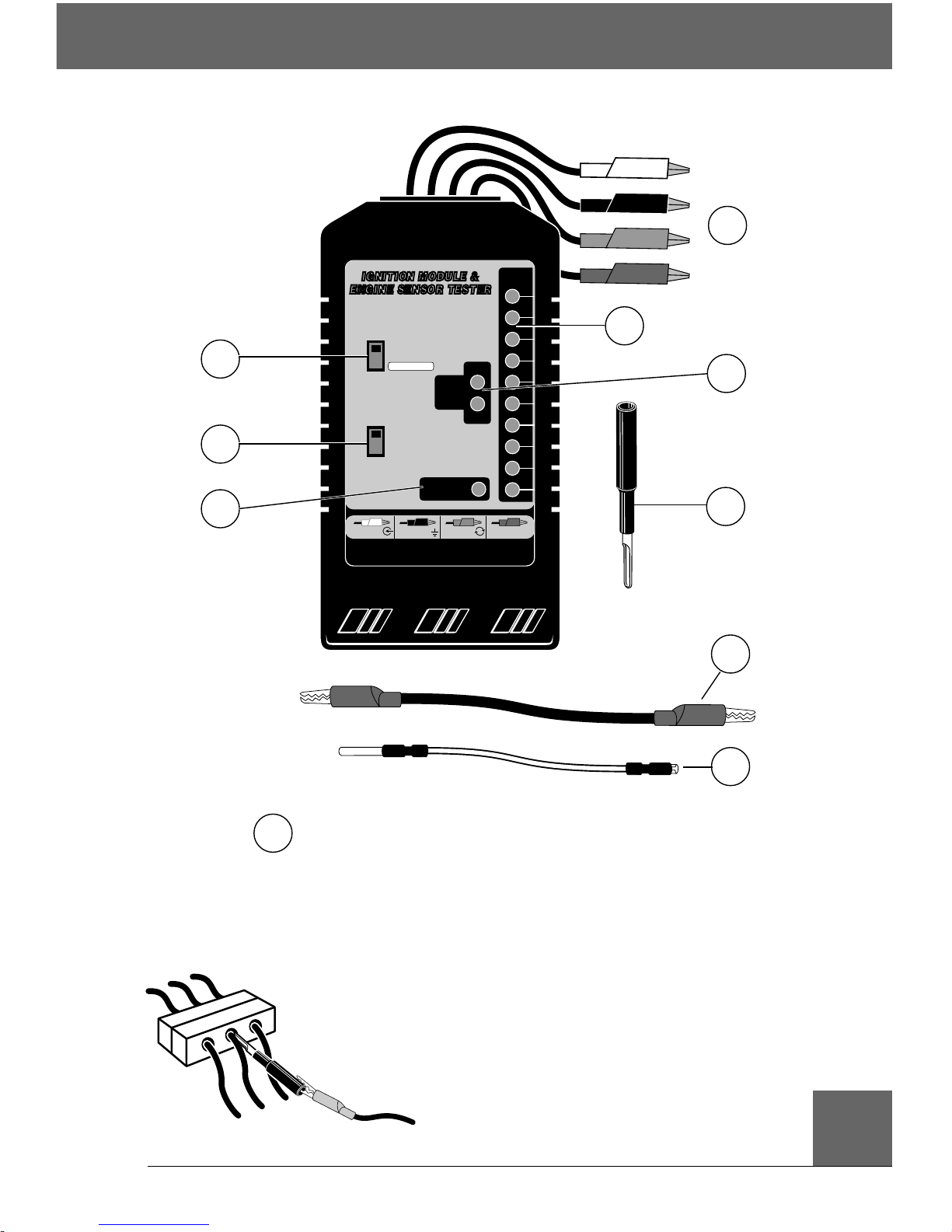
— Description of Controls and Accessories
— Installing and Checking the 9 Volt Battery
Note: Detailed procedures for testing sensors and ignition modules are
located in Section 2 (sensors) and Section 3 (ignition modules).
Controls power to the Tester and selects measure-
ment range sensitivity (as required by various
sensor tests).
• POWER OFF - No power supplied to either the
tester or RED test lead.
• LOW - Tester powered up for use. Voltage from
9 volt battery supplied to RED test lead. Selects
range for measuring low levels of voltage,
resistance or frequency.
• HIGH - Tester powered up for use. Voltage from
9 volt battery supplied to RED test lead. Selects
range for measuring higher levels of voltage,
resistance or frequency.
Selects the type of signal being measured (for
conducting sensor and ignition module tests). Different
kinds of signals are used by various sensors.
• VOLTS - Measures voltages. This function is used
to test most sensors.
• OHMS - Measures resistance. Also used for
checking continuity and testing diodes (see section
4). Mostly used for testing temperature sensors.
• FREQUENCY - Measures frequency signals.
(Peak signal voltage must be at least 3 volts
to register.) Some MAP and MAF sensors
send a frequency signal. This function is
also used to test ignition modules.
1
RANGE
Switch
FUNCTION
Switch
2

Section
1
1-2
3
TEST
Lights
A single TEST light turns on to show the level of a measured signal
(voltage, resistance or frequency). When signal values are low, the
TEST light is off or near the bottom of the column. The TEST light
moves higher up the column as the signal level increases.
Sensor tests involve working the sensor and watching the TEST
light move up, down or flash. Note that the motion of the light is
more important than its actual position.
Used when testing ignition modules. The PULSE light will flash
if the module is good.
Note that the PULSE light will also be on (or flash) whenever
frequency signals are being measured - this is normal.
4
PULSE
Light
RICH/
LEAN
Lights
5These lights are active when the tester switches are set to LOW
VOLTS only.
• LEAN (green): ON for voltages between 0.1 and 0.59 volts.
• RICH (red): ON for voltages above 0.6 volts.
The RICH/LEAN lights work along with the TEST lights and are
helpful when testing oxygen sensors. The RICH/LEAN lights may be
ignored when testing other sensors using the LOW VOLTS range.
6
Test
Leads
Two or more of these are used for the various tests and checks.
Yellow - The SIGNAL lead. Signals probed by this lead cause
the TEST lights to react. Usually connected to a sensor or
ignition module output circuit during testing.
Black - The COMMON lead. Used as a circuit ground or signal
reference point for all tests and checks. This lead is always
used.
Green - The TRIGGER lead. Used when testing ignition
modules. Sends a signal to “fire” the module. Usually connected
to the module crankshaft/camshaft input circuit.
Red - The 9V power lead. This lead is connected to the 9 volt
battery inside the tester whenever the RANGE switch is in the
LOW or HIGH positions. Ignition modules and some sensors
require this power for testing.
6

PULSE
9V BATTERY TEST: 1) SET RANGE TO HIGH.
2) SET FUNCTION TO OHMS. 3) DISCONNECT ALL LEADS.
O.K. IF TOPMOST TEST LIGHT IS ON. WEAK IF ANOTHER LIGHT IS ON.
RANGE
FUNCTION
IGNITION MODULE &
ENGINE SENSOR TESTER
IGNITION MODULE &
ENGINE SENSOR TESTER
TEST
RICH
LEAN
Select
LOW,
VOLTS
HIGH
LOW
POWER OFF
VOLTS
OHMS
FREQUENCY
SIGNAL COMMON TRIGGER POWER 9V
Tester Basics
1-3
Allows test lead to probe sensor circuits when the sensor is
connected to vehicle wiring harness.
• Slide the “scooped” end of adapter next to circuit wire
entering rear of connector.
• Continue pushing adapter until it touches terminal inside
connector. (Slightly twisting adapter while pushing may
ease entry)
• Grasp open end of adapter with test lead clip. Keep
pushing on adapter to maintain circuit contact.
Caution: The “scooped” end of the
adapter will break if you bend it.
7
Backprobe
Adapter
2
3
4
1
6
9
8
7
5
To Sensor
To Computer

Section
1
Tester Basics
1-4
8Used when checking some ignition modules. Makes
extra connections as required for testing.
Jumper Lead
9
Connector
Pin Adapters
Used for easier attachment of test leads to certain
sensor or wiring connector pins.
• Push one end of the adapter onto the desired
connector pin.
• Grasp the other end with the test lead clip.
Sensor
Tester
Power
A 9-volt transistor radio battery must be installed to
power the unit. Use an alkaline battery (conventional
batteries are too weak for ignition module testing).
Installing the Battery
1. Hold the tester face down with both hands.
2. Using both thumbs, firmly press downwards and
outwards on the battery compartment door at the
bottom of the tester.
3. Slide the battery compartment door away from the
tester to remove.
4. Attach battery to connector and install inside
compartment.
5. Replace battery door. Slide door inwards until it
snaps closed.
Checking the Battery
1. Make sure none of the test leads are connected
together or touching anything.
2. Set RANGE switch to HIGH.
3. Set FUNCTION switch to OHMS.
4. Battery is good if the top TEST light is ON. If any light
below the top TEST light is ON, the battery is too
weak for reliable testing and should be replaced.
TIP: To extend battery life, always switch to POWER
OFF when not making a measurement. This is safe to
do even if the tester is connected to a circuit.
9V
RANGE
HIGH
LOW
POWER OFF
FUNCTION
VOLTS
OHMS
FREQUENCY
TEST

2-1
Section 2
Section
2
Testing Sensors
Troubleshooting
Tips
Save yourself time! Always begin with a thorough
visual and “hands-on” inspection. You can often
find the cause of many problems by just looking.
• Has the vehicle been serviced recently?
Sometimes things get reconnected in the wrong
place, or not at all.
• Don’t take shortcuts. Inspect hoses and wiring
which may be difficult to see due to location.
• Inspect the air cleaner and ductwork for defects.
• Check sensors and actuators for damage.
• Inspect all vacuum hoses for:
– Correct routing. Refer to vehicle service
manual, or Vehicle Emission Control Information
(VECI) decal located in the engine compartment.
– Pinches and kinks.
– Splits, cuts or breaks.
• Inspect wiring for:
– Contact with sharp edges (this happens often).
– Contact with hot surfaces, such as exhaust
manifolds.
– Pinched, burned or chafed insulation.
– Proper routing and connections.
• Check electrical connectors for:
– Corrosion on pins.
– Bent or damaged pins.
– Contacts not properly seated in housing.
– Bad wire crimps to terminals.
FRONT
OF CAR
U.S.A.
E
M
G GAP
YST
CE BOOSTER
HVAC
CRUISE
BRAKE BOOSTER
TO TRANS
MODE
EGR
VAC
REG
EGR
VAC
REG
FUEL
PRESS
REG.
12RAC8
6DLC24
5AAC28

Section 2
2-2
Engine TEMPERATURE
What to
Inspect Sensor operation (see test on page 2-4). Poor
connections at sensor or computer. Faulty sensor
wiring (open or short circuits). Heavy deposits on
sensor tip which can cause poor response.
Leakage into sensor housing. Engine running too
hot (problems with antifreeze, thermostat, water
pump, fan, belts, low engine oil).
When to Test • Related trouble codes sent by computer.
• Driveability problems such as hard starting,
rough idle, stalling, hesitation, stumble, surging,
knocking (pinging), poor fuel economy, or black
exhaust smoke.
Location The sensor is usually threaded into the engine
block, lower intake manifold, or cylinder head to
provide direct contact with coolant.
How is It
Used? The computer needs to know engine temperature
so it can modify air/fuel ratios, spark advance, idle
speed, and emission device operation (such as an
EGR valve).
What is It? The engine temperature sensor is a thermistor - a
resister whose resistance changes with tempera-
ture. The hotter the sensor gets, the lower the
resistance becomes. The thermistor is mounted
inside the tip of a threaded metal housing. This is a
2-wire sensor. (Exception: some Chrysler engines
have a dual sensor with three wires.)
HIGH
SENSOR
RESISTANCE
LOW
Cold Hot
TEMPERATURE
Typical Engine Coolant
Temperature Sensor

Inhaltsverzeichnis
Andere Actron Autozubehör Handbücher

Actron
Actron Compression Tester CP7821 Bedienungsanleitung

Actron
Actron OBD II PocketScan Code Reader CP9125 Bedienungsanleitung

Actron
Actron 2513 Bedienungsanleitung

Actron
Actron Global OBD II Scan Tool 9620 Bedienungsanleitung

Actron
Actron OBD II PocketScan Code Reader CP9125 Bedienungsanleitung

Actron
Actron SCANTOOL CP9110 Bedienungsanleitung