
Blunik Trip II PLUS Bedienungsanleitung
BLUNIK TRIP — MANUAL
www.blunik.com
ENG

| v.01 |
BLUNIK TRIP = BLUNIK II PLUS — SPEED TABLE


BLUNIK II PLUS INSTRUCTIONS
· 3 ·
OPERATING MANUAL
CONTENTS
1. INTRODUCTION…………………………………………………………………….…………07
1.1 What is a regularity rally?…………………………….......…………………..............…..07
1.2 How to participate in a regularity rally…………………………….......................09
2. WHAT DOES THE BLUNIK II PLUS CONTRIBUTE TO REGULARITY?.…..…10
3. OPERATION OF THE BLUNIK II PLUS…………………………………….........……12
3.1 Key functions……………………………………………………………..........................…..13
3.2 BLUNIK II PLUS parameters…………………………………………........….......….….15
3.3 Stage programming……………………………………........…..…..............................19
4. INSTALLATION AND CONNECTION………………………………….………....……20
4.1 Connection……………………………………………………………………….................……20
4.2 The wheel sensors……………………………………………………………...........….....…20
5. HOW TO USE BLUNIK II PLUS…………………………………………….…..…......…21
5.1 Summary of the key functions with BLUNIK Inactive…....…....................21
5.2 Calibration……………………………………………………………………………............…..22
5.3 Start protocol – activate a stage………………………………….....................……22
5.4 Screens with BLUNIK Active……………………………………………………..............24
5.5 Actions with BLUNIK Active – against the clock section………………...….25
5.5.1 Distance corrections…………………………………………………………...….25
5.5.2 Our route mistakes……………………………………......…....…………...…..25
5.5.3 Verications………………………………………………………………........…...…26
5.5.4 Compensations………………………………………………………….......…...…26

· 4·
5.5.5 Light brightness…………………………………………………........…….....……27
5.5.6 How to nish a stage – deactivate a stage…………...….….............27
5.6 Summary of key actions with BLUNIK Active…………………….….……...…....28
6. MORE INFORMATION………………………………………………………….........……29
6.1 Rally language…………………………………………………….....…................................29
6.2 Importance of distance measurements………………………………...........…...29
6.3 How to synchronise the clock……………………………………………....…..........…31
6.4 Memories……………………………………………………....……….....……………........……31
6.5 Data validation……………………………………....……….....……………........….........…32
6.6 Change the brightness of the night light……………....……………..........…..…32
6.7 Stage related concepts…..……………………………..........................................…33
6.8 Stage operation modes……………………………..........................................…….33
6.9 Programming a dierent stage……………………………………....…….....…......…34
6.10 Sensor selection……………………………………....………..............…..................…34
6.11 Sensor verication……………………………………....……….................…...........…37
6.12 Sensor information……………………………………....………................…...........…37
6.13 Manual calibration........................……………………………………....………..........37
6.14 Automatic calibration……………………………………....………..........................…38
6.15 START modes……………………………………....………...........................................39
6.16 START button actions……………………………………....………..........................…40
6.17 Accuracy adjustments……………………………………....………........…..............…41
6.18 Changing the average on an external reference……………………….....…42
6.19 Changing the average -unknown……………………………………....……….....…42
6.20 Distance corrections……………………………………....………...........................…43
BLUNIK II PLUS INSTRUCTIONS
· 5 ·
6.21 FINISH button actions……………………………………………….........…......……....43
6.22 Usage of Oset………………………………………………………………................……43
6.23 Calculations made by the ZERO/Calculate button………………........……44
6.24 “Imposed average” mode............................…………………………....……........46
6.25 “Road book” mode………………………………………………………………....…......…47
6.26 “Long sections” mode……………………………………………………………….....……48
6.27 “Imposed tables” (JP) mode………………..………………………………......…....….49
6.28 “Learn / copy” mode…………………………………………………….....…...............…49
6.29 “Partial copy” mode………………………………………………………………........….…50
6.30 SCREEN II Driver’s screen…………………………………………………...….........…..51
6.31 B-Sport Drive………………………………………………………….....…………….....…….52
6.32 B-Sport Calculator………………………………………………….....……………......……53
6.33 B-Acustic Drive………………………………………………………….....……………...……54
6.34 B-Super-Acustic Drive…………………………………………………….....…………...…55
6.35 B-Pad……………………………………………………………………………….............…...…56
6.36 B-Data-Fast…………………………………………………………………..........…....…...…56
6.37 B-Remote…………………………………………………………………….....……...……...…57
6.38 B-Pedal…………………………………………………………………….........….......……...…58

· 6·
BLUNIK II PLUS INSTRUCTIONS
· 7 ·
1. INTRODUCTION
This manual aims to explain a little about the world of tests done in classic
cars.
There are dierent organised activities that can be done in a vehicle (car or
motorbike):
Concentrations.
Navigation rallies. Tests that rely on skill following a route using
maps, road books, etc.
Regularity rallies. Tests in which, apart from following a set route,
we have to comply with certain times and speeds. They are usually
run on public roads and respecting driving regulations.
Speed rallies. They are run on circuits closed to the trac with
maximum safety measures both in the vehicle and on the road.
Specially prepared vehicles are required.
Regularity sport rallies. This is a mixture of regularity and speed
and always run on circuits closed to trac.
1.1. WHAT IS A REGULARITY RALLY?
A regularity rally is a style of rally in which absolute speed is not the
principal objective, but rather the control of the speed, the time and the
distance travelled.
The organiser of a regularity
rally gives us a route to
follow (Road book) and some
specications about speeds,
times and distances with which
we have to comply (regulation).
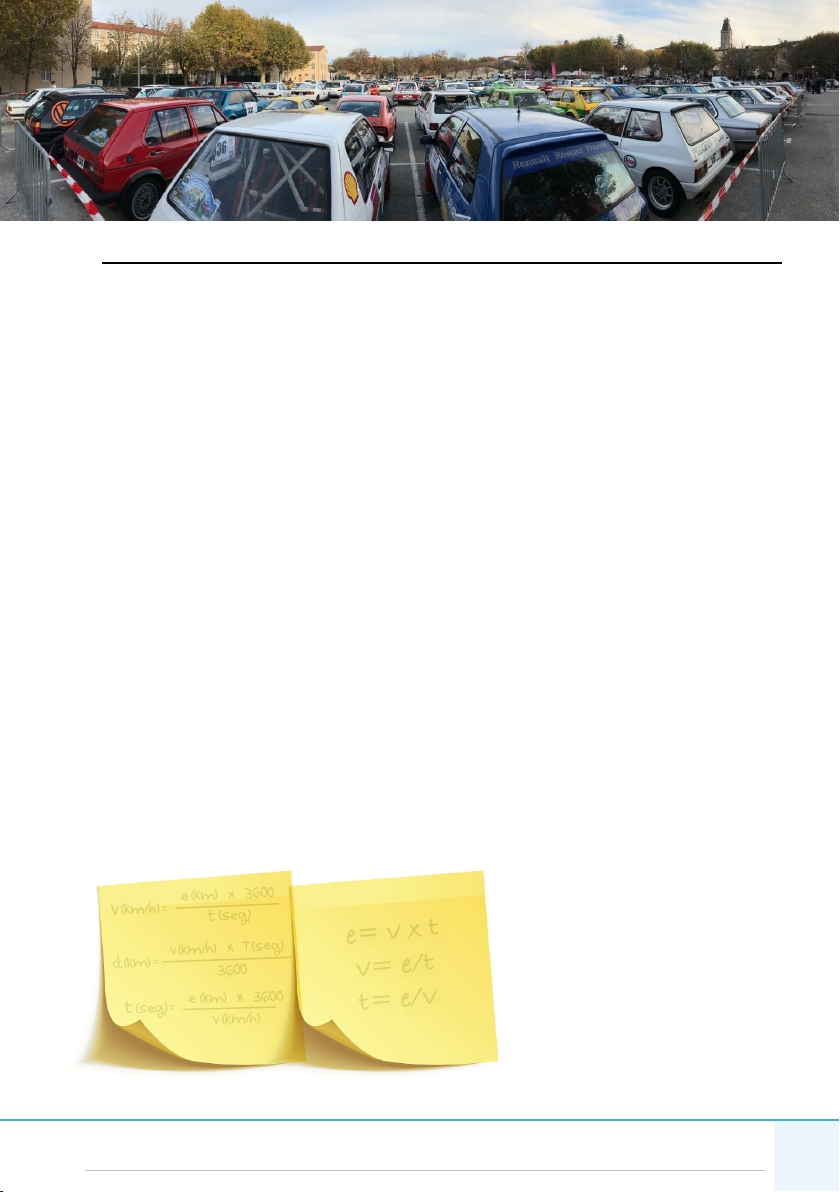
V (km/h) = e(km) x 3600
t
(seg)
d (km) = v(km/h) x t(seg)
3600
t(seg) = e (km) x 3600
v (km/h)
e= v x t
v= e/t
t= e/v
· 8·
There are many ways of giving us these specications. We can be set points
that we have to pass irrespective of the time. We can be given specic times
for passing certain points. We can also be given the average speed that we
have to meet for a set distance. They can set reproducing the same times as
in a previous run through the same area as a specication. The variations are
almost innite.
The organiser monitors our stage times at the opportune points. The
objective is to deviate as little as possible from the set times.
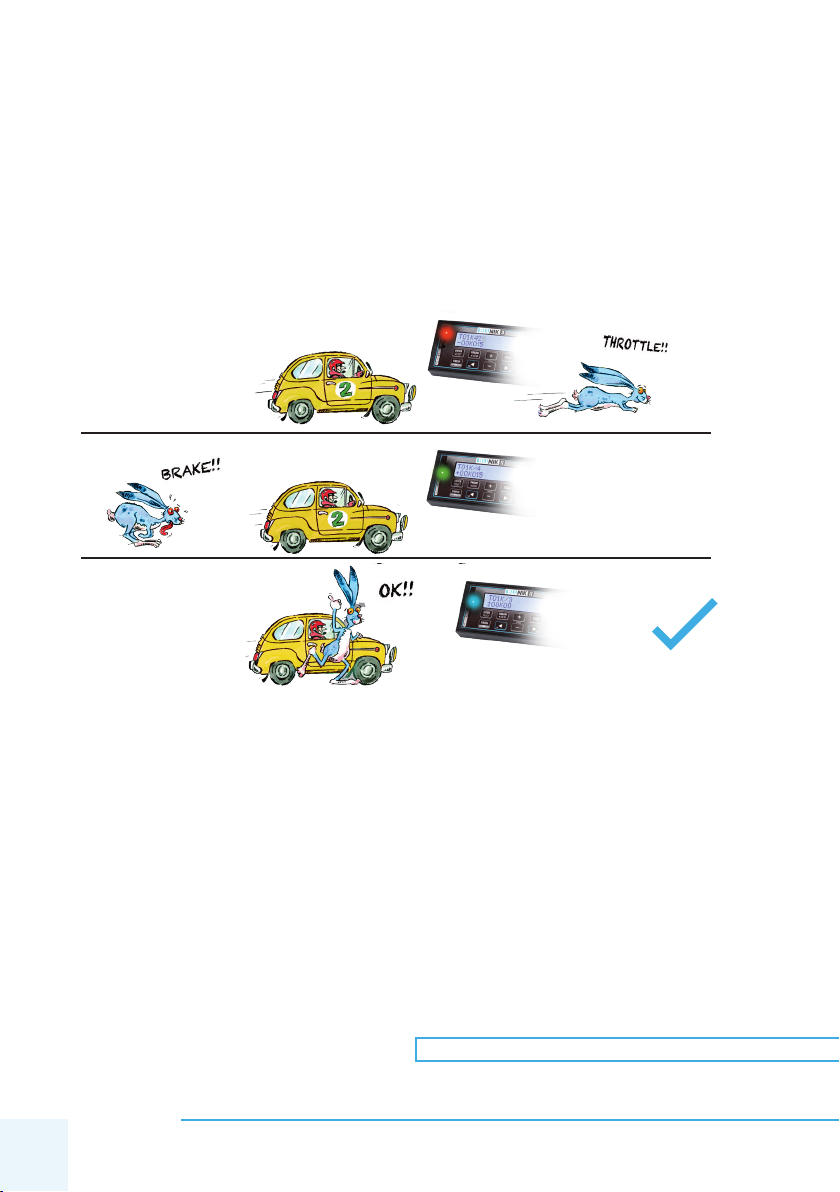
It is as if we had to chase a hare. It would be very easy; but since we cannot
see the hare, we just have to imagine it.
Our clock must be perfectly synchronised with it. Easy! We have to measure
the distance in exactly the same way. Dicult!
To put it another way: The hare runs the theoretical distance in the
theoretical time and we follow the actual distance in real time.
We will be penalised for any time or distance deviation.
We will be penalised for being outside the time limits.
We will be penalised for not following the same route.
The classication is established with the sum of all the penalties. Whoever
has the lowest penalties wins the rally.
+info: RALLY LANGUAGE — page:029

BLUNIK II PLUS INSTRUCTIONS
· 9 ·
Nowadays some regularity rally organisers measure the road with extreme
precision (in metres) and take our stage times in tenths of a second.
Some of the participants in these precision rallies achieve spectacularly tight
results. With your Blunik II Plus, you can also manage this.
In a badly measured rally it is almost impossible to achieve good results. It
all becomes a matter of luck. When we realise that the measurements are no
good, it is already too late to make corrections. Whatever we do, our results
will only get worse.
When a rally is well measured, but timed with little precision (manually or by
GPS) if we go round with maximum precision, we increase the possibilities of
our times being better than our rivals. Over greater distances, the inaccuracy
of the timekeeping aects us less.
1.2. HOW TO PARTICIPATE IN A REGULARITY RALLY
We will need a vehicle that complies with the specications laid down
in the rally regulations.
We have to be a 2 person team: pilot and co-pilot.
We need a good understanding of what a regularity rally is.
• It is not a race. It is not a question of speed.
• They will monitor that we follow the route.
• They are going to monitor lap times at certain points along the
route.
Our automobile must have a certain level of preparation.
• Mechanically reliable.
• Some kind of distance measurer. The vehicles own can be used
as to start with.
• A clock/stop-watch.
Inhaltsverzeichnis
Andere Blunik Messgerät Handbücher


