
Genebre 2403 Bedienungsanleitung
Genebre Building. Av. de Joan Carles I, 46-48
08908 L'Hospitalet de Llobregat. Barcelona (Spain)
genebre@genebre.es - www.genebre.es
GENEBRE S.A.
LAST UPDATE: 04/08/2020 UPDATE NUMBER: 0
1
INSTALLATION, OPERATION AND MAINTENANCE
MANUAL
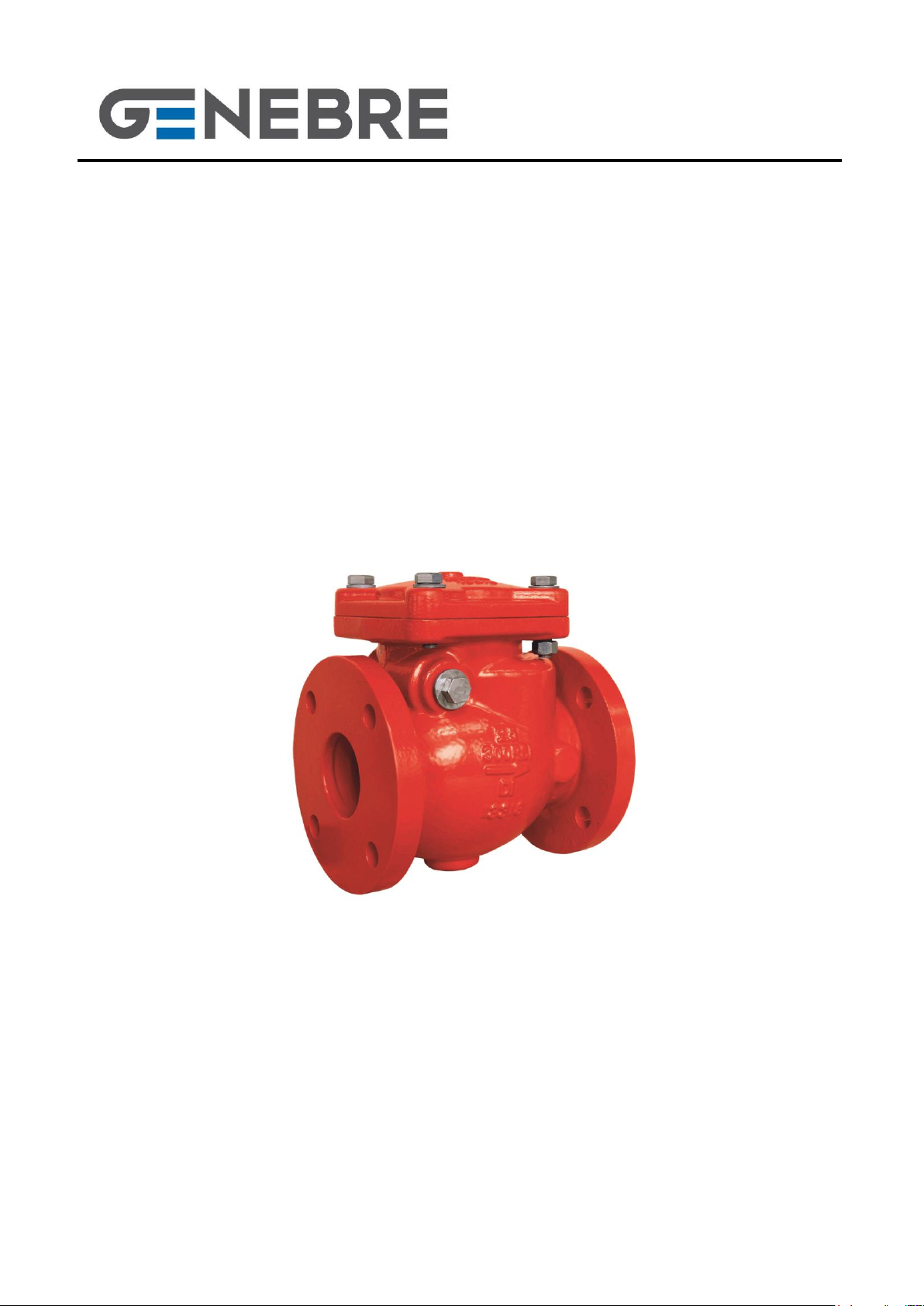
Swing Check valve
Flanged ends –UL/FM Certification
Ref. GENEBRE: 2403

Genebre Building. Av. de Joan Carles I, 46-48
08908 L'Hospitalet de Llobregat. Barcelona (Spain)
genebre@genebre.es - www.genebre.es
GENEBRE S.A.
LAST UPDATE: 04/08/2020 UPDATE NUMBER: 0
2
Installation, operation and maintenance instructions
1) PRODUCT DESCRIPTION.................................................................................................3
2) ASSEMBLY DRAWING AND PARTS LIST .......................................................................3
3) TRANSPORT AND STORAGE CONDITIONS ...................................................................4
4) INSTALLATION INSTRUCTIONS ......................................................................................4
4.1) PREPARATION ................................................................................................................................ 4
4.2) INSTALLATION OF VALVES WITH FLANGED ENDS ........................................................................... 5
5) OPERATION INSTRUCTIONS ...........................................................................................5
5.1) USAGE ........................................................................................................................................... 5
6) MAINTENANCE OPERATIONS .........................................................................................6
7) REPAIR INSTRUCTIONS...................................................................................................6
9) HYGIENE AND SAFETY INSTRUCTIONS: .......................................................................6
Genebre Building. Av. de Joan Carles I, 46-48
08908 L'Hospitalet de Llobregat. Barcelona (Spain)
genebre@genebre.es - www.genebre.es
GENEBRE S.A.
LAST UPDATE: 04/08/2020 UPDATE NUMBER: 0
3
1. Product description
Genebre, S.A. offers a wide range of valves designed and assembled to handle and drive
fluids.
The compatibility of materials used to build the valves (see technical specifications) and the
application of valves to the different industrial processes is at user's risk. Valves will have an
optimal behaviour when working conditions do not exceed pressure and temperature limits
(pressure curve) for which they have been designed. Please, refer to the product datasheet.
Art. 2403: Ductile Iron Check Valve (Swing Disc) with EPDM seal. UL/FM certification for use
in fire protection systems.
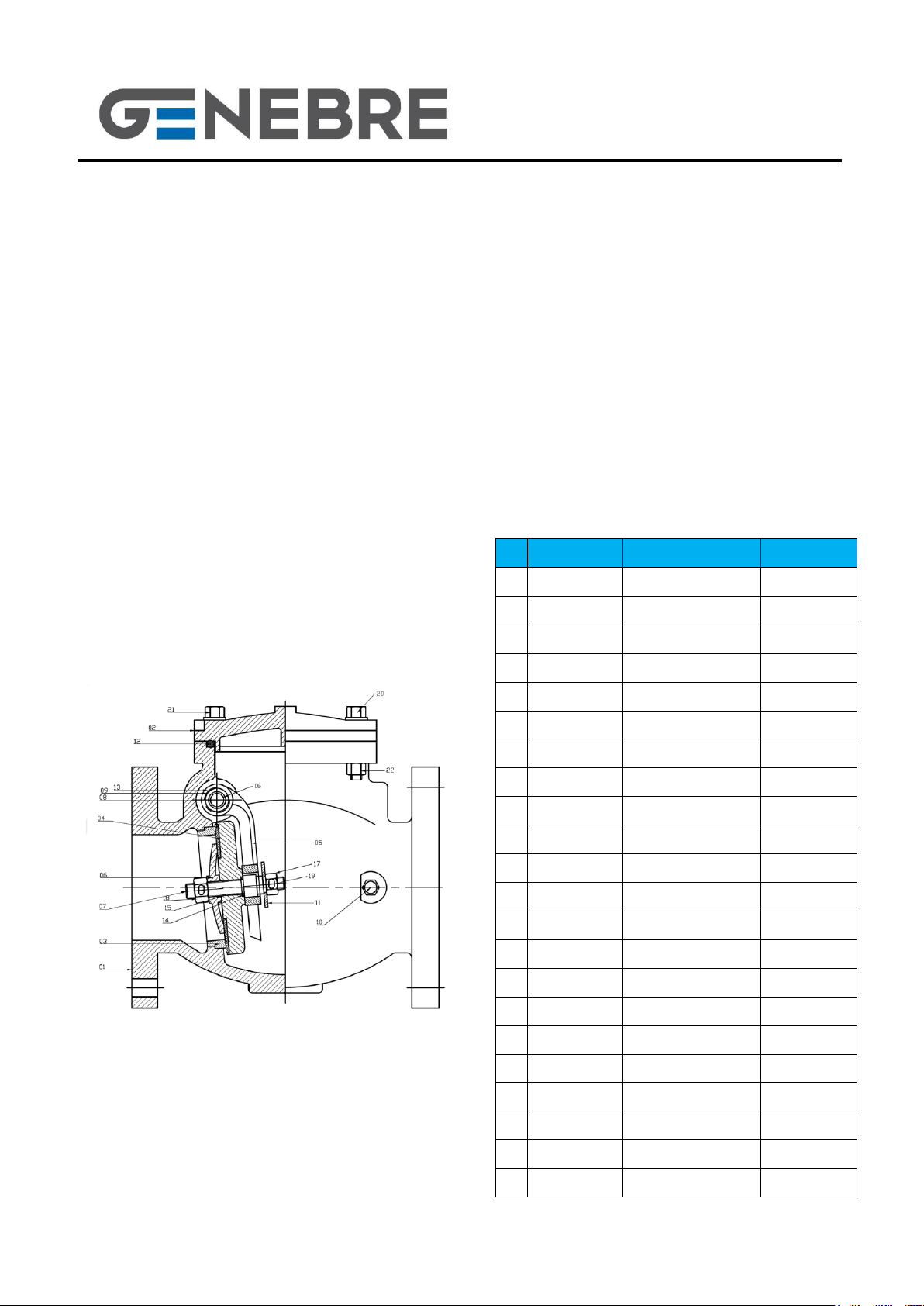
2. Assembly drawing and parts list
Nº
Name
Material
Surface
Treatment
1
Body
Ductile Iron
EN-GJS-400
Epoxy coating
2
Bonnet
Ductile Iron
EN-GJS-400
Epoxy coating
3
Seat Ring
C95400
------
4
Disc
Ductile Iron
EN-GJS-400 + EPDM
------
5
Rocker arm
Ductile Iron
EN-GJS-400
------
6
Baffle plate
C95400
------
7
Middle plate
AISI 304
------
8
Pinned stem
AISI 304
------
9
Bracket screw
AISI 304
------
10
Plug
C95400
------
11
Gasket
Stainless Steel 304
------
12
O’ring
EPDM
------
13
O’ring
EPDM
------
14
O’ring
EPDM
------
15
O’ring
EPDM
------
16
Bushing
Bronze
------
17
Nut
Stainless Steel 304
------
18
Nut
Stainless Steel 304
------
19
Pin
AISI 304
------
20
Bolt
Steel
------
21
Bolt
Steel
------
22
Nut
Steel
------

Genebre Building. Av. de Joan Carles I, 46-48
08908 L'Hospitalet de Llobregat. Barcelona (Spain)
genebre@genebre.es - www.genebre.es
GENEBRE S.A.
LAST UPDATE: 04/08/2020 UPDATE NUMBER: 0
4
3. Transport and Storage conditions
Transport and storage of this kind of products must be done keeping them in their
original package!
VISUAL INSPECTION
Check whether during transport, unloading and placement the products have suffered
damages.
During storage it is recommended to keep them into the included protective wrapping to
avoid damages or dirt accumulation in the inside part of the valve. The wrap must not be
removed until valve is to be installed.
Valves must be stored in a dry and clean environment.
If you notice any kind of anomaly during reception of the goods, contact immediately with
GENEBRE in order to determine the possible responsibilities on the issue.
IMPORTANT NOTE:
Before installing and/or manipulating these elements, READ CAREFULLY these
instructions for use and OBSERVE all contained information. If you fail to
understand any of their content, please contact GENEBRE, S.A.
The responsibility for the safe use of these products lies with the user in
accordance with the provisions of these instructions for use as well as the specific
technical documentation of the device supplied!
4. Installation instructions
4.1) Preparation
Remove any material remains of the valve wrapping.
Serious problems may arise with the installation of a valve in a dirty pipe.

Genebre Building. Av. de Joan Carles I, 46-48
08908 L'Hospitalet de Llobregat. Barcelona (Spain)
genebre@genebre.es - www.genebre.es
GENEBRE S.A.
LAST UPDATE: 04/08/2020 UPDATE NUMBER: 0
5
Make sure the pipe is not dirty and doesn’t have welding particles, for example, before
installing it. This may cause irreparable damages in the valve when the equipment is started
→ prepare a clean working area.
Plan beforehand enough space for future maintenance operations.
4.2) Installation of valves with flanged ends
Make sure the pipe's and edges flanges of the valve are clean.
Use the corresponding screws in all of the flanges drill holes.
Place an adequate joint in each end and align it in the centre of the flanges.
Tighten screws evenly and cross-shaped to avoid deformations. To do so, you must not force
in any case the pipe to centre the valve; it should take its position smoothly. Last, verify that
screws are tightened with the recommended torque for each type of screw.
Make sure the flanges joints are well placed.
After assembling, check the tightness and performance of the valve.
REMARKS:
- Check Valves, ref. 2403 are designed according to AWWA C508 to be
assembled between flanges ASME B16.10 Class 150 at a maximum working
pressure of 300 PSI.
- Verify good parallelism of the flanges.
- It is recommended the use of filters in the pipe to make the valves longer life.
- Any damaged paint/coating during installation must be immediately repaired.
5. Operation instructions
5.1) Usage
Check valves art. 2403 provide a leakproof seal when used adjusted to the pressure and
temperature values for which they have been designed.
Seat material for the valve, joints, body, disk and axis have to be fully compatible with the
fluid circulating through the valve. Otherwise, valve could be seriously damaged.
This valve is suitable for use in fire protection system.

Genebre Building. Av. de Joan Carles I, 46-48
08908 L'Hospitalet de Llobregat. Barcelona (Spain)
genebre@genebre.es - www.genebre.es
GENEBRE S.A.
LAST UPDATE: 04/08/2020 UPDATE NUMBER: 0
6
6. Maintenance operations
Check valves are designed so that they do not need any lubrication and/or periodical
maintenance during their life cycle.
However, periodical checks explained below will be useful to extend the service life of the
valve and reduce installation problems:
- Verify all locks and threaded ends to check if they are loose or with rust. Tighten them if
necessary.
- Inspect the valve and surrounding areas to verify if there is any leakage in the stem or in the
flange connections.
7. Repair instructions
These types of valves, due to their assembling specifications are not worth repairing,
because most of the times are simply not cost-effective, so we recommend to directly replace
them.
8. Hygiene and Safety Instructions:
8.1)When operating valves, you must follow the security instructions and it is recommended
to use personal protection gadgets:
1) Protect your eyes.
2) Wear gloves and appropriate working clothes.
3) Wear safety footwear.
Before disassembling the pipe's valve to clean or replace it, make sure that line
has been closed and depressurized because a bad operational procedure could
cause a serious accident to staff and installation system
Before installing new valve, check if it meets the requirements of the valve
being replaced

Genebre Building. Av. de Joan Carles I, 46-48
08908 L'Hospitalet de Llobregat. Barcelona (Spain)
genebre@genebre.es - www.genebre.es
GENEBRE S.A.
LAST UPDATE: 04/08/2020 UPDATE NUMBER: 0
7
4) Wear a helmet.
5) Have running water at hand.
6) To operate flammable fluids, make sure you have an extinguisher at hand.
8.2) Before removing a valve from a pipe, check always if the line is completely drained and
depressurized.
8.3) Any type of repair or maintenance should be performed in ventilated places.
Inhaltsverzeichnis
Andere Genebre Sanitärprodukte Handbücher

Genebre
Genebre IG20005-00 Bedienungsanleitung

Genebre
Genebre 2015 Bedienungsanleitung

Genebre
Genebre 67135 15 45 66 Bedienungsanleitung

Genebre
Genebre SIGMA 013669 Wartungs- und Serviceanleitung

Genebre
Genebre 2830 Bedienungsanleitung

Genebre
Genebre 568131 45 Installationsanleitung

Genebre
Genebre 67121 15 45 66 Bedienungsanleitung

Genebre
Genebre tucai GE2 Series Wartungs- und Serviceanleitung


