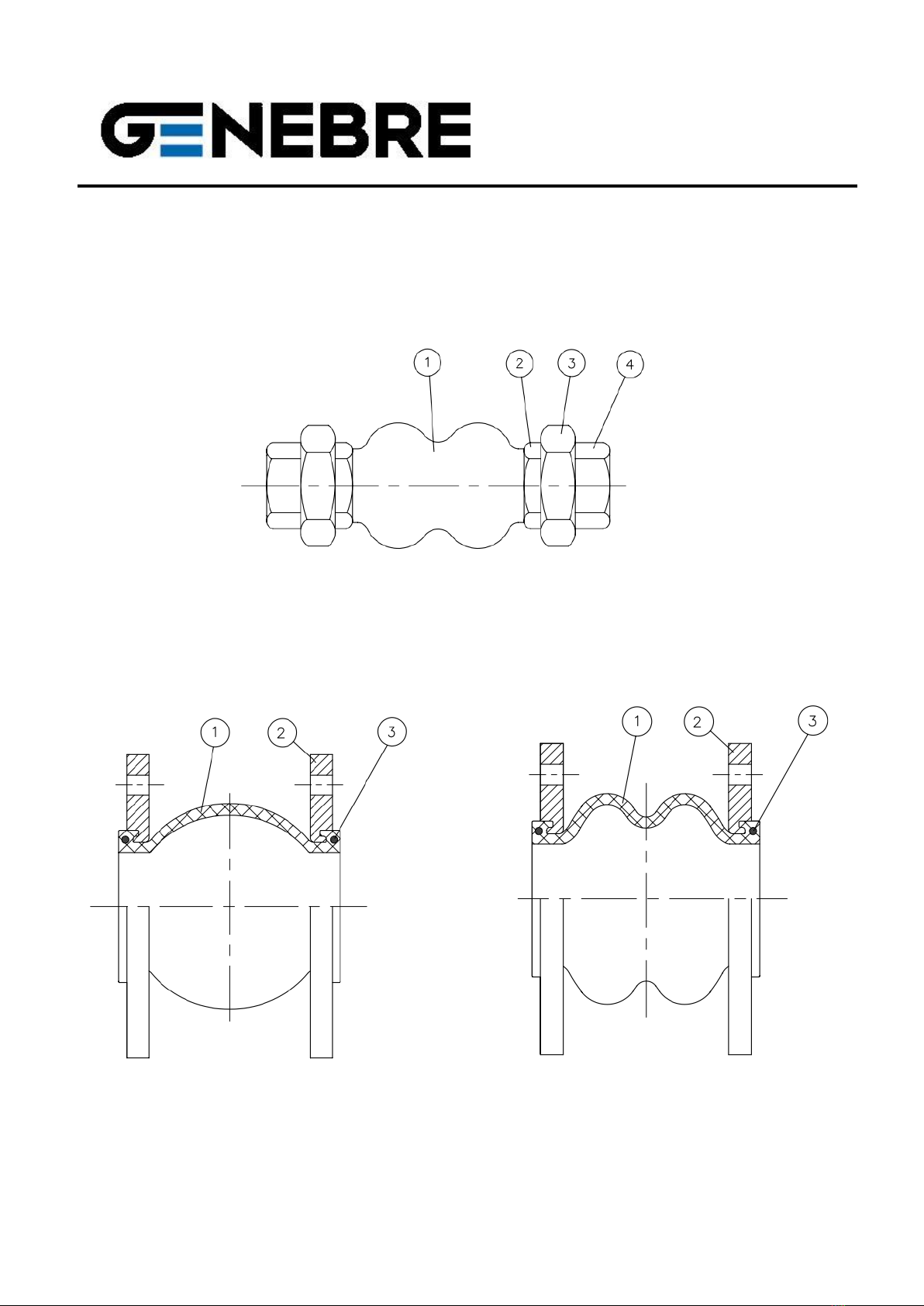
5
Make sure the pipe is not dirty and doesn’t have welding particles, for example, before
installing it. This may cause irreparable damages to the elastomer when the equipment is
started → prepare a clean working area.
Do not use sharp pointed objects when manipulating the product.
Plan beforehand enough space for future maintenance operations.
Gaskets between joints and pipe flanges are not necessary, as the elastomer is designed to
keep tightness amongst them.
It is fundamental a correct selection and placement of the joint (see service settings in the
technical specifications for this product) and a good anchoring and guidance of the system.
Rubber expansion joints are bidirectional and can be installed in any position.
3.2) Assembling
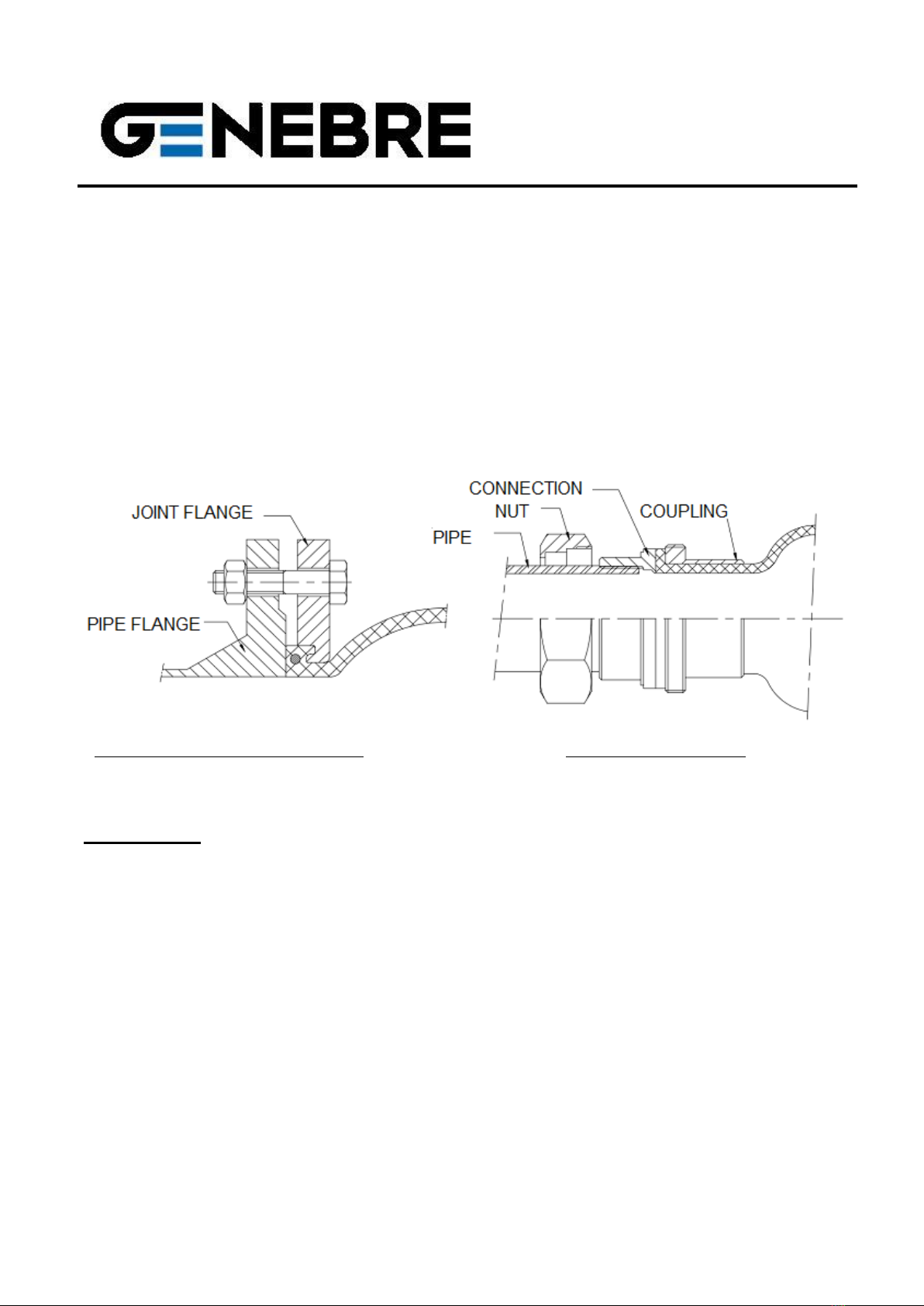
Art. 2831 / Art. 2831A / Art. 2833 Art. 2830 / Art. 2830N
IMPORTANT:
- Rubber expansion joints by Genebre, S.A. are designed to be assembled between
flanges DIN PN10 (art. 2831/art. 2833), flanges ANSI 150 (art. 2831A) or in a threaded
GAS pipe (art. 2830) or NPT (art. 2830N)
- Generally, never install more than one joint between two fixed points
- Flanges used during assembling must be completely flat.
- Tightening of screws and nuts has to be crossed, gradual and even. To obtain more
information, please consult the maximum torque values for the flanges in the table in
section 7.1 of this manual.